
Updated March 12, 2026
Most yoga teachers assume a branded app means a $50,000 conversation with a development agency. That assumption keeps them stuck on scattered tools, rented platforms, and launch-spike revenue that disappears between promotions. Modern no-code platforms have changed what's possible at what cost, and this guide gives you every number you need to budget for a real, store-listed, branded yoga app before you spend a dollar.
What is the real cost of building a yoga app?
Two paths exist: hire a development team, or use a no-code platform. The gap in cost, time, and risk between them will shape your entire business model.
The custom development route
Custom development is the traditional path, and the price tags are rarely what first-time buyers expect. App development cost research from TopFlight shows that a mobile app with content, community, and subscription features costs between $40,000 and $250,000 to build from scratch. That range reflects real-world components:
- UI/UX design: $5,000-$12,000 for custom screens and user flows
- Front-end and back-end development: $30,000-$80,000+ for a v1 build
- Developer rates: React Native specialists in the US bill between $60 and $90/hour for full-time equivalents, and senior contractors or agencies charge $100 to $150+/hour
- Annual maintenance: 15-20% of the original build cost per year, with the first year often hitting 50% due to OS updates, bug fixes, and user feedback changes
A $60,000 build carries a $9,000-$12,000 annual maintenance bill on top of the upfront spend. Development timelines vary widely based on complexity, ranging from 4-6 months for simple builds to 12-14 months for multi-feature platforms.
The no-code platform route
No-code platforms replace the upfront capital expense with a predictable monthly operating cost. You pay a subscription, upload your content through a visual builder, configure your pricing tiers, and submit your app to the stores. Hosting, security patches, and feature updates come included.
How do no-code platform tiers compare to custom development?
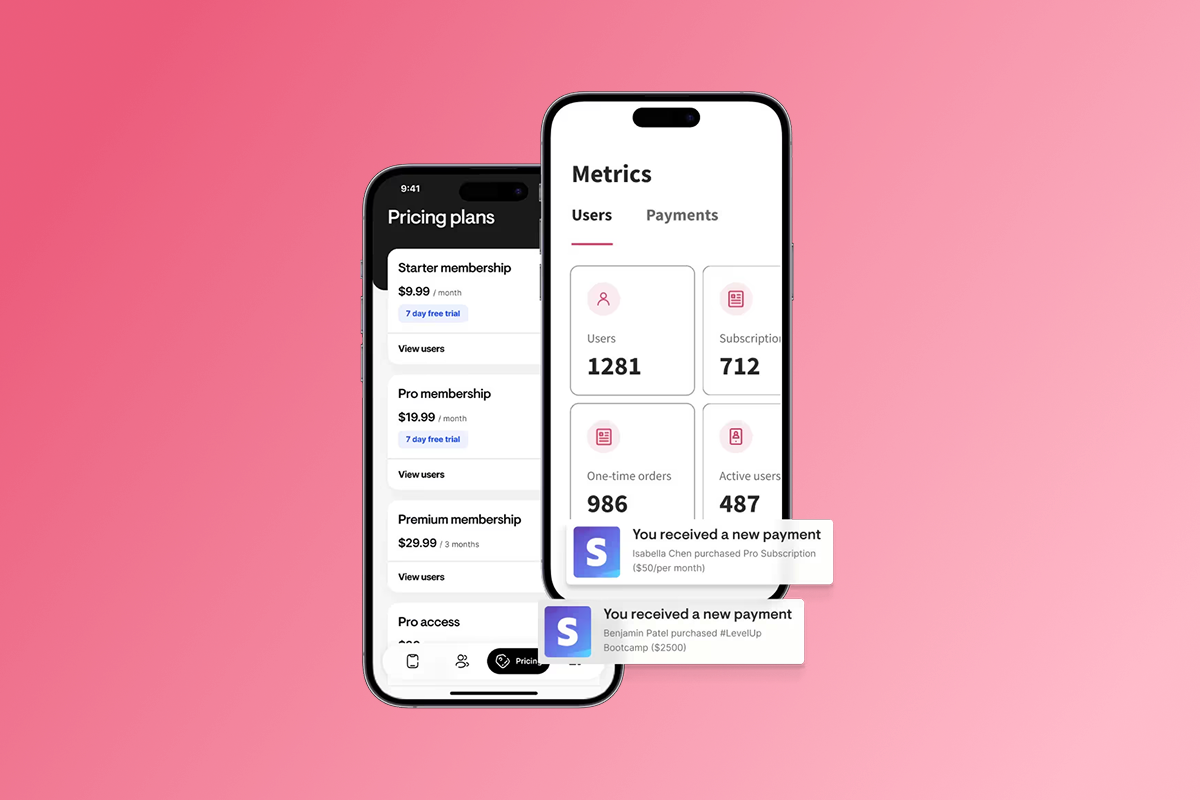
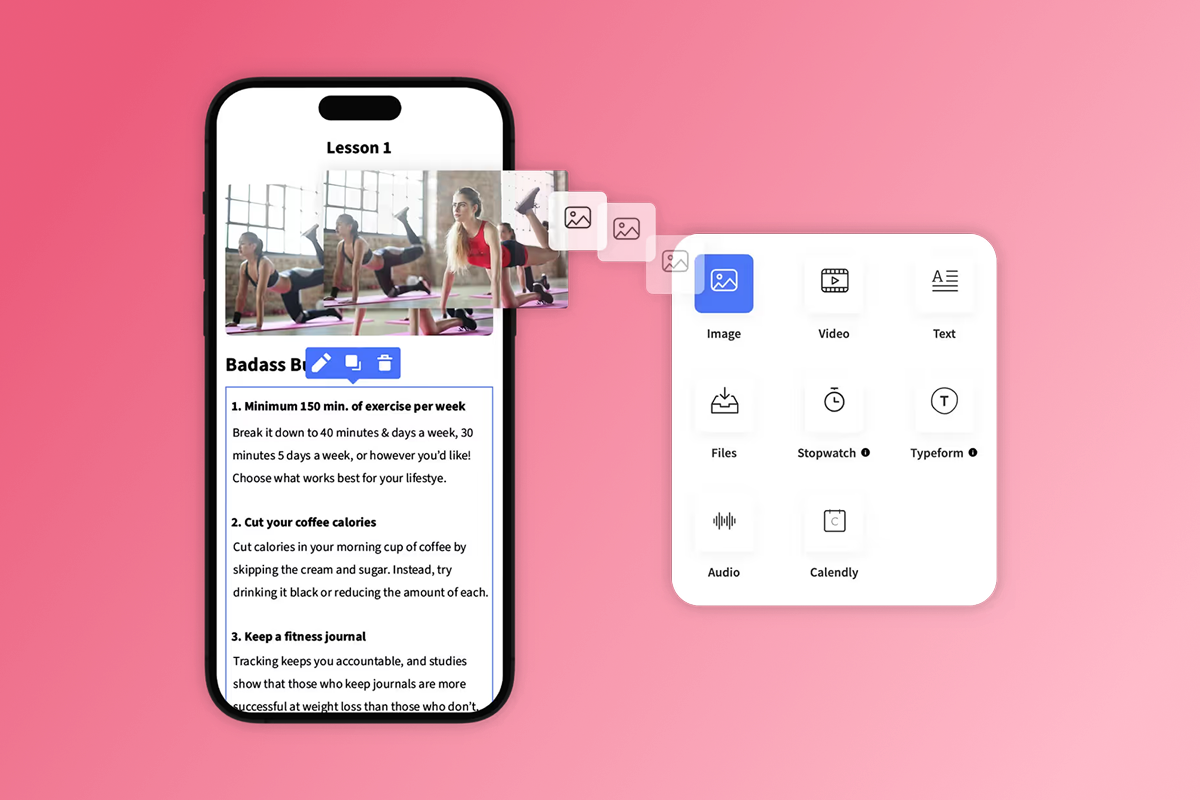
Passion.io gives you a branded iOS, Android, and web app that you build through our no-code drag-and-drop editor. Here's what each tier delivers, based on published details from Passion.io's pricing breakdown:
- Launch: Starting at $99/month (billed annually) or $119/month. Covers up to 100 subscribers, 100 videos, and 1,000 push notifications per month. Includes subscriptions, one-time purchases, drip content, interactive lessons, in-app community, and 1:1 messaging. The app carries Passion.io branding at this tier.
- Scale: Starting at $239/month (billed annually) or $299/month. Removes Passion.io branding, expands subscriber and video quotas, and adds automation tools.
- Expand: Starting at $599/month (billed annually) or $699/month. Covers unlimited users, products, communities, videos, and push notifications, and adds App Store listing support.
- Plus: Custom-priced at $10,000-$20,000 depending on scope, according to Passion.io's starter cost guide. We configure your builder, migrate your content, and handle full App Store submission, plus assign a dedicated success manager to handle the technical lift.
Always verify current pricing on Passion.io's plan comparison page before committing, as fees can change.
What the builder replaces in a custom build
When you drag a yoga video into a lesson block inside the Passion.io builder, you gain functionality that would otherwise require custom UI/UX design work. You can see the interface in action in this platform overview video. Beyond the build itself, your subscription covers hosting, CDN delivery, SSL security, and automatic updates whenever we ship new features, as noted in our features guide. Custom development bills each of those items separately.
"I have really enjoyed creating my passion app over the past year and half. I would not have been able to make my idea for an app come to life without the platform passion provides." - FitWithBrit on Trustpilot
How do I choose between web checkout and in-app purchase fees?
Your payment routing decision has a direct impact on margin. Think of IAP as a toll road: fast, frictionless, and trusted by users who complete purchases with Face ID, but it costs more per transaction. Web checkout is the longer route, and you keep significantly more per sale.
IAP (In-App Purchase)
When a student buys your $29/month subscription through the App Store or Google Play, the platform takes its cut first. Apple charges 30% standard for developers earning above $1M/year, while the Apple Small Business Program reduces this to 15% for those earning under $1M/year. You can apply for that 15% rate directly through your developer account. Auto-renewing subscriptions retained for 12+ months also drop to 15% from year two. For Google Play, auto-renewing subscriptions qualify for the 15% tier from day one. Full details on Apple and Google IAP commissions are available in our help center.
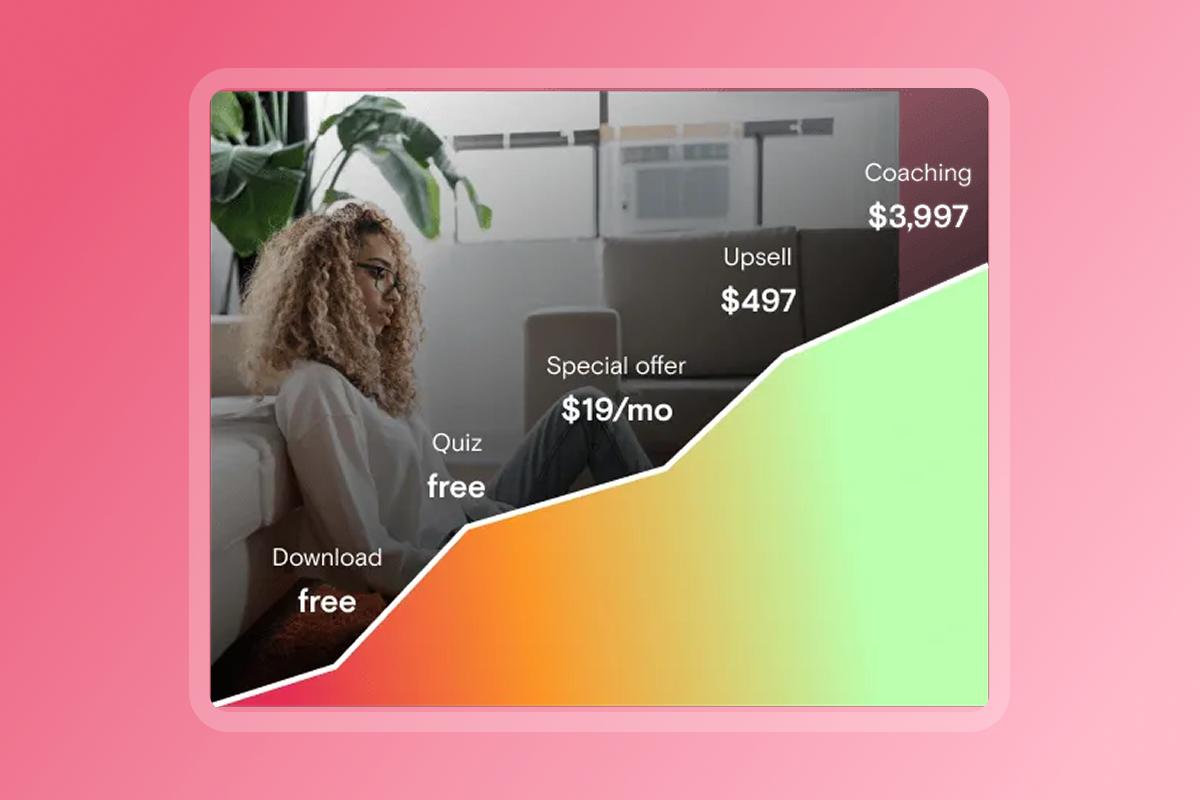
IAP works well for lower-ticket, high-volume subscriptions where convenience improves conversion. If a student is already in your app and sees your $19/month offer, one Face ID tap closes the sale.
Web checkout (PassionPayments)
PassionPayments processes payments through your web app or checkout page. You pay a 3.9% platform fee plus Stripe's standard rate (approximately 2.9% + $0.30), totaling roughly 6.8% + $0.30 per sale, as detailed in our payment processing guide. On a $500 teacher training purchase, that's approximately $34 versus $150 via Apple standard IAP. Scale plan and above offer 0% platform fee on external checkout tools, where you pay only your processor's fee.
The hybrid strategy
The smart approach uses both. Route high-ticket offers through web checkout and use IAP for convenience on lower-ticket mobile subscriptions:
For step-by-step setup, our payment collection help guide walks through both configurations, and you can customize IAP prices directly inside the builder.
What are the hidden costs of app store submission and maintenance?
There are only two mandatory external fees outside your platform subscription, and one of them is a one-time charge.
Developer account fees
Before your app can appear in the App Store or Google Play, you need two developer accounts. The Apple Developer Program costs $99 USD per year (recurring), as detailed on the Apple enrollment page, and the Google Play Developer account requires a $25 USD one-time registration fee with no annual renewal. Our Apple Developer account setup guide walks through each step. Open both accounts in Week 1 of your build to save 7-10 days of waiting when you're ready to submit.
App Store submission and what to expect
Getting an app through the App Store review process takes attention to detail. Our iOS submission preparation guide covers screenshots, metadata, and common rejection reasons. Plan a 1-4 week buffer for first-time submissions, and review when resubmission is required so you're not caught off guard after a content update. The Expand and Plus tiers include done-for-you App Store listing support. If you're on Launch or Scale, you handle submission yourself using the checklists we provide.
"Passion does a great job with supporting their clients to succeed, even after purchasing their product. I only give them a 4 out of 5 because the actual process of getting your app approved by the Google Play Store in particular is a lot more challenging than Passion makes it sound." - Jesse Wiens Chu on Trustpilot
Budget time for the process, not just money. App Store approvals are not instant.
Ongoing maintenance
We build server costs, bug fixes, and feature rollouts into your subscription, so platform updates arrive automatically at no extra charge. This is the practical difference from custom development, where a single iOS version update can trigger a $2,000-$5,000 compatibility bill.
Is a branded app worth the investment for a yoga business?
The return on a branded app comes from two directions: higher retention and direct revenue control.
Top-performing app categories achieve day-30 retention rates of 25-40%, compared to industry averages of 5-7%, according to Adapty's mobile engagement benchmarks. On a generic web course platform, your content competes with browser tabs and an email login link. On a branded app with push notifications, your content sits on the student's home screen. Passion.io creators using push and in-app challenges report lesson completion increases of 15-30% within 90 days, based on our published case data, which also documents one fitness creator whose monthly churn dropped from 8% to under 6% after moving their challenge into a branded app. Retaining a user costs five times less than acquiring a new one, according to app retention research from Enable3, so every percentage point of churn you cut compounds over time.
The revenue math is equally clear. A wellness creator with 250 active subscribers at $22.22/month generates over $66,000 in annual revenue, crediting in-app community and interactive classes for retention, according to Passion.io's pricing analysis. The Scale plan at $239/month ($2,868/year) against $66,000 in annual revenue represents a 4.3% cost ratio. And as the SplitMetrics fee breakdown reinforces, a 15% fee difference on a $500 annual tier represents $75 per subscriber kept in your business instead of going to Apple; at 200 subscribers that's $15,000 per year. Creators building wellness-focused apps find the cost-to-value ratio compelling:
"I am excited for being give a cost-effective way to create an app so Shift Your Life® teachings can reach more people to have the personal (body, mind, emotion, spirit) or entrepreneurial business transformation they desire." - Tracy Latz on Trustpilot
Here's how to move from scattered tools to a published app in 30 days without overspending.
Steps to launch your yoga app on a budget
- Consolidate your core content. Pull your top 10-15 yoga videos, PDFs, and guides into a single folder. You don't need 100 lessons to launch. A focused beginner series or signature challenge is enough to onboard your first 50 paying students.
- Start the 14-day free trial. Build your app inside the trial before paying for a plan. Upload two or three lessons, configure your pricing tiers, and validate the tool against your actual content before any money changes hands.
- Set up PassionPayments and your web checkout first. Your web app goes live faster than your store listing, so run a "Founding Member" offer at a discounted annual rate to cover your first year of platform costs before your iOS and Android apps are even published. This secures cash flow while App Store approval is in progress.
- Open your Apple and Google developer accounts in Week 1. The Apple Developer Program enrollment costs $99/year and takes a few days to process, while the Google Play registration costs $25 and is usually faster. Starting both accounts early saves 7-10 days of waiting when you're ready to submit.
At the end of 30 days, your web app is live and your founding members are onboarded. Your first milestone: 50 paying subscribers. Your second milestone, at day 60: run a push-driven in-app challenge to lift completion by 15-20% and cut churn below 6%. By day 90, add a second subscription tier or bundle and measure MRR growth against your platform cost.
Launching a branded yoga app costs hundreds per month, not tens of thousands upfront. The budget splits into three buckets: a fixed platform subscription, two developer account fees, and a transaction fee that varies by how you route payments. Plan the hybrid checkout strategy from day one, account for App Store timelines, and your first 50 subscribers will cover your platform cost in Month 1. The question isn't whether you can afford the app; it's whether you can afford to stay on rented platforms where your reach and revenue are controlled by algorithms you don't own.
Book a Passion.io demo and build your first yoga app before you commit to a plan. The 30-day money-back guarantee means the trial has a real safety net.
FAQ
How much does it cost to build a yoga app?
Custom development runs $40,000-$250,000 upfront plus 15-25% annual maintenance. A no-code platform like Passion.io starts at $99/month (annual billing), plus $99/year for an Apple developer account and $25 one-time for Google Play.
Does Apple take 30% of my yoga class sales?
Apple takes 30% on IAP for developers earning above $1M/year, or 15% under the Apple Small Business Program for those earning under $1M. Web checkout via PassionPayments avoids Apple's cut entirely, charging approximately 6.8% + $0.30 total (3.9% platform fee + Stripe).
Can I build a yoga app for free?
No free tier exists for a published, store-listed branded app, but Passion.io offers a 14-day free trial to build and test before you pay, plus a 30-day money-back guarantee after purchase.
Is it expensive to build a yoga app?
Relative to custom development ($40,000+), a no-code platform is significantly more affordable. The total first-year cost on a Passion.io Launch plan runs approximately $1,188 in platform fees plus $99 for Apple and $25 for Google Play, compared to $40,000-$250,000 for a custom build with ongoing maintenance, according to cost research from Cubix.
Key terms
IAP (In-App Purchase): A transaction completed through Apple's App Store or Google Play using the user's stored payment method (Face ID, Touch ID, or saved card). Apple and Google take a commission (15-30% Apple, 15-20% Google on subscriptions) before funds reach the creator.
PassionPayments: Passion.io's integrated web checkout gateway, powered by Stripe. Charges a 3.9% platform fee plus Stripe's standard processing rate (~2.9% + $0.30), totaling approximately 6.8% + $0.30 per transaction on web sales.
Native app: A standalone app installed directly on a user's phone from the App Store or Google Play, with its own icon on the home screen. Distinct from a mobile-responsive website or a container app where your content appears inside another brand's app.
MRR (Monthly Recurring Revenue): Total predictable subscription revenue collected per month, and the primary metric for tracking whether a subscription model is growing, stable, or churning.
Churn: The percentage of subscribers who cancel in a given month. Reducing churn by even 2-3% compounds significantly over 12 months, making it one of the highest-leverage metrics for a yoga membership business.
Apple Small Business Program: Apple's reduced commission tier for developers earning under $1M in annual proceeds. Drops the standard 30% IAP rate to 15% and requires annual application and re-enrollment each year.