
Updated March 12, 2026
Every yoga teacher building a digital business reaches the same inflection point: Instagram engagement drops, a course platform changes its fee structure, and students quietly stop finishing programs. The tools are scattered, the revenue is unpredictable, and the audience technically belongs to someone else.
A yoga instructor app builder solves all three problems by giving you a single, branded home for your content, community, and payments on the device your students already use most. This guide compares the top platforms, breaks down every cost from developer accounts to in-app purchase fees, and gives you a concrete 30-day plan to launch your own digital studio.
What is a yoga instructor app builder?
A yoga instructor app builder is a SaaS platform that creates native iOS and Android apps for wellness creators without writing code. You upload your content, configure your branding, set your pricing, and the platform handles the technical infrastructure.
We distinguish this category from studio management software like Mindbody, which focuses on booking in-person classes and managing physical locations. App builders like Passion.io are purpose-built for selling digital content, running online communities, and building recurring subscription revenue with a mobile-first experience.
The platform generates a fully branded app listed in the App Store and Google Play under your name, with your logo and your colors. Your students download it, subscribe, and engage through it. You own the relationship.
Why move from social media to a branded app?
Social platforms are for discovery. Your app is for retention and recurring revenue. The distinction is practical: algorithm changes on Instagram or TikTok can cut organic reach overnight, while your app gives you a direct, permission-based connection to every subscriber.
Own your audience and data
When a student subscribes through your branded app, their data belongs to you. You get their email, usage patterns, and completion rates, and you can act on that data without a platform intermediary.
87% of mobile time in apps, not mobile browsers. Building your business on social feeds means competing for attention in the remaining 13% of time users spend outside dedicated apps. Moving to your own app puts your content where attention actually lives.
An audience on rented land (social platforms, generic course marketplaces) is always one policy change away from disruption. An audience in your app is yours.
Increase student retention with push notifications
Push notifications are the most direct re-engagement tool available to mobile app owners. Push click rates 7x higher than email marketing, and fitness push campaigns average 14.4% open rates, compared to 1.45% click rates for health and fitness email campaigns per Mailerlite's 2025 benchmarks.
For a yoga teacher, this translates directly. A push that says "Your morning flow is waiting" at 6:45am reaches students on the device in their hand, at the moment they are most likely to practice. Email with the same message sits in a tab they may check later, if at all. Push notification research puts average open rates around 20%, roughly ten times the typical email marketing rate. The goal is to become part of the morning routine, not just another newsletter.
Create recurring revenue stability
The shift from one-off course sales to monthly memberships changes the financial structure of your business. A launch-dependent revenue model means income spikes when you promote and drops when you don't. A subscription model generates predictable MRR that compounds as your subscriber base grows.
Fitness app session research shows that apps with average sessions over 5 minutes achieve a 30-day retention rate of 35%, compared to 22% for apps with shorter sessions. Building sessions around structured programs, community challenges, and offline access keeps students in the app longer and reduces churn, which protects the MRR you build.
Top app builder platforms for yoga teachers
The platforms below represent different trade-offs between video infrastructure, marketing tools, and mobile engagement. Use this comparison to match your priorities to the right tool.
Platform app features
Passion.io
Passion.io is built specifically for creators who want to drive student habit and retention, not just host videos. The no-code app builder generates fully branded iOS, Android, and web apps with native push notifications, drip content, quizzes, progress tracking, in-app community, offline access, and live streaming integration.
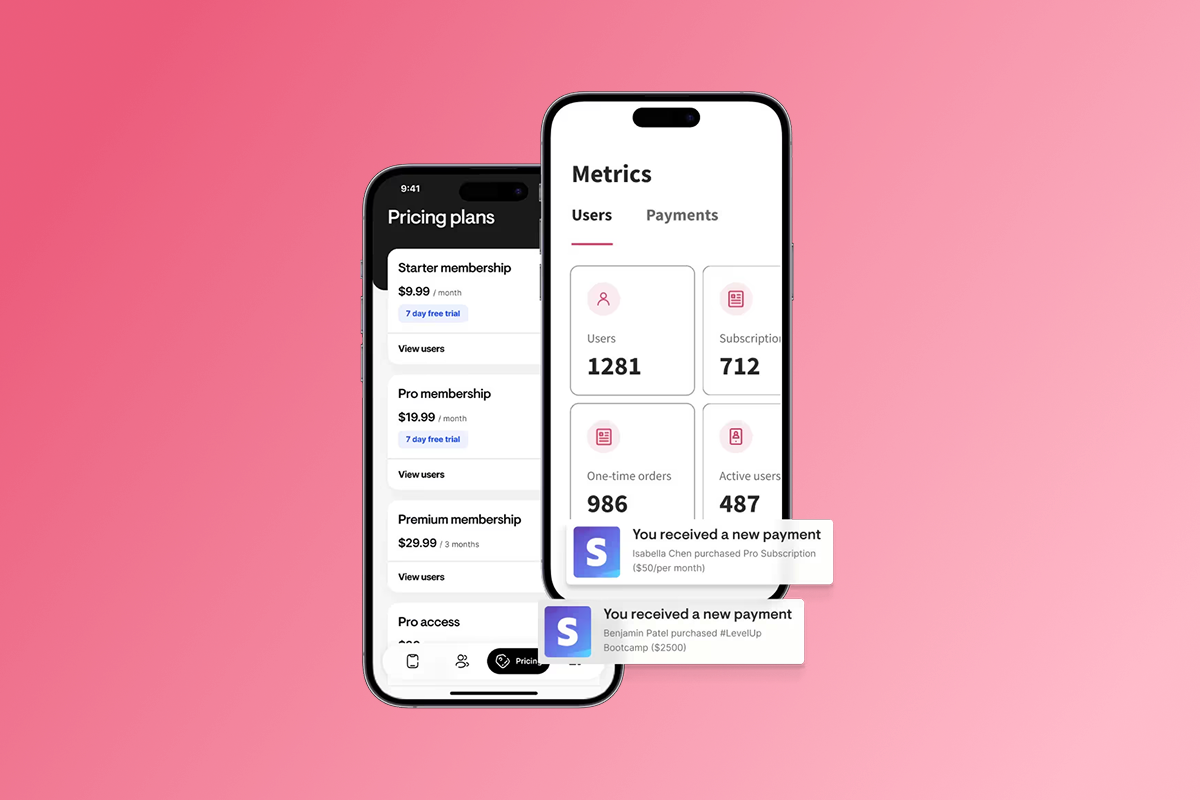
The platform supports both web checkout via PassionPayments (3.9% platform fee plus Stripe processing) and in-app purchases (15 to 30% Apple or Google fee). This payment flexibility lets you route high-margin subscriptions through web checkout and offer IAP for mobile convenience.
"Everything is housed in one place - content, communication, client access, design - and it's all optimized to save time while delivering a high-quality user experience." - Everchanging Butterfly on Trustpilot
"I have really enjoyed creating my passion app over the past year and half. I would not have been able to make my idea for an app come to life without the platform passion provides." - FitWithBrit on Trustpilot
Expand and Plus plans include App Store submission support, which reduces the risk of rejection delays for first-time submitters.
Uscreen (best for video-heavy libraries)
Uscreen positions itself as an OTT (over-the-top) platform focused on video delivery infrastructure, TV casting (Apple TV, Roku, Fire TV), and large content libraries. If your primary product is an on-demand video library and TV casting is a priority, Uscreen's infrastructure suits that use case. Community features are available on Pro and Plus plans.
The trade-off is focus: Uscreen's infrastructure optimizes for video delivery rather than mobile habit formation. For yoga teachers whose retention strategy centers on push notifications, daily practice nudges, and integrated community challenges, Passion.io's engagement-first architecture is a closer fit.
Kajabi (best for web-based marketing)
Kajabi excels at web-based marketing infrastructure: email funnels, landing pages, and course hosting. It is a strong choice if your primary revenue comes from email list marketing and web course sales, and you do not need a fully branded native mobile app.
Its mobile offering functions as a container app rather than a fully white-labeled native experience on lower-tier plans, which limits push notification capabilities and in-app community features. For yoga teachers whose growth strategy centers on mobile habit formation and in-app engagement, that constraint matters.
Mindbody (best for in-person studio booking)
Mindbody is a studio operations platform, not a digital content builder. It handles in-person class scheduling, point-of-sale, and staff management for physical studios. If you run a physical location and need booking infrastructure, Mindbody is purpose-built for that.
While its primary focus is in-person studio operations, Mindbody does offer some digital content delivery and subscription capabilities through video-based services. However, for a comprehensive digital content business with branded mobile apps and advanced engagement features, most studios use a separate app builder alongside Mindbody's booking system.
Key features that drive student practice
A yoga app should do more than host videos. You want it to help students build a consistent practice. The features that drive completion and retention are specific.
Push notifications and habit tracking
Push notifications meet students where they are at the right moment. For a 30-day yoga challenge, a practical cadence looks like this: a morning nudge at 6:30am on practice days, a mid-week milestone message ("You've completed 14 days, your strength is building"), and a re-engagement trigger if a student misses three consecutive days. Progress tracking shows students how far they have come, which itself reinforces retention.
You configure this cadence inside Passion.io's notification settings and adjust frequency based on your program design. The program launch tips in the Passion.io help center covers the specific setup steps for your first launch.
In-app community and challenges
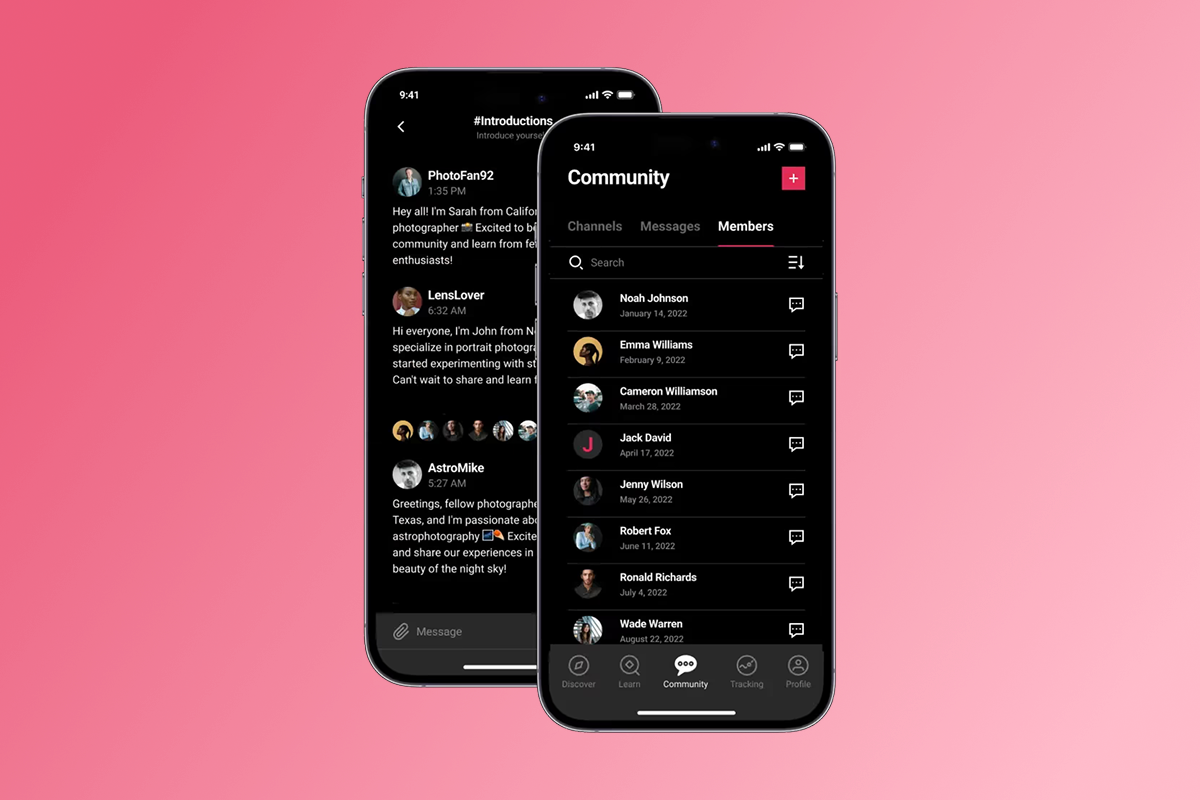
In-app community keeps students accountable to each other, not just to the content. A "30-Day Handstand Challenge" with a community wall inside your app generates social proof (students posting their progress), peer accountability to continue, and organic word-of-mouth when students share results externally.
In-app, the community lives next to the content. A student finishes Lesson 8, sees a peer's post about their breakthrough, and immediately comments. The feedback loop stays inside the product. You can explore how building community on Passion.io works to configure your first challenge wall.
"I've just started, but I'm already very impressed with the level of clarity and the emphasis on supporting one another." - Miriam on Trustpilot
Offline mode for practice anywhere
Offline access removes the biggest friction point in mobile yoga learning: the need for a stable internet connection. A student on a yoga retreat, in a hotel without reliable WiFi, or on an airplane can still complete that morning's flow if the content is downloaded to their device.
Passion.io supports offline content access so students can download lessons before traveling and practice without a connection. For yoga teachers whose students often practice outdoors or while traveling, this feature directly reduces friction and increases completion.
How much does it cost to launch a yoga app?
The total cost of ownership for a yoga app depends on the build path you choose.
Platform fees vs. custom development
Custom app development costs typically run $80,000 to $250,000 for a v1 build, with ongoing maintenance adding thousands per update. One cost analysis puts the range at $30,000 to $250,000 depending on complexity, with development timelines of 3 to 9 months.
For a yoga teacher with $1k to $100k MRR, that upfront cost and timeline is prohibitive. A no-code platform changes the math entirely. Passion.io plans run approximately $99 to $599 per month annually (Launch through Expand), with Plus tier scoped at $10,000 to $20,000 depending on requirements.
"I am excited for being given a cost-effective way to create an app so Shift Your Life teachings can reach more people." - Tracy Latz on Trustpilot
Understanding Apple and Google IAP fees
In-app purchase fees work like toll roads: fast and convenient for the student, but they cost more per transaction. Here is how the math works.
Apple App Store fees:
- Standard rate: 30% on IAP for digital goods and subscriptions
- Apple Small Business Program rate: 15% for developers earning under $1 million per year
- Subscriptions: 30% in year one, dropping to 15% after 12 months of continuous billing
- Developer account: $99 per year (Apple Developer Program details)
Google Play fees:
- Standard rate: 30% on IAP above $1 million in annual earnings
- Reduced rate: 15% on the first $1 million in annual earnings (requires enrollment in the program)
- Google's reduced rate change lowered its standard cut to 20% in the US, UK, and EEA starting mid-2025, with subscriptions dropping to 10%
- Developer account: $25 one-time fee only
Web checkout via PassionPayments:
- Platform fee: 3.9% plus Stripe processing fees (typically 2.9% plus $0.30 per transaction)
- No Apple or Google cut applies
The practical rule: use web checkout for core subscription plans where margin matters, and offer IAP for convenience upsells where switching to a browser would cost you the sale. For a $29 per month membership, the difference between a 3.9% web fee and a 15% Apple Small Business rate compounds significantly at scale. You can read the full app store submission costs breakdown on the Passion.io blog.
How to launch your app in 30 days
This is a step-by-step sequence for launching a yoga app from zero to live in the App Store. Plan for a 2 to 4 week App Store review window, and run your initial launch through the web app while the iOS/Android listings process.
Materials needed: Logo files, brand colors, video content (minimum 5 lessons), pricing structure, Apple Developer account ($99/yr), Google Play account ($25 one-time).
Target outcome: Web app live by end of Week 2, App Store submissions underway by Week 3 to 4.
- Week 1 - Developer accounts and branding setup. Register your Apple Developer Program account ($99/yr) and Google Play Console account ($25 one-time) right away, as processing takes time. Configure your app's name, logo, colors, and App Store metadata in Passion.io. Identify the right keywords for your listing with free ASO tools.
- Weeks 1 to 2 - Content upload and program structure. Upload your core video lessons, PDFs, and audio files. Organize content into a logical program with drip scheduling if you want to release lessons over time. Set up quizzes or reflection prompts at key milestones to drive completion, and configure your first push notification cadence.
- Week 2 - Pricing and payment paths. Set your monthly and annual subscription tiers. Decide which plans use web checkout (PassionPayments) and which use IAP. Review update developer account pricing guidance before submission. Publish your web app and begin onboarding your first subscribers.
- Week 3 - App Store submission. Submit to the Apple App Store and Google Play. For Expand and Plus plan users, Passion.io's team supports this process directly. For Launch and Scale, use the submission checklist. Google Health and Fitness apps require a compliance declaration, which you should complete before submitting. Plan for a 2 to 4 week review window for a first submission.
- Week 4 and beyond - App Store approval and launch push. Once approved, announce the app to your email list and social audience. Run a 7-day launch push with daily notifications. Connect external tools using Zapier integration to automate onboarding sequences. If the App Store requests clarifications, fix the flagged items and resubmit within 1 to 3 days.
"Our support team has been so helpful and personable from day one... I cannot recommend Passion enough for their professional, highly experienced and enthusiastic staff, especially for building an app from the ground up." - Angie on Trustpilot
The PassionFighters in-app community and training programs inside Passion.io also support you through the launch with peer accountability and structured coaching.
"Passion.io have been so supportive in helping me develop my App, the training, customer support have been second to none! They guide you through the process every step of the way." - Karen on Trustpilot
Your students are already on their phones. Whether they open Instagram or your app first depends on whether your branded app exists. Moving your program from a browser tab on a generic course platform to a native mobile app with push notifications and in-app community changes that default, and it does not require a $250,000 build or months of development.
A 30-day launch plan, a $124 investment in developer accounts, and the right platform get you to a live branded app in under 8 weeks. The yoga teachers who act in the next 30 days own their audience before the next algorithm change affects everyone else.
Try it with a 30-day money-back guarantee, or book a demo to see the no-code builder in action.
Frequently asked questions about yoga apps
FAQ: Do I need my own Apple and Google developer accounts?
Yes. Apple charges $99 per year and Google charges a one-time $25 fee. Your app lists under your account, not the platform's, which is what makes it fully branded and owned by you.
FAQ: Can I live stream yoga classes inside my app?
Yes. Passion.io supports live streaming integration so you can broadcast live classes directly within your branded app experience, alongside your on-demand library.
FAQ: Who owns my content and subscriber data?
You do. Your videos, course materials, and student records belong to you. The platform licenses its infrastructure to host and deliver your content but does not claim ownership of your intellectual property or customer relationships.
FAQ: How long does App Store review take for a yoga app?
Most Apple App Store reviews take 24 to 48 hours, per Apple's official guidelines, though first submissions can occasionally take longer. Google Play reviews are often faster. Build a buffer into your launch timeline and use that period to run your web app with your existing audience.
FAQ: Can I offer free trials alongside paid subscriptions?
Yes. You can configure free trial periods for subscription plans, one-time purchase options, and bundled offers within your Passion.io app.
FAQ: What completion rates should I target?
Course completion research puts industry-wide rates at 5% to 15%, with MOOC completion rates as low as 3 to 6%. A push notification cadence plus in-app community can move your rate meaningfully above that baseline. Aim for +15 to 30% improvement over your web-only starting point by Day 90, using weekly push touchpoints and a structured challenge.
Glossary of key app terms
Native app: An app built specifically for iOS or Android that lives on your device's home screen, accesses device features like push notifications and the camera, and delivers the best performance. This is what you get with a no-code builder like Passion.io, as opposed to a website shortcut.
PWA (Progressive Web App): A website you can save to your home screen that looks like an app but runs through a browser. PWAs cannot send push notifications as reliably as native apps and offer limited device integration.
IAP (In-App Purchase): A transaction that happens inside a mobile app, where the IAP fee structure means Apple or Google retains 15 to 30% of the revenue. IAP offers convenience for students buying on mobile but reduces your margin compared to web checkout.
Push notification: A short, clickable message delivered directly to a student's phone, even when they are not using your app. Push notifications are the primary habit-formation tool in mobile fitness and wellness apps, with average open rates around 20% according to push notification engagement data.
Churn: The percentage of subscribers who cancel in a given month. If you have 200 subscribers and 10 cancel in a month, your churn rate is 5%. Reducing churn by even 2 to 3 percentage points has a compounding effect on MRR over 6 to 12 months.
MRR (Monthly Recurring Revenue): The predictable monthly income from active subscriptions. It is the core financial metric for a subscription-based yoga business and the most reliable indicator of business health.