

Pre-Launch ASO Checklist: Optimize Before You Publish
Updated March 12, 2026
Securing organic search visibility before launch is the goal, so that Day 1 brings installs rather than silence. This comes down to three pillars: keywords in your title and subtitle, visuals through your screenshots, and metadata in your description text. On the technical side, both iOS and Google Play cap titles at 30 characters, the iOS keywords field gives you 100 characters total, and descriptions allow up to 4,000 characters on both stores. For research, ASOTools.io is now fully free following its Appark.ai acquisition, and FoxData offers a solid free tier, both cover everything you need at the creator stage. Finally, make sure to enter your optimized App Information fields inside the Passion.io builder before requesting your build submission, so you avoid delays and re-queuing.
Roughly 70% of installs from store searches, according to MobileAction's ASO research. That means before a single push notification fires, before your first member logs in, the store listing you write today determines whether new people ever find you at all.
We built this guide to walk you through the non-technical, pre-launch ASO checklist covering keywords, visuals, and metadata, plus a breakdown of the best free and paid ASO tools to help you rank fast. Passion.io handles the code and submission infrastructure, but you control the store listing. This checklist ensures that listing converts.
Why pre-launch ASO determines your app's survival
ASO (App Store Optimization) improves your app's visibility and conversion rate inside the App Store or Google Play. Think of it as SEO for your app store listing rather than for a website.
The stakes are high from Day 1. Apple confirmed in late 2025 that nearly 65% of downloads happen directly after searches in the App Store. While social platforms now account for 35-40% of new app discoveries, app store search remains the single largest acquisition channel for most creator apps. Skipping ASO before launch means losing that channel entirely on Day 1, when momentum matters most.
The cost argument compounds over time. Every member who finds you through organic search has zero acquisition cost, which directly improves your margin and lowers the monthly recurring revenue (MRR) you need to reach profitability. Paid ads can supplement growth later, but organic ranking is the foundation you build everything else on.
One more reason this matters for creators specifically: your app exists to help you escape algorithm-dependent "rented land" on social platforms. If your app store listing is unoptimized, you are just renting a different kind of invisible land. ASO is how you claim ownership of discoverability in the marketplace. You can review Passion.io's pre-submission checklist in the knowledge base for the full pre-submission scope.
The 3-step pre-launch ASO checklist for creators
Keep your focus on three areas. Everything else is a refinement you can test post-launch. This is the Minimum Viable Optimization for a creator app.
Step 1: Build your keyword strategy (finding ASO keywords)
Your app title carries the heaviest ranking weight of any metadata field, so you should place your primary keyword there. Your subtitle or short description carries the second-most weight. Choosing the right terms before launch sets your initial ranking trajectory.
Character limits to work within:
| Field | Apple App Store | Google Play |
|---|---|---|
| Title | 30 characters max | 30 characters max |
| Subtitle / Short description | 30 characters max | 80 characters max |
| Keyword field (iOS only) | 100 characters, comma-separated, no spaces | Not applicable |
| Long description | 4,000 characters | 4,000 characters |
Google Play does not have a separate keyword field. As Google Play's description guidelines explain, Google indexes keywords directly from your title, short description, and long description, so keyword placement in those fields is critical on Android.
How to find the right keywords in 3 steps:
- Brainstorm 3-5 seed terms that describe what your app does at its core. For a postpartum fitness coach, that might be "postpartum yoga," "postnatal fitness," and "new mum workout." For a business coach, it might be "productivity training" or "business coach app."
- Run each term through a free ASO tool (FoxData or ASOTools.io, both covered in the next section) to check search volume and keyword difficulty. FoxData's keyword analytics identifies high-potential keywords based on market trends, including niche terms you may not have considered.
- Choose based on the difficulty vs. volume trade-off. A term like "fitness" has enormous volume but near-impossible competition for a new app. By contrast, "postpartum yoga challenge" has lower volume but far less competition, so you can rank faster and convert more specifically. Target at least one niche-specific term in your title or subtitle from Day 1.
You can read more about this process in Passion.io's dedicated guide on identifying keywords with free ASO tools.
Step 2: Create visual conversion assets (screenshots and previews)
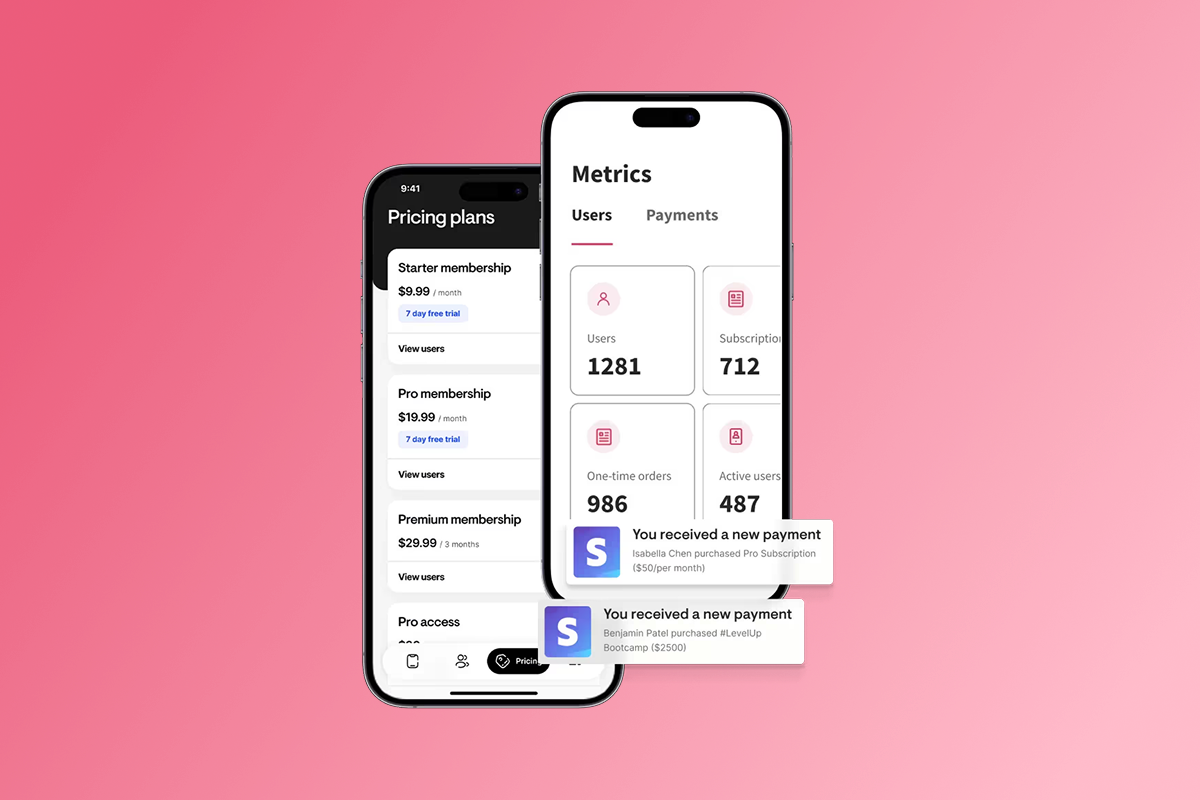
Your screenshots are not decorative. They are sales copy, and the first three screenshots matter most because iOS displays them in search results while Google Play shows them at the top of your listing page. On Google Play, the first screenshot and any video preview carry the most conversion weight.
Follow the Value-Usage-Trust sequence for your first three screenshots:
- Value: Screenshot 1 shows what the member gets. ("Track your 30-day challenge progress." "Access 50+ guided workouts.")
- Usage: Screenshot 2 shows one clear, compelling action inside the app. Show the community feed, a lesson in progress, or a push notification.
- Trust: Screenshot 3 includes social proof if you have it. A member count, a rating badge, or a recognizable creator name all work here.
Design rules that protect conversion:
- Keep text readable on small screens because your screenshots appear even smaller in search results. One short phrase per image at a large font size beats a paragraph at a small size.
- Use simple backgrounds and concise text because too much information per frame drops conversion.
Passion.io has a specific guide on custom screenshots for Apple and Google that covers the required dimensions and file formats for each store.
Step 3: Write your metadata and store description
Your description text does two jobs. It persuades humans who scroll past the fold, and it signals relevance to the store's algorithm. The App Store product page guidelines confirm that descriptions can be up to 4,000 characters. Google Play's character limit matches that at 4,000 characters for the long description.
What to write where:
- First 3 lines (above the fold): This is your headline. Write one clear sentence that says who the app is for and what they get. "The app for busy mums who want a 20-minute home workout that actually fits their day." Then include a direct CTA: "Download to start your free 7-day trial."
- Body: List 3-5 specific content benefits in short sentences or a brief bulleted list. Use the niche keywords you identified in Step 1 naturally throughout the copy.
- iOS promotional text: This 170-character field sits above the description and can be updated at any time without submitting a new app version. Use it for a time-sensitive offer or seasonal hook.
Passion.io has a dedicated app description writing guide that walks through this structure in full.
Best ASO tools to automate your research
Stop guessing at keywords or testing screenshots blindly. Free and paid tools give you real search volume data, keyword difficulty scores, and competitor intelligence. Here is what to use at each stage.
Top free ASO tools for budget-conscious creators
FoxData handles keyword discovery well for a creator-stage app. Its ASO Intelligence feature analyzes titles and descriptions to suggest high-potential optimizations based on market trends. The free tier is usable before you invest in premium features.
ASOTools.io is now completely free following its acquisition by Appark.ai. The 50 million keyword database covers 6 million apps across iOS and Android, with over 1 billion total data points. For a creator doing initial keyword research, this is the most capable zero-cost option available right now.
| Tool | Best for | Free features | Starting price |
|---|---|---|---|
| ASOTools.io | Keyword research and market intelligence | All features free (Appark acquisition) | Free |
| FoxData | AI-powered keyword recommendations | Free tier plus 7-day premium trial | Free tier available |
| AppRadar | Competitor intelligence and rank tracking | Free plan available | Free (paid plans for ASO and Growth) |
Premium ASO tools for scaling apps
Once your app has initial traction and you are ready to invest in deeper intelligence, these tools provide significantly more data.
AppTweak is the most decorated option in the category, having been awarded "ASO Tool of the Year" and trusted by companies including Uber, Adobe, and Zynga. Its AI-powered keyword intelligence and Apple Search Ads integration make it useful for creators scaling to paid acquisition. Plans are available monthly and annually with a 7-day free trial.
MobileAction focuses on user acquisition intelligence and campaign automation, which makes it more relevant once you are running paid campaigns alongside organic ASO. Their keyword research tools are comprehensive for competitive category analysis.
Appfigures rounds out the set with strong analytics and reporting. Their live ASO answers resource covers practical optimization questions that come up during active ranking work.
For a creator just launching, start with ASOTools.io and FoxData. Upgrade to AppTweak or MobileAction when you are ready to run Apple Search Ads alongside your organic strategy.
How to apply ASO settings inside Passion.io
We handle the code, the submission pipeline, and the app infrastructure on Passion.io. Your job is to fill in the metadata fields correctly before your build goes into the submission queue.
Steps to complete inside the Passion.io builder:
- Log into your Passion.io dashboard and open your app project.
- Navigate to your Sales Page settings and find the App Information section.
- Enter your App Title using the keyword-optimized name you developed in Step 1. Keep it at or under 30 characters for both stores.
- Enter your Subtitle (iOS) or Short Description (Google Play) with your secondary keyword. iOS allows 30 characters here. Google Play allows 80 characters for the short description.
- Paste your full description into the Long Description field. Make sure the first 3 lines carry your core value statement and CTA.
- Upload your custom screenshots using the file format and dimension requirements in Passion.io's custom screenshots guide.
- Complete this entire step before requesting your build submission. If you submit with missing or incorrect metadata, you will need to correct and re-queue your build, which adds days to your launch timeline.
For the full iOS submission preparation workflow, including developer account setup and review requirements, Passion.io's iOS app submission guide covers every required action in sequence.
You can also watch the Passion.io platform walkthrough to see the builder in action before you sit down to complete your metadata.
"Passion.io is legit. They are professional, helpful, and incredible. I could NOT have launched my app without their help. Even with their platform, and their incredible guides of step by step to do, I still needed hand-holding in the process. And I have a tech background. Apple and Google aren't easy, but it IS doable with Passion!" - Kirsten Larsen on Trustpilot
"There is a lot of education on everything you need and building the app was very easy." - Angie Marie on Trustpilot
For a deep-dive into the full ASO strategy, including post-launch keyword updates and review management, bookmark Passion.io's knowledge base article on boosting app visibility and downloads.
Launch with organic visibility from Day 1
Completing this checklist before you submit is the single highest-return hour you can spend on your app launch. The keywords, screenshots, and description you write now set the ranking trajectory for your first 30-90 days, and organic installs from Day 1 compound in ways that paid acquisition alone can't replicate.
If you are building on Passion.io and ready to complete your pre-launch metadata, start with Passion.io's ASO guide and use ASOTools.io for your keyword research. Book a demo before getting started on your build. If you are not yet on Passion.io, start with a 30-day money-back guarantee and complete this checklist as part of your first 30 days.
The metadata you set today is the traffic foundation you build your recurring revenue on. Get it right once, and the store works for you around the clock.
Frequently asked questions about pre-launch ASO
FAQ: What is the difference between SEO and ASO?
SEO (Search Engine Optimization) improves your visibility on web search engines like Google. ASO improves your visibility inside the Apple App Store and Google Play Store. The ranking factors differ: ASO weights your app title, keyword field, description, download velocity, and ratings, whereas SEO weights backlinks, domain authority, and page content. Both focus on matching the right words to search queries.
FAQ: Can I change my ASO keywords after launch?
Yes, but with conditions. You can update your subtitle when submitting a new version of your app, and your description updates the same way. The iOS promotional text (170 characters at the top of your description) is the one exception: you can update it at any time without a new version. For this reason, get your title right before launch because changes to the app name affect branding and require a full version submission.
FAQ: How long does it take to rank after launch?
Initial ranking improvements typically appear within a few weeks to a few months of publishing. More practically, allow 3-4 weeks between updates to collect stable ranking and conversion data before drawing conclusions. For competitive keywords, expect a 3-4 week assessment window before you know if the term is working.
FAQ: Do I need a paid ASO tool to launch?
No. ASOTools.io is currently fully free and covers keyword research across 50 million keywords on both iOS and Android. FoxData's free tier handles initial discovery and competitive analysis. Paid tools like AppTweak add value once you are running Apple Search Ads or tracking a competitive keyword set, but they are not required for a creator's first launch.
FAQ: What happens if Apple rejects my app because of metadata?
Apple's review team may flag descriptions that make unsupported claims (for example, "the #1 fitness app") or that contain misleading category terms. If your metadata gets flagged, fix the copy and resubmit. Review the Apple App Store Review Guidelines before writing your description to avoid common rejection reasons. Passion.io's Expand and Plus plans include submission support to help you handle these situations.
Key terms glossary
ASO (App Store Optimization): The process of improving your app's visibility and conversion rate in the Apple App Store or Google Play Store. Similar to SEO but specific to app store search algorithms and listing elements.
Metadata: The text and image elements that describe your app in the store listing, including the title, subtitle, description, keyword field (iOS), and screenshots. Metadata is the primary input the store algorithm uses to decide when to show your app in search results.
Keyword difficulty: A score that indicates how competitive a search term is in the app store. High-difficulty terms are dominated by established apps with large download volumes. Low-difficulty niche terms are easier to rank for and convert more specifically for your audience.
Conversion rate: The percentage of users who view your app store listing and then download the app. Strong screenshots and a clear description above the fold are the two biggest drivers of conversion rate for a new app.
Promotional text (iOS only): A 170-character field that appears at the top of your App Store description. Unlike all other metadata, you can update it without submitting a new app version, making it useful for seasonal offers or launch announcements.