.png)

Updated March 06, 2026
You're probably spending $1.75 to $5 per install on social ads for education and fitness apps, with no guarantee those users will stick around. Meanwhile, your existing students already trust you. They finished a challenge, hit a streak, and got a real result. You have a referral engine sitting idle right now.
This guide covers how to build a referral program that turns engaged users into your primary growth channel: the incentive structure to choose, the exact steps to build the loop inside your Passion.io app, and the metrics to track so you know it is working.
Why do passive referral links fail for creators?
You post a passive referral link once and forget it. It sits in an email footer, a course landing page, or a pinned social post. Nobody clicks it because nobody sees it at the right moment, and you gave them no reason to share it because there is nothing in it for them or their friend.
You face a trust problem. According to Nielsen data from over 28,000 respondents across 56 countries, peer trust over ads is 92% stronger, meaning consumers trust recommendations from friends and family over any form of paid advertising. That trust advantage is completely wasted when the referral mechanism is a static link buried in a footer.
Compare that to active viral loops built into the product experience itself. An educational services business that moved from passive outreach to a structured referral program saw a 53% vs 8% conversion lift, compared to paid ads. That is a 6x improvement, driven entirely by the quality of the moment and the incentive structure. Buying installs gets you a number. Building a referral loop gets you compounding, higher-retention users at near-zero marginal cost.
How do I choose the right incentive structure?
Two-sided incentives outperform one-sided offers in creator communities. When you reward both the person referring and the person joining, sharing feels helpful to them rather than self-promotional. Two-sided reward psychology shows that the friend reward creates a trust signal, while the referrer reward amplifies motivation, and together the psychological lift is far stronger than rewarding only one side.
Here is how the main incentive types compare for a creator context:
For most coaches and course creators, exclusive content is the right primary reward. You have already created the content, or you can record a short bonus module specifically for advocates. Cash beats points in practice because it feels real and immediate, but for creators, exclusive content aligns directly with why students enrolled in the first place, giving it high perceived value at zero marginal cost.
A practical two-sided structure for a 30-day challenge might look like this:
- Referrer (your existing student): Extended subscription access plus a bonus module or exclusive Q&A session.
- New user (the friend they invite): Free trial access to the challenge, or a discount on their first month.
At the global average CPI of $2.24 across iOS and Android, even 50 organic referrals per month saves you $112 or more in avoided acquisition costs, while delivering users who are 16% more valuable by lifetime revenue than non-referred customers.
"I am excited for being given a cost-effective way to create an app so Shift Your Life® teachings can reach more people..." - Tracy Latz on Trustpilot
How do I build a viral referral loop in my app?
The steps below use Passion.io's push notifications, in-app community, and Zapier integration together to build a loop that runs without manual management.
Step 1: Identify your app's "shareable moment"
Do not ask for referrals at signup. Your student has not yet achieved anything, so they have no social currency to spend. Ask at the moment they feel the most positive about what they have accomplished.
Target these specific moments in your app flow:
- Completing a lesson or module: a concrete win worth sharing.
- Hitting a streak (7 days, 14 days, 30 days): a public milestone.
- Finishing a challenge: the single highest-emotion event in your app.
- Receiving a community badge or recognition: social proof in action.
In practice, push notifications deliver higher engagement with a 7x higher clickthrough rate than email, so you can reach users at exactly the right second, not hours later when the feeling has passed. Passion.io's push scheduler lets you configure behavior-based and time-based triggers, so you automate the ask without writing a single message manually after setup.
A push message at a shareable moment might read: "You just finished Week 3. You're crushing it. Invite a friend to join you for the final push and you both get [bonus reward]."
15-30% completion lift in 90 days is what creators report when combining push notifications with structured challenges. The same push timing that improves completion also converts to referrals when the message includes a share prompt.
Step 2: Set up referral tracking with Zapier and Passion.io
Passion.io does not generate unique referral codes natively, so you will need a lightweight workaround to track who referred whom. The most practical path uses Passion.io's Zapier integration with a custom onboarding field and Google Sheets.
Add a "Referred by" text field to your onboarding flow, then create a Zap that triggers on Passion.io triggers in Zapier (Plan Purchased or Account Created), filters for non-empty referral fields, logs the new user and referrer name to Google Sheets, and sends the referrer an automated reward email. You can also use Passion.io's tracking code feature on your web app to layer additional analytics on top of this flow. Once the Zap runs cleanly in testing, it runs automatically from that point forward. Passion.io's Zapier automation docs cover additional patterns you can build on top of this foundation.
"Our support team has been so helpful and personable from day one... I cannot recommend Passion enough for their professional, highly experienced and enthusiastic staff, especially for building an app from the ground up." - Angie on Trustpilot
Step 3: Launch a "Bring a Friend" in-app challenge
Challenges carry a natural share trigger built in: group accountability. A solo challenge is something you complete alone. A squad challenge is something you recruit for. Design your "Bring a Friend" challenge using this structure:
- Challenge duration: 30 days gives enough time for real progress while keeping the invitation window short enough to feel urgent.
- Entry mechanic: To join the challenge, the user must invite at least one friend to download the app and register. Frame this as "squad mode," not a marketing task.
- Reward structure: Both the inviter and the new friend get access to a bonus module or live session at the end of the challenge.
- Push cadence: Send push notifications across the challenge period: one at the start ("Invite your squad before Day 3"), one mid-challenge ("You're halfway there - is your friend keeping up?"), and one at the close ("Final push - celebrate with your squad").
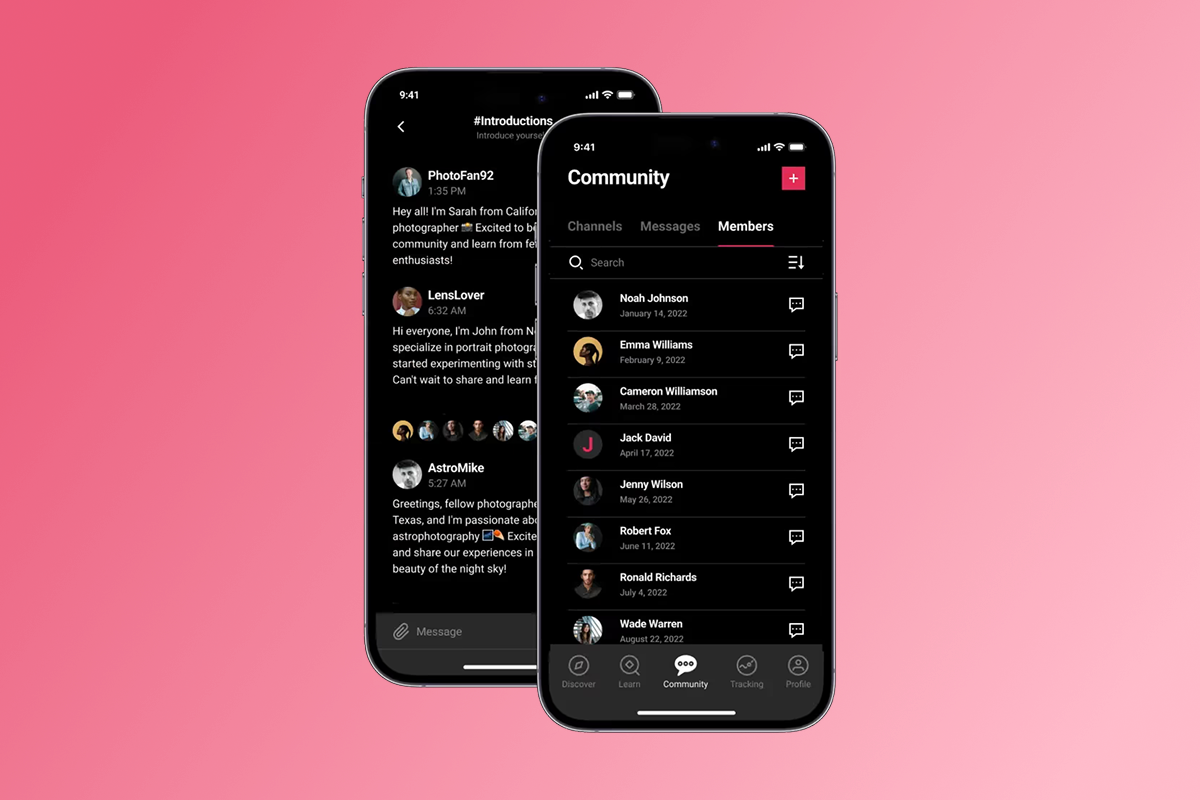
The Passion.io in-app community gives challenge participants a space to post progress, tag their invited friends, and celebrate wins publicly. Public wins are referral fuel. Every post about completing a challenge is a visible signal to the poster's network that something real is happening inside your app. Community reactions and direct messaging features add the social layer that makes the experience feel like a shared event rather than a course transaction.
Build this into your program launch plan using Passion.io's 8 program launch tips and the 120+ sign-ups playbook for additional organic launch mechanics.
"Passion.io helped me turn my vision into a fully branded app that inspires equestrian women daily. It's easy to use, incredibly supportive, and built for creators who actually care about changing lives." - Jenna Knudsen on Trustpilot
How do I measure my viral coefficient?
Once your challenge is live, track your viral coefficient (also called the K-factor) to measure how many new users each existing user brings in. It is the single most important number for a referral program.
Formula: K = i × c
- i = average number of invites sent by each active user
- c = conversion rate of those invites (percentage who sign up)
Example: If your active users each send an average of 3 invites and 12% of those invites convert to new signups, then K = 3 × 0.12 = 0.36.
Here are the benchmarks to measure against:
For context, top programs hit 8%+ conversion on referral shares, and a healthy share rate benchmark falls between 5% and 15% of active users. Dropbox's two-sided free storage offer is the benchmark case study for this mechanic, reaching Dropbox's referral results of a 60% increase in signups and a 3,900% total growth rate after launching its program.
You are not Dropbox, and your first month K-factor will not be 3,900%. However, 5-9% active referral rate is what structured programs consistently generate, and referred customers are 5x more likely to refer others than non-referred customers. That compounding effect is what turns a K-factor of 0.3 into meaningful growth over six months.
Your 90-day referral scorecard:
- Month 1: K-factor above 0.2, share rate above 5%, at least 30 tracked referrals.
- Month 2: K-factor above 0.3, churn on referred users at least 10% lower than overall churn.
- Month 3: Referral source accounts for 15-20% of new signups. If share rate is low, increase push frequency. If conversion is low, test a stronger new-user incentive.
Track your referral traffic alongside ASO practices, since every referral that converts to an app download also improves your store ranking, compounding organic discovery on top of your referral traffic. Make sure your app link is clean and easy to copy so the referral share itself is frictionless.
Referral program launch checklist
Use this as your pre-launch quality check. Mark each item done before you send the first push.
Incentive setup:
- Two-sided reward defined (referrer reward + new user reward)
- Exclusive content or subscription extension created and ready to deliver
- Reward email template written and tested in Zapier
Technical setup:
- "Referred by" field added to onboarding flow
- Zapier Zap created: trigger = Plan Purchased or Account Created
- Filter step added to capture only referred signups
- Google Sheet logging referrer name, new user name, and date
- Reward trigger email active and tested end-to-end
Challenge setup:
- 30-day challenge created in Passion.io with clear entry mechanic
- Squad entry requirement communicated in challenge description
- Community channel set up for challenge participants
- Push notification schedule set: Day 1, Day 15, Day 28
Measurement:
- K-factor spreadsheet template set up (invites sent, conversions logged)
- Month 1 targets documented (K above 0.2, share rate above 5%)
- Churn comparison tracking enabled (referred vs. non-referred cohorts)
The shift from rented land to owned growth comes down to one decision: stop buying strangers and start mobilizing your fans. Your happiest students are already telling people about you in DMs and group chats. A structured referral program with a two-sided incentive, a challenge mechanic, and automated Zapier tracking makes that sharing visible, measurable, and scalable. Start with the 30-day "Bring a Friend" challenge inside your app. Measure your K-factor at the end of month one. Then adjust the push cadence or incentive based on where users drop out of the funnel.
Book a Passion.io demo with a 30-day money-back guarantee and launch your first referral challenge inside your own branded app.
Frequently asked questions about app referral programs
FAQ: Can I promote my app for free?
Yes. Organic referral loops bring high-retention users at near-zero cost, while ASO tools for keyword research improve your app's discoverability in search results without paid placement.
FAQ: What is the best way to market an app launch?
A waitlist referral campaign is a strong launch mechanic: give early access to users who refer friends before launch day, which builds urgency, social proof, and your initial user base simultaneously. Combine it with a strong app store description to capture organic search traffic from day one.
FAQ: What participation rate should I expect from a referral program?
Industry benchmarks put 5-9% participation rate as the active referral range for structured programs, with top-quartile programs converting 8% or more of those shares into actual signups.
FAQ: How does a two-sided incentive differ from a one-sided one?
A one-sided incentive rewards only the referrer, while a two-sided incentive rewards both the referrer and the new user. Research on rewarding new users shows this may be more efficient at acquiring customers because the friend reward acts as a trust signal that makes the invitation feel like a gift rather than a recruitment pitch.
Key terms glossary
Viral coefficient (K-factor): The number of new users generated by each existing user, calculated as K = invites sent per user × conversion rate of those invites. If users send 3 invites at a 12% conversion rate, K = 0.36.
Two-sided incentive: A reward structure where both the person referring and the new user receive a benefit. In creator programs this typically means exclusive content for the referrer and a discounted or free trial period for the invitee.
Push notification: A clickable message sent directly to a user's mobile device at the exact moment they are most likely to act. Passion.io's push notification feature delivers a 7x higher clickthrough rate than email, making it the right channel for triggering referral shares.
CPI (Cost Per Install): The average amount paid to acquire one app download through paid advertising. For education and fitness apps, CPI ranges from $1.75 to $5 per install on major platforms, making organic referrals a strong cost alternative.
ASO (App Store Optimization): The process of improving your app's visibility in the App Store and Google Play through keywords, ratings, and download velocity. Referral programs indirectly improve ASO by increasing download rate, which is a store ranking signal.