

Best White Label App Builder for Fitness Creators 2026
 By Julieta Gil
TL;DR: If you run a fitness or wellness brand generating mid-five to six-figure revenue, a white-label mobile app gives you owned audience data, higher retention through push notifications, and predictable recurring revenue without algorithm risk. Passion.io offers the only done-for-you path (PassionPlus) that delivers a fully branded iOS and Android app in 30 days, with offline mode, in-app community, and white-glove App Store submission support starting at $10,000–$20,000. Custom development costs $80,000–$250,000 and takes 6–9 months. Push notifications achieve 20% open rates compared to 2% for email. That difference drives the engagement and retention that scale MRR.
Instagram's organic reach has collapsed to just 4.0% in 2024, an 18% decline from the previous year. Facebook sits even lower at 1.37% average reach. If you've built a 50,000-follower audience through years of consistent content, only 2,000 people will see any given post you publish. For high-revenue fitness and wellness creators, that's not a marketing problem, it's a business risk.
Fitness creators aren't shifting to owned apps to follow trends. They're securing the asset they built. When you consolidate content, community, and payments into a branded mobile app, you control the customer relationship, own the data, and eliminate the algorithm as a variable in your revenue model. For creators at the six-figure MRR level, a white-label app builder offers the speed and cost advantage of a platform solution with the premium brand experience custom development promises but rarely delivers on time or budget.
Why fitness creators are moving from social media to owned apps
The business case for owned apps rests on three measurable shifts: engagement mechanics, revenue predictability, and operational efficiency.
Engagement mechanics favor mobile-native features. Push notifications deliver a 20% open rate and 28% click rate, compared to less than 2% open and 1-2% click for email. For fitness programs, completion drives retention and retention drives lifetime value. That engagement difference compounds quickly. A yoga instructor running an 8-week challenge can send a push notification when a student misses a day and see 90% of her members receive that nudge in real time. Email sits unread in a crowded inbox. The health and fitness sector sees benchmark email open rates of 47.81% and click rates of 1.45%, which is strong for email but still far below push notification performance. Push is experienced in a fundamentally different way than email, with an average engagement rate of 21 percent.
Revenue predictability improves when you own the channel. Social platforms change algorithms, introduce new fees, and prioritize their own monetization over yours. A white-label app gives you direct access to subscribers through push, in-app checkout flows you control, and customer data you can export if you ever need to migrate. Passion.io creator Allie Cooper launched Cirque+ for aerial artists and made over $4,000 in her first week, then scaled to $50,000+ in annual revenue with 50 subscribers. That kind of trajectory requires owned infrastructure, not rented reach.
Operational efficiency increases when tools consolidate. Before a branded app, most creators juggle scattered platforms for content, community, live classes, and payments. Each tool adds friction and integration points that break. A white-label app builder puts courses, community, streaming, and payments into one interface, letting you focus on growth instead of admin work. Passion.io's health and fitness use case shows how trainers structure challenges, track progress, and send push reminders without switching tabs.
The "before" state looks like this: content scattered across platforms you don't control, low mobile engagement because email and social don't deliver real-time nudges, and revenue exposed to algorithm changes you can't predict. The "after" state is a branded iOS and Android app with offline access, push notifications that bring users back when they drift, and subscription revenue that flows through checkout paths you own.
Key features to look for in a white-label fitness app builder
Not all white-label platforms deliver the same mobile experience. Four features separate premium solutions from web-wrapper alternatives.
1. Native push notifications with scheduling and segmentation. Push is the primary retention lever in mobile apps. Look for platforms that let you schedule notifications in advance, segment by user behavior (completed Day 3 but not Day 4), and deliver messages even when the app isn't open. For fitness challenges where daily check-ins drive completion, contextual push scheduling is non-negotiable.
2. Offline mode for video and audio content. Gym floors, yoga studios, and outdoor workout spaces often have weak Wi-Fi or no connectivity. A true native app lets users download lessons offline so they can follow a HIIT routine or meditation sequence without buffering. Web apps wrapped in mobile containers can't deliver this experience reliably. If your members train in basements, parks, or commuter settings, offline access is the difference between completion and churn.
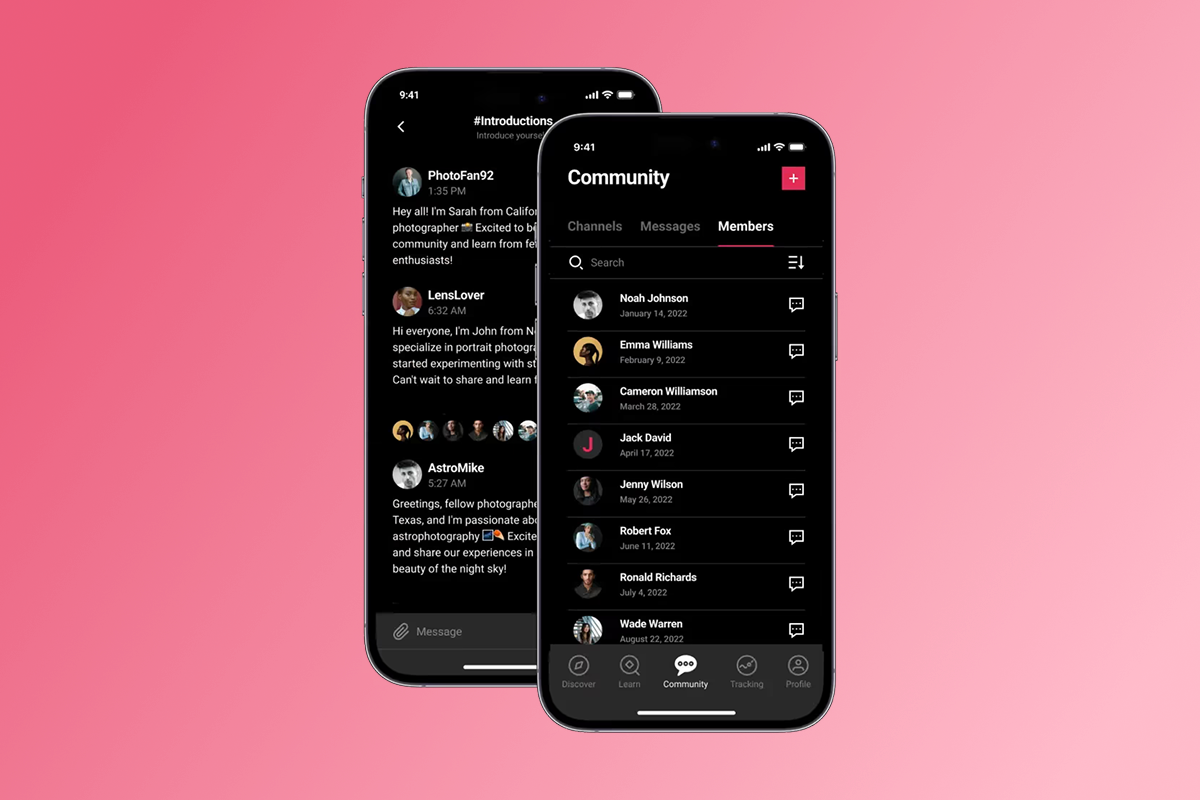
3. In-app community with channels, direct messaging, and moderation tools. Facebook Groups are free but you don't own the member list, can't send push to the whole group, and compete with every other distraction in the Facebook feed. A white-label app community feature keeps conversations inside your branded environment, lets you create channels for specific topics (nutrition, mobility, accountability), and integrates with your content so a user can comment on a workout video without leaving the app.
4. White-glove setup and App Store submission support. Building the app is half the work. Submitting to Apple and Google requires developer accounts ($99/year for Apple, $25 one-time for Google), metadata that passes review, and screenshots formatted to platform specifications. Some platforms make you handle submission alone. Others offer support on higher tiers. PassionPlus handles content migration, app build, and submission coordination. You work with a dedicated success manager and launch in 30 days. For a creator billing $20,000/month, the $10,000-$20,000 fee is a time-to-market investment.
Additional features that matter for fitness: progress tracking, goal setting, drip scheduling for phased programs, and Zapier connectivity to automate workflows. These aren't differentiators, they're baseline expectations for a platform charging $99-$599/month.
Top white-label app builders for fitness and wellness in 2026
I've ranked these platforms based on mobile-native features, white-glove service availability, and transparent pricing for enterprise creators.
1. Passion.io
Passion.io is the only platform that combines true native mobile apps with a done-for-you launch path. You get branded iOS and Android apps (not web wrappers), offline content downloads on the Expand tier, in-app community with channels and DMs, and push notification scheduling that integrates with your course structure and challenges.
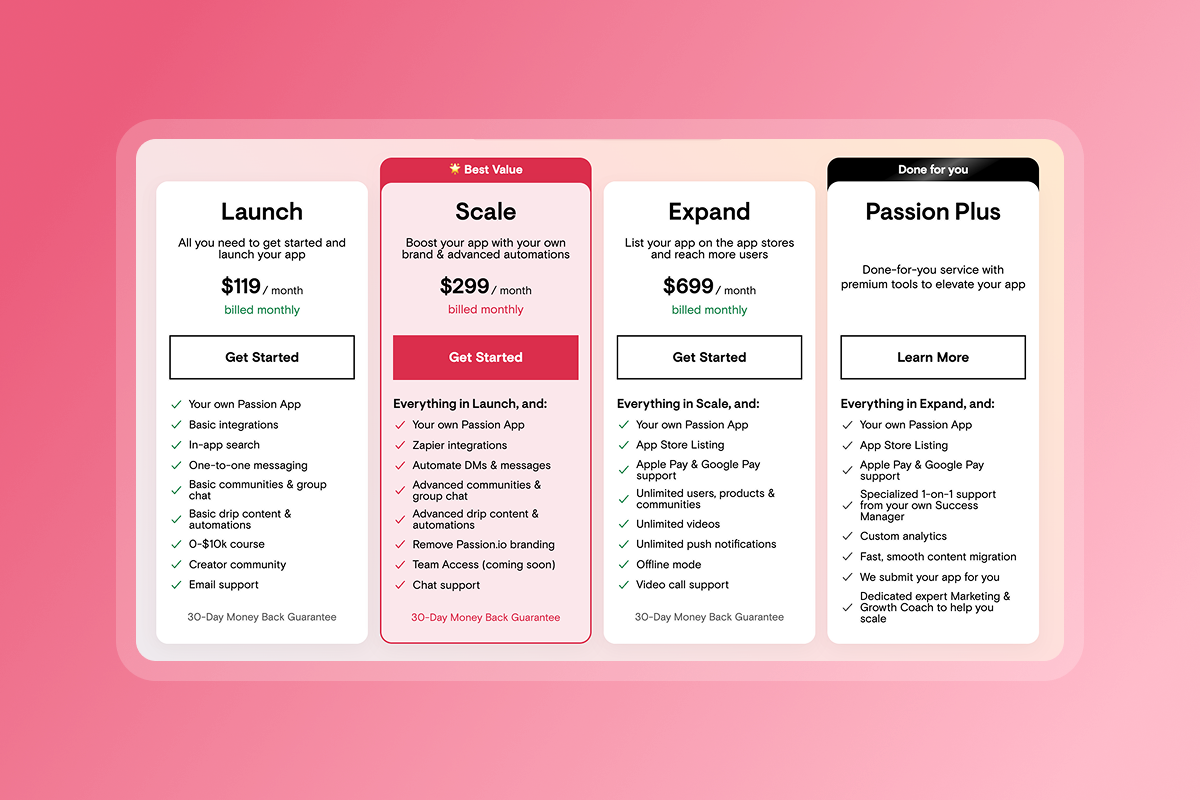
Pricing and fees. Plans start at $99/month billed annually (Launch tier), $239/month for Scale, and $599/month for Expand. PassionPlus is custom pricing starting at $10,000-$20,000 for white-glove build and launch. PassionPayments web checkout adds a 3.9% platform fee plus Stripe's standard processing (approximately 2.9% + $0.30), totaling about 6.8% + $0.30 per web transaction. Apple and Google charge 15-30% for in-app purchases, with the 15% rate applying to small businesses under $1 million annually or subscriptions after the first year. Passion.io charges no additional platform fee on top of app store commissions. Apple developer accounts cost $99/year and Google Play is $25 one-time.
White-glove service. PassionPlus includes content migration from your existing platforms, app design and build, App Store submission coordination, and a named success manager. You launch in days, not months.
"Setting up my coaching app on Passion.io has been one of the easiest and most intuitive processes I've experienced. The platform walks you through every step with clarity... A huge shoutout to Emily and Andrea from the customer service team! They were incredibly responsive and supportive." - Everchanging Butterfly on Trustpilot
Fitness-specific features. Passion.io's health and fitness use case highlights goal tracking, progress dashboards, and challenge templates. The offline mode works on both iOS and Android, so members download a full week of workouts and follow along in a basement gym or outdoor park without connectivity.
Why this is the best choice? Custom development costs $80,000-$250,000 and takes 6-9 months according to industry data. PassionPlus delivers the same premium brand experience at a fraction of the cost and timeline. The mobile-first engagement features (push, offline, community) drive the retention metrics that stabilize recurring revenue. Another creator confirmed:
"Passion.io have been so supportive in helping me develop my App, the training, customer support (especially Hope) have been second to none!" - Karen on Trustpilot
Watch Passion.io's platform demo to see the builder interface, push scheduling, and community features in action.
2. Uscreen
Uscreen focuses on video-first monetization with OTT (over-the-top) app distribution alongside iOS and Android. Uscreen's strength is video playback across OTT devices (Roku, Fire TV, Apple TV), but the platform lacks the interactive challenge, progress tracking, and community depth fitness coaches need for member engagement. White-glove setup is available but pricing sits higher than DIY tiers and isn't as transparently published as Passion.io's model.
Best fit: Video-only wellness brands with large streaming libraries who don't need deep community or challenge features.
3. Kajabi
Kajabi excels at web-first marketing with landing pages, email sequences, and funnel automation. The mobile experience is delivered through a shared Kajabi container app rather than a fully white-labeled native app under your brand in the App Store, which limits push notification control and reduces premium brand perception.
Best fit: Creators who prioritize email marketing funnels over mobile-native engagement.
4. Virtuagym
Virtuagym targets gyms and studios with class booking, member check-ins, and facility management. Many features (equipment booking, in-person scheduling) don't apply to pure digital creators.
Best fit: Gym owners who need operational software alongside content delivery.
5. Exercise.com
Exercise.com serves certified trainers with detailed exercise libraries, 1:1 programming, and assessment tools. Higher pricing and clinical features are overkill for group coaching.
Best fit: Personal trainers and physical therapists programming detailed 1:1 plans.
Comparison: Feature sets, pricing, and white-glove support
This table reflects 2026 pricing and features. Always confirm current details directly with vendors before committing.
Table 1: Core Features
| Platform | Native Mobile App | Offline Mode | In-App Community |
|---|---|---|---|
| Passion.io | Yes (iOS & Android) | Yes (Expand+) | Yes (channels, DMs) |
| Uscreen | Yes (+ OTT apps) | Video caching | Limited |
| Kajabi | Shared container | Limited | Basic |
| Virtuagym | Yes | Limited | Basic |
| Exercise.com | Yes | Limited | Basic |
Table 2: Service & Pricing
| Platform | White-Glove Service | Starting Price | Best For |
|---|---|---|---|
| Passion.io | Yes (PassionPlus) | $99/mo (annual) | Mobile-first creators |
| Uscreen | Available | Higher tier | Video-only brands |
| Kajabi | No | Plans vary | Web funnel focus |
| Virtuagym | Available | Studio-focused | Physical gyms |
| Exercise.com | Available | Professional tier | 1:1 trainers |
Key differentiators. Passion.io is the only platform in this set that offers a fully branded native app, robust offline mode for all content types, deep community features, and a transparent done-for-you service (PassionPlus) with published pricing. Uscreen comes closest for video-only businesses but lacks the challenge and community depth fitness coaches need. Kajabi excels at web funnels but doesn't prioritize mobile-native engagement. Virtuagym and Exercise.com serve specific professional niches (studios and 1:1 trainers) rather than digital-first wellness brands.
For creators, the decision comes down to mobile engagement mechanics and white-glove support. If push notifications, offline access, and a 30-day launch timeline matter, Passion.io is the clear choice.
Case studies: How fitness brands scaled MRR with a branded app
Three Passion.io creators moved from scattered tools to owned apps and saw measurable revenue growth in under 180 days.
Case 1: Allie Cooper, Cirque+ (Aerial Arts). Allie coaches circus and aerial arts professionals who've taken breaks from training. She launched Cirque+ after completing Passion.io's training program. In her first week, she made over $4,000 with 22 founder members. She now has more than 50 subscribers and generates $50,000+ in annual revenue. Allie uses drip content scheduling to pre-sell new programs and release lessons on a set cadence, giving her time to create while subscribers stay engaged. For a niche as specific as aerial arts, the branded app model proves you don't need massive audiences to hit $50K ARR.
Case 2: Savannah Bohlin, The Portal (Holistic Wellness). Savannah teaches energy practices and sustainable fitness routines. She built her app to consolidate live classes, on-demand videos, and community discussion. With 250 subscribers at $22/month, she generates $66,000 in annual recurring revenue. The business model is simple: predictable monthly subscriptions, in-app community that reduces her support load, and push notifications that keep members active without manual outreach.
Case 3: Ellen Decker, Fit in Twenty (Quick Daily Workouts). Ellen targets busy women who want to lose fat and tone up in 20-minute daily sessions. Her app offers structured programs with short, high-intensity workouts. With approximately 60 subscribers at $34.99/month, she earns over $2,400 in passive income monthly, or $30,000+ annually. Ellen's model relies on low-friction daily engagement. Push notifications remind subscribers to complete each day's workout, and the short format reduces completion anxiety. The app's offline mode means users download a week of workouts and train anywhere, which is critical for her target persona.
Common patterns. All three creators charge subscription fees between $22 and $35 per month, serve audiences of 50-250 paying users, and generate $30,000-$66,000 in annual recurring revenue. None required six-figure budgets or massive social followings. They succeeded by consolidating content and community into a branded app, using push notifications to drive daily or weekly engagement, and offering pricing that converts casual followers into committed subscribers.
Security and data protection for enterprise creators
When you move your audience from social platforms to your own app, you take on responsibility for data protection. High-revenue creators ask two questions: who owns the data, and how is it secured?
Data ownership. With a white-label app on Passion.io, you own your customer list, email addresses, payment information (processed through Stripe for PassionPayments or Apple/Google for IAP), and content. If you decide to migrate to another platform or export your member list for email marketing, you control that data. Social platforms don't give you this portability.
Encryption and infrastructure. SaaS platforms typically use SSL/TLS encryption for data in transit and host on trusted infrastructure like AWS, Google Cloud, or Microsoft Azure. For payment processing, Passion.io integrates with Stripe, which handles PCI-DSS compliance and tokenizes credit card data so sensitive information never touches your app directly. Apple and Google IAP also process payments through their secure systems, so you're not responsible for storing payment credentials.
Customer safeguards. Enable two-factor authentication (2FA) on your admin account, use unique strong passwords, and review access permissions for team members. If you're handling health data (like fitness assessments or biometric tracking), consult Google's health and fitness apps declaration requirements to ensure compliance with app store policies.
Security diligence means confirming the platform's track record, understanding where data lives, and implementing admin-level hygiene (2FA, password management, team role restrictions). If your business handles EU customers, verify GDPR compliance. For US audiences, confirm the platform's data processing agreements and breach notification policies.
How to choose the right platform for your business stage
The right white-label app builder depends on your current revenue, content readiness, and willingness to DIY versus paying for done-for-you service.
- If you're generating $50K+ MRR and value time over cost: Choose PassionPlus. You launch in 30 days with white-glove migration, App Store submission support, and a dedicated success manager. The $10,000-$20,000 investment is less than one month's revenue and eliminates the 3-6 month DIY learning curve.
- If you have a large video library and want TV app distribution: Choose Uscreen. The platform's strength is video playback across OTT devices (Roku, Fire TV, Apple TV) alongside mobile apps. You'll pay more than course-focused competitors but get best-in-class streaming infrastructure.
- If you need marketing funnels and email automation more than mobile engagement: Choose Kajabi. The platform excels at landing pages, email sequences, and web-first sales funnels. The mobile experience is lighter, but if your primary channel is email and your audience converts on web, Kajabi's all-in-one model reduces tool sprawl.
- If you run a physical gym or studio and need member management: Choose Virtuagym. Class booking, facility management, and in-person payment processing are built in.
- If you're a certified trainer delivering 1:1 programming: Choose Exercise.com. The exercise database, assessment tools, and professional-grade programming features justify the higher price point for clinical or professional contexts.
For most fitness and wellness creators at the six-figure revenue level, the decision comes down to mobile engagement mechanics (push, offline, community) and white-glove support. Passion.io wins on both.
If you're ready to move from rented platforms to owned infrastructure, book a demo with Passion.io or explore the PassionPlus white-glove service for a 30-day launch. The creators in these case studies generate $30K-$66K ARR with audiences of 50-250 paying users. You already have the audience and content.
Frequently asked questions about white-label apps
How long does it take to launch a branded app? Most creators publish their web app in 2-4 weeks, and App Store submissions add 1-4 weeks depending on review timelines. PassionPlus delivers launch in 30 days or less.
Do Apple and Google take a cut of my revenue? Yes, Apple and Google charge 15-30% on in-app purchases, with the 15% rate applying to small businesses under $1M annually or subscriptions after the first year. For web checkout, the 3.9% PassionPayments platform fee plus Stripe processing totals about 6.8% + $0.30.
Can I migrate my Facebook group into my app? Yes, build an engaged community in your app by creating channels, enabling DMs, and using push notifications. Migrate your 10-15 most active members first and redirect Instagram links to your branded app during a 30-day transition.
What happens if I want to cancel my subscription? You can cancel your Passion.io subscription at any time. You retain ownership of your content and customer data.
Do I need coding skills to build the app? No, Passion.io is a no-code platform where you drag and drop content into lesson templates and customize branding with your logo and colors. Watch the Welcome to Your Passion App video to see the builder interface.
Key terminology for app builders
Native app. A native app runs on iOS and Android devices using the operating system's code, which allows offline access, push notifications, and better performance than web-based alternatives.
Web app (PWA). A web app (PWA) runs in a browser and looks like a native app but has limited access to device features. PWAs typically cannot send push notifications or work fully offline.
IAP (In-app purchase). In-app purchases (IAP) are digital content or subscriptions bought directly within a mobile app, processed by Apple or Google, which retain 15-30% of revenue.
Push notification. Push notifications are short, timely messages sent directly to a user's mobile device to bring them back into your app, bypassing email and social algorithms.
White-label. A product or service made by one company that other companies rebrand to make it appear as if they had made it. In the app context, it means a fully customizable platform where creators apply their own branding, logo, and colors.

Build the business
behind what you know.
Turn your expertise into a branded app with courses, community, and the You AI Coach. Launch plan from $99/month.