

Push Notifications for Yoga Apps: Driving Engagement Without Annoying Students
Updated March 17, 2026
Most yoga instructors lose students not because their content is bad, but because there is no consistent nudge pulling students back to practice. Strategic push notifications, sent 2-4 times per week with the right timing and segmentation, can increase course completion by 15-30% in 90 days. A branded iOS, Android, and web app with native push built in launches in 4-8 weeks on Passion.io. Plans start at $99/month (annual billing). Web checkout fees run 3.9% via PassionPayments plus Stripe. Apple/Google in-app purchase fees run 15-30%. No coding required.
5% retention increase boosts profits 25-95%, according to research by Bain and Company. That retention tool already sits in your student's pocket. If you run a yoga business with content ready but struggle with low completion rates and fragmented engagement across Instagram DMs, Facebook groups, and email, this playbook is for you. We cover how to use strategic push notifications to increase daily active users, cut churn, and build predictable recurring revenue on a platform you own.
Why yoga apps need native push notifications
You probably built your business on platforms you do not own. Your courses live on a generic web builder, your community sits in a rented Facebook group, and your reach depends on an algorithm you cannot control. When engagement drops, your instinct is to send another email newsletter. Email alone will not solve this.
Native mobile push notifications ~90% delivery rates and generate click-through rates 7x higher than email. More importantly, they land on the lock screen before a student even unlocks their phone, creating a habit-building touchpoint that web-first tools cannot replicate. Web push notifications reach users with browsers open, while native mobile push delivers to the lock screen regardless of app activity.
The cost of low engagement and high churn
Low completion is not a content problem but a distribution and habit problem. When students fall off a yoga program mid-week, a web-based course has no mechanism to reach them until they decide to log back in, and most do not.
The financial impact compounds fast. If you run a $49/month membership with 200 students and 8% monthly churn, you lose 16 students every month, which equals $9,408 in lost annual revenue from churn alone. Moving engagement to a branded mobile app with push notifications is the most consistent lever for keeping that number below 5%.
Retention vs. acquisition: the ROI of push
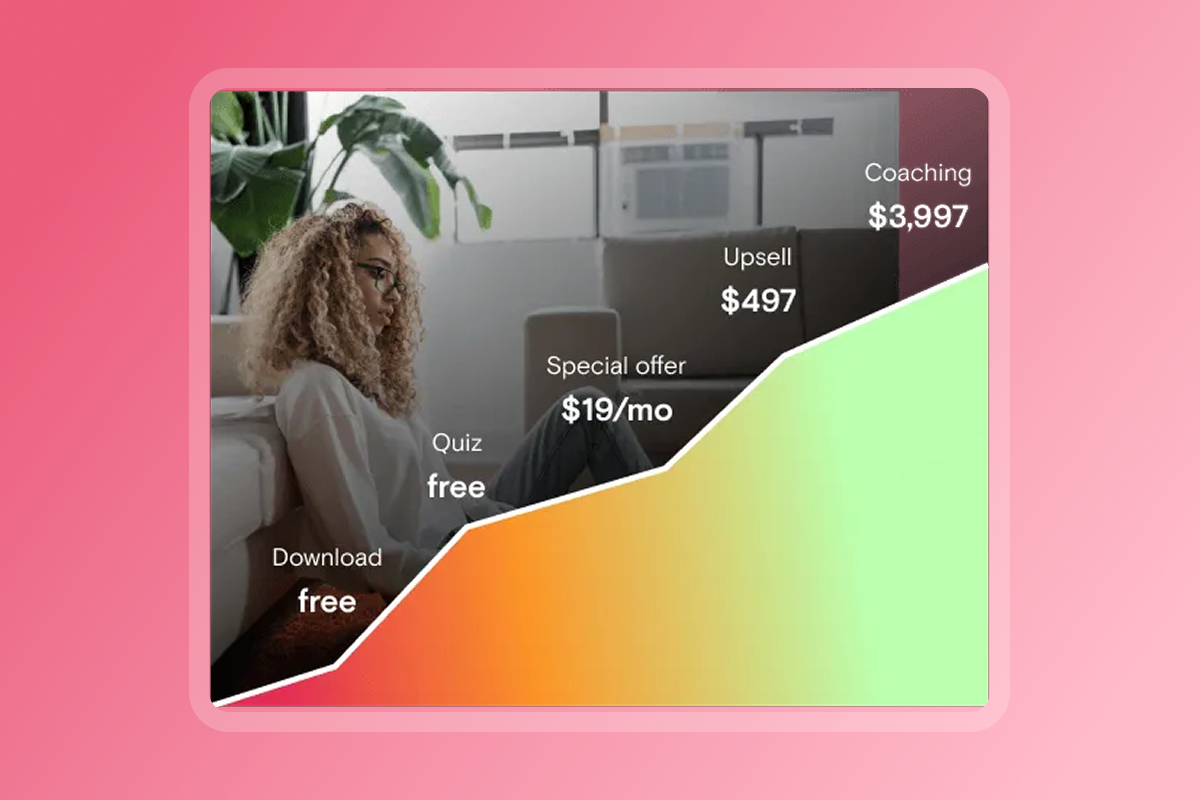
You will spend 5 to 25 times more acquiring a new student than keeping an existing one. Despite this, most yoga instructors spend the majority of their marketing budget on acquisition while doing almost nothing to retain the students already paying them.
Push notifications are a direct line to your existing audience at near-zero marginal cost. Research shows that 60% of app users use an app more frequently when they receive push notifications, and fitness app engagement can lift 88% with timely, targeted pushes.
5 push notification campaigns that increase daily active users
The most effective push campaigns are not promotional. They are habit-building touchpoints tied to the student's practice, progress, and community. Here are five campaign types that consistently move the needle on DAU and completion rates.
Class reminders and booking confirmations
The simplest and highest-return campaign is a timed reminder before a scheduled class or the next lesson in a drip program. For live class formats, send a push 15-30 minutes before the session: "Live Flow with [Your Name] starts in 15 minutes. Tap to join." For on-demand drip content, a morning nudge tied to the day's lesson ("Your Day 3 Morning Flow is ready. Roll out your mat.") is enough to pull students back into the habit. Research on fitness business app engagement consistently identifies booking confirmation push as one of the primary re-engagement drivers.
30-day challenge prompts and gamification
A 30-day yoga challenge inside a branded app is one of the highest-engagement formats available to instructors. Push notifications tied to daily prompts and milestone rewards build the completion habit faster than any other mechanism. A proven sequence includes a Day 1 kickoff ("Welcome! Day 1/30: Your first 10-minute flow is ready"), a Day 15 midpoint reward ("You've earned the 'Halfway Hero' badge! 15 days down, 15 to go."), and a Day 30 celebration ("You did it! 30 days complete. Tap to claim your certificate"). Yoga creators using this push challenge approach reportedly see 15-30% higher completion rates within 90 days.
Personalized content and mindfulness nudges
Personalization separates a push notification that drives action from one that gets ignored. If a student has been watching your hip-opener series, a nudge recommending the next class in that sequence is far more relevant than a generic "check out new content" alert. Behavior-based triggers use previous app activity to calculate the best send time for each individual user, updating every two hours for higher accuracy. For wellness instructors, this opens up a high-performing format: the mindfulness nudge. An example: "You haven't opened the app in 3 days. A 5-minute breathing session is ready when you are."
Community engagement and live event alerts
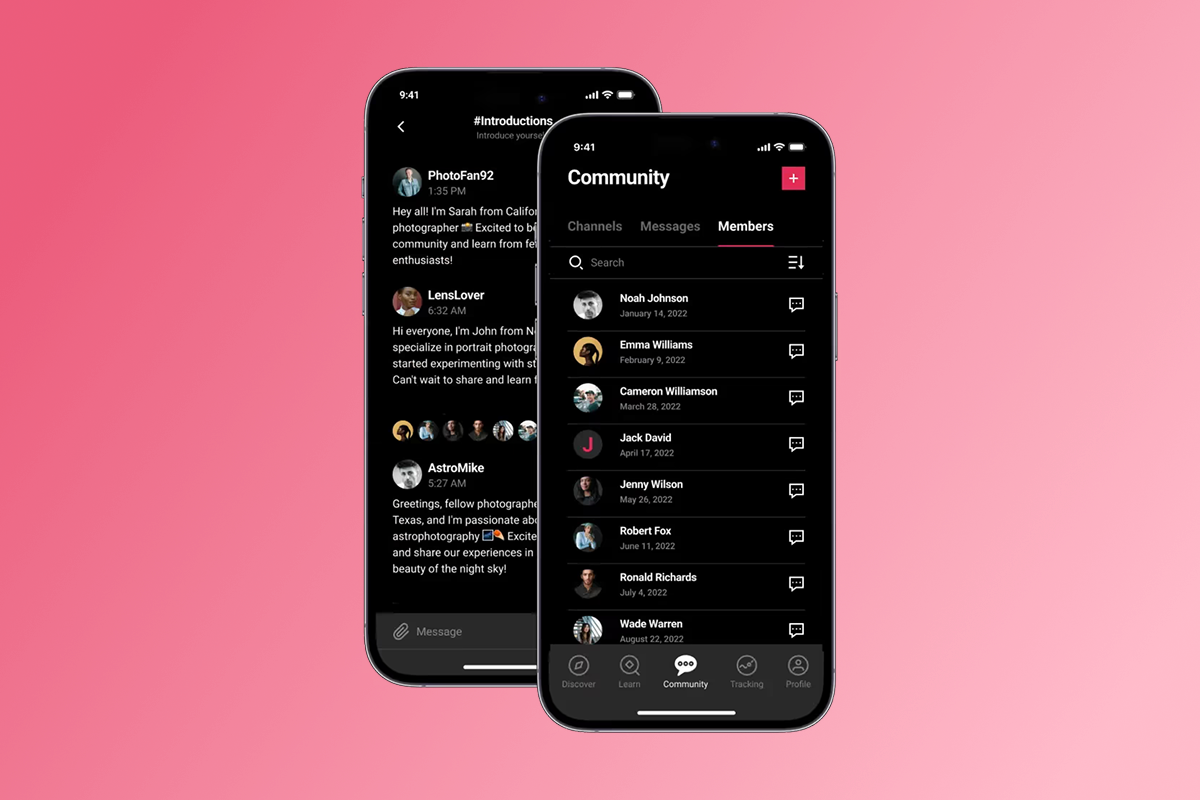
An in-app community feed without push is a silent room. When a student posts a question or shares a win, a targeted notification to relevant community members ("Sarah just posted a question in the Flexibility channel. Tap to help.") drives participation and peer connection. Research on fitness push campaigns identifies live event promotion as one of the highest-converting notification types. For yoga instructors running monthly Q&As or guest workshops, a push 24 hours before and again 15 minutes before the event consistently lifts attendance. You can set up community notification triggers directly in Passion.io.
Win-back campaigns for inactive students
Students who go quiet are not necessarily gone. They are drifting. A structured re-engagement sequence can recover a meaningful percentage of inactive users before they cancel. The key is making each message relevant to where the student left off rather than sending a generic "come back" prompt:
- Day 7 of inactivity: "We miss you! Your progress is waiting."
- Day 14: "New meditation just dropped. Your community is asking about you. Tap to rejoin."
- Final nudge: "Don't lose your streak. Resume your practice now. Your mat is waiting."
Pair this with a strong onboarding framework to reduce the likelihood of students going dormant in the first place.
How to implement a push strategy that respects student boundaries
The fear of annoying students with too many notifications is legitimate. Push abuse is the fastest way to earn an opt-out and damage the relationship you built through your content. The solution is not to send fewer notifications but to send smarter ones.
Timing, time zones, and daily routines
Health and fitness apps see significantly higher click-through rates in two windows: 5-7am and 5-8pm. Early morning aligns with intention-setting and morning practice, while early evening aligns with post-work wind-down, which is a natural yoga moment for many students.
The most important operational rule is local time zone delivery. Sending a "morning intention" push at 7am your time when a student lives in a different time zone means the notification arrives at 3am. Research on push timing best practices confirms that segmenting users by location and scheduling based on local time is a standard requirement for any push program. For a yoga challenge, a daily push is appropriate. For general membership engagement, 3-4 notifications weekly is the recommended ceiling before open rates begin to decline.
Segmentation and personalization
Segmentation means grouping students by shared traits so each person receives notifications relevant to their actual practice. A beginner in Week 1 of your foundation program needs different nudges than an advanced student working through a teacher training series.
Passion.io lets you segment users by subscription tier, course progress, and activity level, which can support common yoga instructor segments such as new students in their first 14 days (focus on habit formation), active students mid-program (focus on milestones and community), and inactive students (focus on win-back). The setup guide for custom notifications walks you through configuring each segment inside your app dashboard.
Clear opt-ins and privacy policies
Both Apple and Google require explicit user opt-in for push notifications. The App Store Review Guidelines state that push notifications must not be required for the app to function and require explicit in-app opt-in when used for promotions or direct marketing purposes. Android 13 and higher requires a runtime permission for all non-exempt notifications.
Frame your opt-in screen around value to the student ("Get daily practice reminders and challenge updates") rather than the feature itself. Students who opt in actively want to be reached, which means your notification list is a genuinely engaged audience from day one. You can find guidance on enabling push for your Apple developer account in the Passion.io help center.
Measuring the success of your push campaigns
Open rate tells you who tapped the notification. It does not tell you whether that tap changed behavior. For yoga instructors, the metrics that matter are downstream of the open.
Key metrics beyond open rates
Track these four numbers for a complete picture of push performance:
- Conversion rate: The percentage of users who completed the desired action (watched a lesson, attended a live class) after receiving the notification.
- Retention lift: How many more students remained active compared to a baseline period before push was active.
- Course completion rate: The percentage of students who finish a program within a defined timeframe. Target +15-30% in your first 90 days of active push.
- DAU/MAU ratio: Daily Active Users divided by Monthly Active Users. A healthy ratio for a subscription yoga app is 20-30%, and a rising DAU/MAU ratio is a strong signal that push is working.
A/B testing your messaging
Test one variable at a time across a split of your user base. Start with send time (morning vs. evening), then test message copy (instruction-led vs. emotion-led), then test the call to action (specific class name vs. general "practice today"). A 14-day test cycle typically gives you enough data to see meaningful differences without running the experiment so long that external factors skew the results.
How to launch a branded yoga app with native push in 30 days
Moving from a generic course platform to a branded mobile app is the structural change that makes every push strategy in this guide actually work. Without native push, you are renting land and hoping the algorithm cooperates. With your own app, you own the relationship.
Consolidating your tools into one platform
Passion.io replaces your course builder, community platform, payment processor, and push notification tool with one no-code branded app for iOS, Android, and web. App store submission support is included on Expand and Plus plans, with DIY submission available on Launch and Scale plans.
On payment fees, here is a direct comparison:
| Method | Platform fee | Best for |
|---|---|---|
| PassionPayments (web) | 3.9% + Stripe (~2.9% + $0.30) | Subscriptions, bundles, higher-margin sales |
| Apple IAP | 15% (under $1M/yr) or 30% | Mobile convenience upsells |
| Google IAP | 15% (first $1M/yr) then 30% | Mobile convenience upsells |
Route monthly and annual subscription purchases through web checkout to protect margin, and offer IAP as a convenience option for students who prefer buying through their phone's app store. The IAP fees and setup guide covers this decision in detail.
Setting up your first push cadence
This 4-week launch plan gives you a live app and an active push program without doing everything at once:
- Week 1: Open your Apple Developer account ($99/yr) and Google Play account ($25 one-time). Upload core lessons and set your monthly and annual subscription tiers in PassionPayments. Submit your web app for launch.
- Week 2: Configure your first push templates (welcome series, habit check, progress nudge). Set up your in-app community feed and test the opt-in flow on both iOS and Android.
- Week 3: Submit your app to the App Store and Google Play. Build a launch push campaign for your existing audience.
- Week 4: Go live. Send push notifications regularly. Measure DAU, lesson completion, and churn at the 30-day mark.
iOS App Store review typically takes 24-48 hours (Apple reports 90% of submissions reviewed in less than 24 hours), while Google Play review takes approximately three days. New Google Play developers with personal accounts created after November 2023 must run closed testing with at least 12 testers for two weeks before approval. The app launch checklist covers every step of this process, and 8 program launch tips covers the content side. Your students can also access lessons offline, which removes the connectivity barrier that causes drop-off for students practicing in studios or traveling.
Set your 90-day completion rate target before you launch and use it as the baseline that every push campaign is measured against. Start building with a 14-day free trial of Passion.io, backed by a 30-day money-back guarantee.
Specific FAQs
How much does it cost to launch a branded yoga app on Passion.io?
The Launch plan begins at $99/month on annual billing, with a 3.9% PassionPayments platform fee plus Stripe processing on web sales and Apple/Google IAP fees of 15-30% on in-app purchases. First-year developer account costs total $124 ($99 Apple annual, $25 Google one-time).
Do I need to know how to code to send push notifications from my yoga app?
No coding is required. Passion.io's no-code builder includes a push notification creation tool where you write the message, set the timing, choose the segment, and schedule delivery without touching a line of code.
What is a good push notification frequency for a 30-day yoga challenge?
Many programs send one daily notification during an active 30-day challenge. For general membership engagement, fitness apps send 3-4 weekly as the recommended ceiling before opt-out rates begin to rise.
How long does it take to get a yoga app approved on the App Store?
iOS App Store review typically takes 24-48 hours, though planning a few extra days for potential revisions is prudent. Google Play review averages around 3 days, and new developers with personal accounts created after November 2023 must complete a closed testing period (minimum 12 testers for 2 weeks) before approval. Our Expand and Plus plans include app store submission support to reduce back-and-forth with reviewers.
Key terminology
Daily Active Users (DAU): The number of unique students who open your app at least once on a given day. This metric tracks whether your push cadence is successfully pulling students back into a daily practice habit.
In-App Purchases (IAP): Any purchase processed by Apple or Google from within your mobile app, including subscriptions and one-time content buys. Apple and Google retain 15-30% of each IAP transaction depending on your annual revenue tier.
Churn rate: The percentage of students who cancel their subscription in a given month. A churn rate of 5% means 5 out of every 100 subscribers cancel each month, and reducing this by even 2-3 percentage points via push engagement directly increases your annual MRR.
Segmentation: Grouping your students by shared traits, such as skill level, program stage, or activity level, so each group receives push notifications relevant to where they are in their practice rather than a generic broadcast message.