.png)

Updated February 5, 2026
High-revenue creators face a common problem: audiences scattered across Instagram DMs, private Facebook groups, Zoom calls, and patchwork course platforms. You know you need a branded mobile app to own the relationship and control the experience, but the build vs. buy decision is paralyzing.
This guide breaks down the strategic and financial trade-offs between custom native apps, generic white-label builders, and modern platform apps so you can protect your margins while building predictable recurring revenue. I'll show you when each approach makes sense, what the true costs look like over 24 months, and how to avoid the "vanity trap" of custom code that delays revenue for months.
Defining the landscape: Native, white-label, and platform apps
Most creators struggle with app development terminology because vendors use overlapping terms inconsistently. Let me clarify the three distinct models.
What is native app development?
Developers build native applications explicitly for a single platform. iOS apps use Swift or Objective-C, while Android apps use Java or Kotlin. You hire a development team to write every line of code from scratch, designing custom UI components, business logic, and server infrastructure. Native apps require separate codebases for iOS and Android, effectively doubling development time and cost because you need dedicated specialists for each platform.
The advantage is infinite flexibility. You control every pixel, every interaction, and every data flow. The disadvantage is cost. Medium-complexity apps typically cost $50,000 to $150,000 upfront, with some reaching $180,000 when you add rich UX and third-party integrations.
What is a white-label app?
A white-label agreement is a legal contract where a software provider builds the core technology and you rebrand it under your name. White-label course app creators provide a drag-and-drop solution with design templates, letting you configure the app without writing code. You don't own the underlying software, but you own your content, user data, and brand presentation.
Generic white-label builders focus on broad use cases like restaurants, e-commerce, or corporate directories. They launch quickly at low cost but lack specialized features for creators who need course progress tracking, drip content, community moderation, and subscription management.
The "platform app" nuance
Platform apps represent the modern middle ground. They combine managed SaaS infrastructure with true native capabilities and deep branding control. With Passion.io, the builder outputs three platforms simultaneously: a native iOS app, a native Android app, and a web app. You're not just getting a mobile-responsive website wrapped in an app shell.
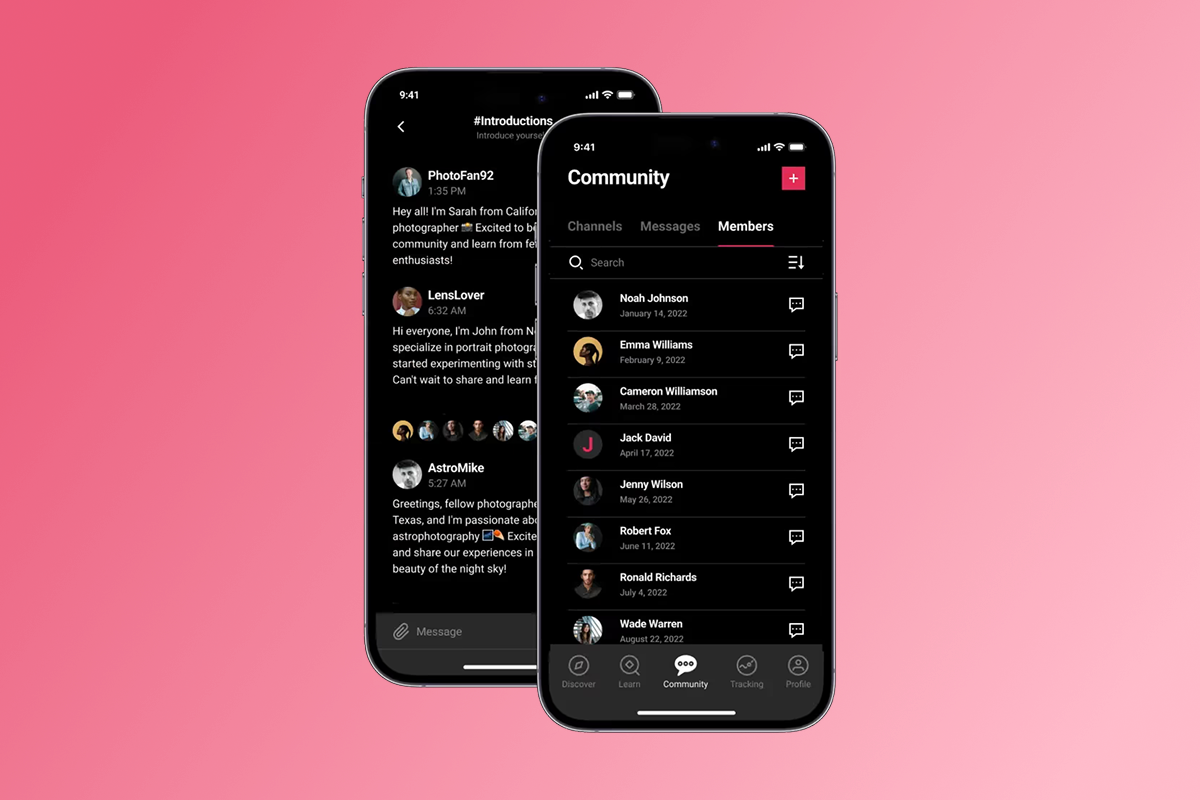
Platform apps deliver push notifications that appear on user lock screens, offline content downloads, and in-app community features without relying on external social platforms. On Scale plans and above, Passion removes its own branding entirely, giving you a white-labeled experience. You configure rather than customize, but for creator business models, that distinction is liberating rather than limiting.
The core trade-offs: Cost, speed, and control
The "build vs. buy" decision comes down to three factors: what you'll pay, how fast you'll launch, and what level of control you actually need.
Cost breakdown and ROI
Native app development costs an average of $75,000, with low-end projects starting at $25,000 to $30,000 for simple apps and high-end builds reaching $150,000 to $500,000+ for fully custom, feature-rich products. North American development teams charge $70 to $180+ per hour for senior mobile specialists.
But upfront cost is only the beginning. Maintaining an app typically costs 15 to 20% of its original development cost annually, which is the industry benchmark. For a $100,000 app, you should expect to allocate $15,000 to $20,000 annually covering hosting fees, bug fixes, OS updates, security patches, and dependency updates.
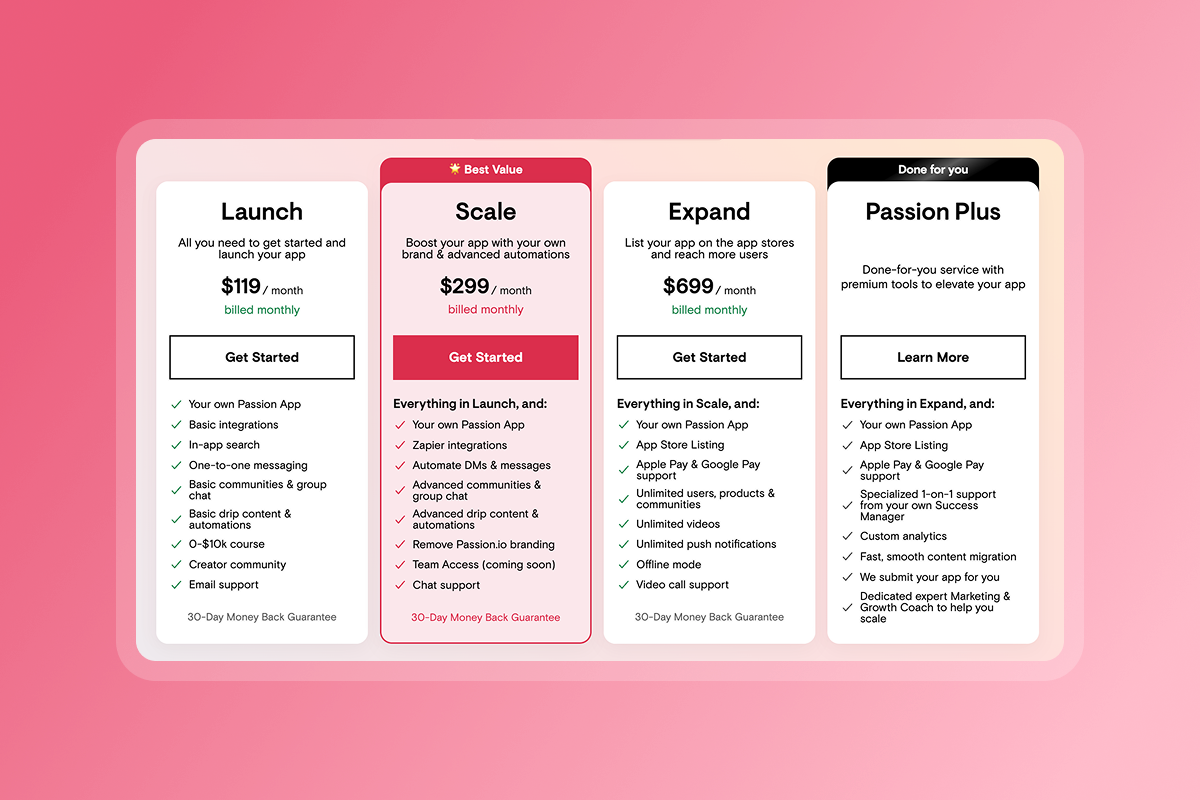
White-label platforms invert the cost structure by frontloading configuration and eliminating maintenance overhead. Passion.io's Launch plan starts at $99/month billed annually, the Scale plan runs $239/month annually, and the Expand plan costs $599/month annually. Passion Plus is a custom, done-for-you service where the team builds your app, handles content migration, manages App Store submission, and provides a dedicated success manager. Plus typically costs $10,000 to $20,000 depending on complexity, with no hidden fees for migration or submission.
Over 24 months, a $100,000 native app costs $130,000 to $140,000 including maintenance. A Passion.io Plus setup with the Expand plan costs roughly $10,000 to $20,000 upfront plus $14,376 over 24 months, totaling $24,376 to $34,376.
You also avoid hidden fees. Apple Developer Program membership costs $99 annually, and Google Play registration is a $25 one-time fee. These apply to both models, but with native development you manage the accounts yourself or pay your agency to handle renewals and submissions.
Speed to market
Average apps take 4 to 6 months to develop, and complex apps take 9+ months. The timeline breaks into four phases:
- 2 to 3 weeks to 1 to 2 months for discovery and planning
- 3 to 6 months for development
- 4 to 6 weeks for testing and QA
- 1 to 2 weeks for App Store submission
Passion.io offers white glove service with a dedicated success manager to assist you as you build your app, migrate content, and submit to app stores, with the ability to launch in 30 days or less with Passion Plus. Most creators launch a functional web app within 2 to 3 weeks of signup, with App Store submissions typically happening by week 3 to 4.
In the six months it takes to code a native app, you could launch a white-label app, run your first cohort, gather user feedback, adjust pricing, and iterate on content twice. That's lost revenue time you never recover.
Customization vs. configuration
The argument for native development usually centers on control. You can build any feature you imagine without platform constraints. The question is whether you need that level of customization or just want it.
Distinguish between cosmetic preferences like button shapes and strategic needs like unique business models. Cosmetic changes rarely impact revenue, while business model flexibility drives growth. With a white-label app builder like Passion.io, you aren't reliant on a development team to make changes to your product. You upload your content when you want, adjust pricing plans in real time, and launch new courses without submitting code for review.
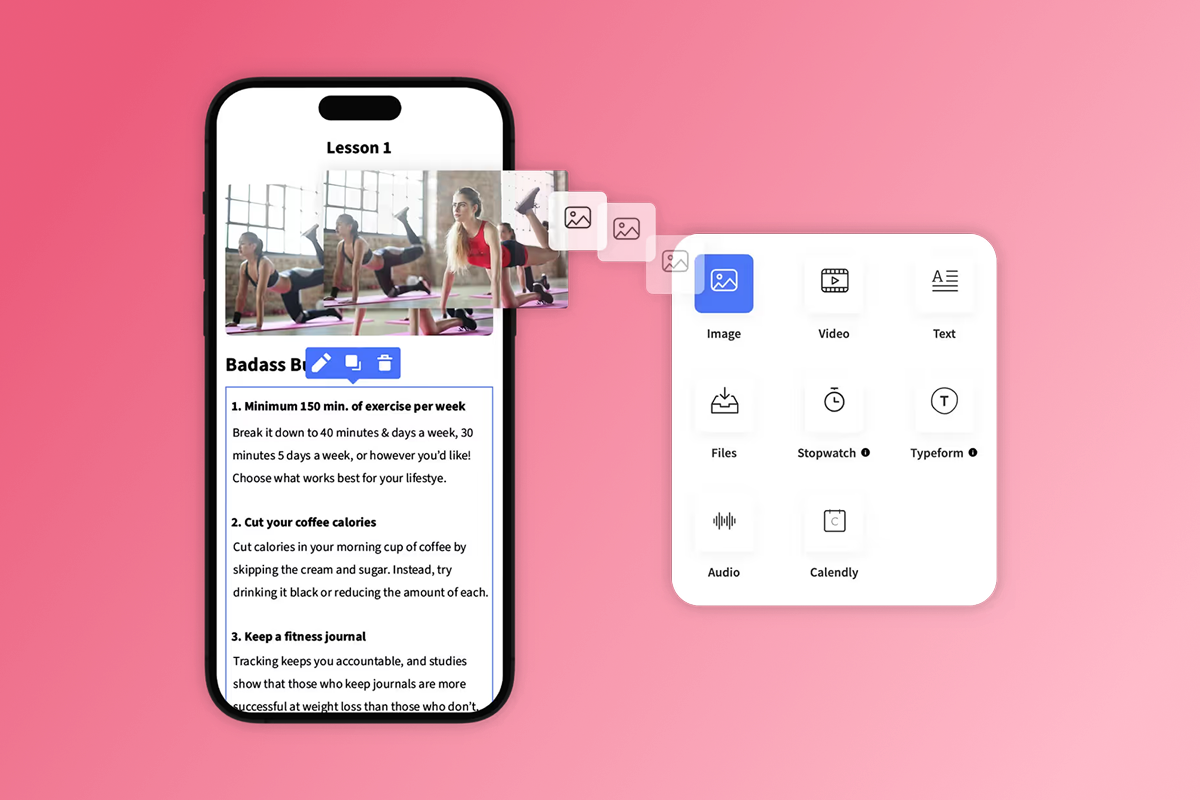
Passion.io allows creators to turn services into digital products and interactive courses, choose from templates across various industries, add features, content, pricing plans, and branding, and go live on iOS, Android, and Web with in-app payments.
Native development makes sense when you need proprietary technology, not when you need a faster checkout button or a different shade of blue.
Deep dive: Creator-specific features and platform scale
Platform features and scale
Push notifications, offline content access, and in-app purchases drive mobile engagement. Native apps offer push notifications that appear on user lock screens, offline content downloads, and in-app community features without relying on external social platforms. Passion.io's interactive lessons are designed for today's learning with higher completion rates, and you can upload audio, video, courses, and files with casting ability like Netflix.
Passion.io's infrastructure auto-scales to handle traffic spikes without you managing servers, deploying patches, or monitoring uptime dashboards. Whenever Passion.io rolls out new features, your app is updated automatically at no extra cost.
"Creating an App takes commitment, patience and time I've found. Tracy has been great and has often gone above and beyond." - Dr. Liesl Roome Inc. on Trustpilot
When native development is actually necessary
Native development is the only viable option in three scenarios:
- Complex hardware integration beyond standard camera or GPS, such as proprietary Bluetooth devices, real-time biometric data, or medical device pairing. Native technologies have easy access to hardware elements like camera, GPS, NFC, or microphone.
- Unique gaming physics or real-time multiplayer architecture. Gaming and multimedia apps benefit significantly from native code, leveraging GPUs for stunning graphics, sound, and visualization capabilities not achievable with web apps.
- Platform-specific performance where milliseconds matter to your business model. Native Android apps launch faster due to pre-compiled execution, unlike interpreted code.
For coaching programs, fitness challenges, meditation series, or business frameworks, none of these apply. You need structured content delivery, progress tracking, community engagement, and subscription billing. Those are configuration problems, not coding problems.
Security and data ownership: Who owns your business?
Data ownership clarity
You own your user list, email addresses, payment history, and content with white-label SaaS. You don't own the underlying code, but you also wouldn't own agency-built code unless you negotiate expensive IP transfer upfront, which adds significant cost.
The critical difference is portability. The agreement should address service discontinuation, data export rights, transition assistance, and any refund or termination terms. You can export your user database and content from Passion.io. You cannot export the platform's infrastructure, but if you migrate to custom development, you'd be rebuilding that infrastructure anyway.
Security posture comparison
With managed SaaS, you inherit enterprise-grade infrastructure. While Passion.io doesn't publicly claim SOC 2 or ISO 27001 certification, the platform uses SSL/TLS encryption in transit and integrates with Stripe for payment processing. Apple and Google's in-app purchase systems handle payment security, so you're not storing credit card data on your own servers.
The trade-off is transparency. With custom development, you control the architecture but also bear the liability. With SaaS, you trust the vendor's controls but shift the operational burden.
Decision matrix: When to build native vs. white-label
Five-step assessment framework
Use this sequence to decide in under 10 minutes:
- Budget check: Can you allocate $100,000+ upfront and $20,000 annually without affecting cash flow? If no, skip to white-label.
- Timeline urgency: Can you wait 6 to 9 months to launch? If no, white-label wins.
- Feature audit: Do you need proprietary hardware pairing, AR/VR rendering, or real-time multiplayer physics? If yes, native is required. If no, continue.
- Team capacity: Do you have an in-house product manager to oversee dev roadmaps and coordinate agencies? If no, white-label reduces risk.
- Revenue model: Does your business center on courses, coaching, challenges, or community? If yes, white-label platforms already build these features natively.
If you answered "no" to questions 1, 2, or 4, or "yes" to question 5, choose a white-label platform.
Choose native development if
You have $100,000+ available and can wait 6 to 9 months for launch. Your business model requires proprietary hardware integration, unique real-time multiplayer architecture, or platform-specific performance optimization. You have an in-house product manager who will oversee the development roadmap and coordinate with external agencies or internal developers.
You should choose native mobile development if your app is targeting one specific audience, the user interface is critical to your future application, or your team is equipped with highly skilled Android and iOS developers.
Choose a white-label platform if
You're a creator, coach, or educator who wants to launch in under 8 weeks and prioritize recurring revenue over code ownership. Your business model centers on courses, coaching, challenges, or community. You want to own the customer relationship and eliminate algorithm dependency without managing developers.
Conventional wisdom is that you should choose a white label app if you are working with a limited budget, you need the app NOW, and you don't need any custom functionality.
"I purchased Passion.io to build an app that was easy for me and my clients to utilize. The group onboarding training was super helpful to getting started on the right foot." - LAT CPA Firm on Trustpilot
The hybrid approach: How Passion.io bridges the gap
Passion.io Plus represents the "agency experience at SaaS pricing" model you need. Plus is best for high-revenue creators or business coaches who want white-glove service and minimal founder time spent on setup, allowing them to launch in 30 days or less with a dedicated success manager who assists with building the app, migrating content, and submitting to app stores.
The service includes content migration from your existing platforms, App Store and Google Play submission handling, branding setup with your logo and color palette, pricing plan configuration, and ongoing success manager access. Plus typically costs $10,000 to $20,000 depending on complexity, with no hidden fees for migration or submission.
You focus on content and community strategy while Passion's team handles the technical plumbing. Whenever Passion.io rolls out new features, your app is updated automatically at no extra cost. You don't manage releases, coordinate QA testing, or budget for feature development. The platform evolves, and your app evolves with it.
For creators earning mid-five to six figures monthly who value time over customization control, this model delivers the brand authority of native development without the management overhead. You can learn more about app submission requirements and how to optimize your app store presence in Passion's help documentation.
"Build an app with ease, adequate support and in a short amount of time... We chose the Passion Plus Lite package, and feel that every penny of it was well invested from creation to launch." - Angie on Trustpilot
Choosing the path to recurring revenue
The goal isn't to become a software company. The goal is to build predictable recurring revenue with a branded experience you control. Custom native development offers infinite flexibility at the cost of time, budget, and ongoing management. White-label platforms offer speed, predictability, and automatic updates at the cost of code ownership.
For creators who need courses, community, push notifications, and subscription billing, the white-label path delivers faster time-to-revenue with lower total cost of ownership. For businesses that require proprietary technology or unique hardware integration, native development remains the only viable option.
The decision comes down to one question: Do you want to own the code or own the revenue? For 99% of creators, white-label platforms deliver faster time-to-revenue at lower total cost of ownership. Native development remains viable only when you need proprietary technology or unique hardware integration that doesn't exist in any SaaS solution.
Book a demo to see how a branded app fits your business model in under 30 days, with a 30 day money-back guarantee if you aren't satisfied. For case studies in your niche, explore how health and fitness professionals are scaling with Passion.io.
Frequently asked questions
Do I own my code with a white-label app?
No. You own your content, user data, and brand assets, but the platform owns the underlying software code, similar to how you use Stripe for payments without owning Stripe's infrastructure.
Can I migrate from white-label to native later?
Yes, but you'll rebuild the app from scratch because you can export your user database and content but not the app's functionality. Budget for full native development cost.
What are the ongoing costs for native apps?
Expect 15 to 20% of the original development cost annually for hosting, bug fixes, OS updates, and security patches. A $100,000 app costs $15,000 to $20,000 per year minimum.
How do in-app purchase fees work?
Apple charges 30% standard commission, dropping to 15% for developers earning under $1 million annually, while Google charges 15% on the first $1 million in revenue per year, then 30% beyond that. Passion charges no extra fees on top of Apple or Google in-app purchases.
How long does App Store approval take?
Apple reviews apps within 24 to 48 hours in most cases, though you may face delays if revisions are needed. Budget 1 to 2 weeks for the full submission and approval cycle.
Key terminology
Native App Development: Software built specifically for one platform (iOS or Android) using that platform's core programming language (Swift for iOS, Kotlin for Android), compiled to run directly on the device hardware.
White-Label SaaS: A software product built by a vendor that you rebrand under your own name and sell to your customers, where you own the user data and content but not the underlying code.
Total Cost of Ownership (TCO): The complete cost of acquiring and operating a technology asset over its useful life, including initial purchase price, implementation, training, maintenance, upgrades, and eventual replacement.
In-App Purchase (IAP): A monetization method where users buy digital content or subscriptions directly inside a mobile app through Apple App Store or Google Play billing systems, which charge a 15 to 30% transaction fee.
Platform App: A hybrid model that combines managed SaaS infrastructure with native mobile features (push notifications, offline access, in-app billing), allowing rapid deployment without custom development while delivering a fully branded experience.
SDK (Software Development Kit): A collection of tools, libraries, and documentation that developers use to build applications for a specific platform, such as Apple's iOS SDK or Google's Android SDK.