

White Label Mobile App: Is Your Business Ready? 5 Signs
Updated February 5, 2026
TL;DR: Social platform reach dropped to 1–4% in 2025 while web course completion stalls at 5–15%. A white-label app consolidates courses, community, and payments into one branded ecosystem you own. Push notifications drive significantly higher engagement than email. Custom development costs $100k–$500k and takes 5–9 months. Passion.io’s white-label platform launches your iOS, Android, and web app in weeks, with PassionPlus handling build, migration, and App Store submission.
You have content that sells. You have recurring revenue. You probably have a Frankenstein tech stack held together by Zapier, hope, and a growing list of login credentials. Facebook Groups for community, a course platform for lessons, Stripe for payments, Zoom for live calls, and email for everything else.
The stack worked when you launched. But at $20k+ monthly recurring revenue, the seams show. Organic reach on Instagram dropped to 2-3% for business accounts in 2025, and Facebook sits at 1.37%. Your completion metrics lag because students forget to log in. Support tickets pile up because someone lost their course link again.
You need a white-label mobile app as infrastructure to own your audience, reduce operational drag, and drive retention through push notifications, offline access, and in-app community. This guide helps you self-diagnose whether you are ready to make the shift.
What is the difference between a mobile-optimized website and a white-label app?
A mobile-optimized website is a browser experience that resizes for smaller screens. A white-label app puts native software directly on your user's device through the App Store or Google Play.
The distinction matters for coaching and education businesses because apps deliver engagement mechanisms that websites cannot.
- Access and visibility. An app lives on your user's home screen between Instagram and their banking app. A mobile website requires them to remember your URL, open a browser, and type it in. Apps reduce friction and maintain brand visibility.
- Offline mode. Native apps function without internet connectivity using the device's local storage. Your users download video or audio lessons and access them on the subway, in the gym, or mid-flight. Mobile websites stop working the moment the connection drops.
- Push notifications. This is the critical differentiator. Apps send messages directly to the lock screen. While push notification engagement varies by industry and implementation, well-executed push campaigns deliver substantially higher open rates than email. Contextual push campaigns achieve 14.4% open rates compared to 4.19% for generic messages. Email marketing benchmarks show average open rates of 42% in 2025, but this figure is inflated by Apple's Mail Privacy Protection, which preloads content even when recipients never open messages. For habit-based content like fitness challenges or daily coaching prompts, push is the retention tool that works.
- Device integration. Apps access the camera, microphone, GPS, and biometric authentication natively. If your coaching program includes video check-ins, location-based content, or progress tracking, you need a native app.
| Feature | Mobile Website | Native App |
|---|---|---|
| Home Screen Presence | No | Yes |
| Offline Access | No | Yes |
| Push Notifications | Limited or none | Native, reliable delivery |
| Device Hardware | Browser-restricted | Full camera, GPS, biometric access |
Passion.io delivers both a native app and a web app so users access your content wherever they are.
5 signs you have outgrown your current tech stack
You do not need an app just because it looks professional. You need one when your current setup actively caps revenue and prevents you from owning your audience. These five signals indicate tool sprawl and "rented land" are limiting your growth.
Sign 1: Your algorithm reach has collapsed
Facebook's organic reach measured 1.37% in 2024, with engagement rates at 0.2%. One retail brand tracked their Facebook reach declining from 8% to under 3% between 2022 and 2024.
If you rely on Facebook Groups or Instagram DMs to deliver content and maintain community, you do not own the distribution. The platform does. Policy changes, algorithm tweaks, or account suspensions cut off your audience overnight.
This algorithm risk is why you need to move your community onto infrastructure you control. A white-label app puts members on your platform, under your rules. Passion.io's in-app community features let you replicate the social experience without the algorithm risk.
"I purchased Passion.io to build an app that was easy for me and my clients to utilize. The group onboarding training was super helpful to getting started on the right foot." - LAT CPA Firm on Trustpilot
Sign 2: You are losing revenue to tool sprawl and support tickets
Managing separate platforms for courses, community, payments, scheduling, and email creates operational chaos. Each tool has its own login, admin panel, and failure modes. When a Zapier integration breaks, your onboarding sequence stops. When a user forgets their course password, they email you instead of completing the lesson.
The hidden cost shows up in admin hours and missed conversions. Passion.io consolidates lessons, community, payments, and push notifications into a single platform so your team manages one system instead of seven. You stop paying for duplicate features across platforms, and your members experience a cohesive brand instead of a patchwork of third-party tools.
"Our support team has been so helpful and personable from day one... I cannot recommend Passion enough for their professional, highly experienced and enthusiastic staff, especially for building an app from the ground up." - Angie on Trustpilot
Sign 3: Your completion rates are stuck below 10% and you need better re-engagement tools
Online course platforms report average completion rates between 5% and 15%, with some dropping as low as 3-5%. Desktop learning environments rely on email reminders, which students ignore or filter.
In contrast, community-powered platforms consistently bring in results by integrating peer interaction, accountability systems, and progress sharing. The difference comes down to re-engagement tools.
Push notifications appear on the lock screen as gentle nudges: "Ready for Day 3?" or "Your cohort is live now." Mobile apps with push notification strategies give you a direct channel to bring users back into the learning flow.
Offline access also matters. Passion.io allows users to download lessons for offline viewing, which is critical for fitness routines in the gym, meditation sessions during commutes, or skill drills in environments without reliable Wi-Fi.
If you run habit-based programs or challenges, the app format lifts completion by making the next step visible and accessible every time the user unlocks their phone.
Sign 4: You need features a website cannot deliver
Some coaching and education models require device-level functionality that browsers cannot provide.
Video or photo check-ins: If your program asks users to submit form videos, progress photos, or daily reflection clips, native camera access simplifies the workflow. Web-based file uploads add friction.
Audio-only mode for background listening: Meditation, affirmations, or instructional audio need to play while the phone is locked. Apps handle this natively. Mobile websites do not.
Streak tracking and gamification: Apps can surface widgets, badges, and progress bars on the home screen. Goal tracking features in Passion.io let you build accountability directly into the user experience.
Biometric authentication: Face ID or fingerprint login reduces friction for members who log in multiple times per day. It also increases perceived security and professionalism.
Sign 5: Competitors are launching their own branded apps
Brand perception matters in premium coaching and education markets. An app signals scale, professionalism, and commitment. When competitors in your niche publish iOS and Android apps, staying on a web-only platform risks looking outdated.
Users associate apps with established authorities. If a prospect compares two coaching programs and one has a polished app while the other sends Zoom links via email, the app wins on perceived value.
"Passion.io helped me turn my vision into a fully branded app that inspires equestrian women daily. It's easy to use, incredibly supportive, and built for creators who actually care about changing lives." - Jenna Knudsen on Trustpilot
A branded app also improves member retention by increasing visibility. Your brand sits on the home screen, not buried in a browser bookmark folder. Every time the user scrolls past your app icon, you stay top of mind.
Calculating the ROI: Custom dev vs white-label platforms
The business case for a white-label app depends on comparing total cost of ownership (TCO) across your options: custom development or a no-code platform.
Custom development costs. Mobile app development budgets range from $80,000 to $250,000 for typical creator apps. Simple apps cost $5,000-$60,000, medium complexity apps run $50,000-$150,000, while complex enterprise solutions exceed $400,000. Production-ready apps with content delivery, community, and payments fall into the mid-to-high range.
Timeline. E-commerce and education apps typically require 5-9 months of development time, not including discovery and design phases. Custom projects carry scope risk. Delays, feature changes, and App Store rejections extend timelines further.
Ongoing maintenance. Annual app maintenance costs run 15-25% of the original development budget. If you spent $150,000 building an app, budget $22,500-$37,500 per year for hosting, updates, bug fixes, and compatibility patches as iOS and Android release new versions.
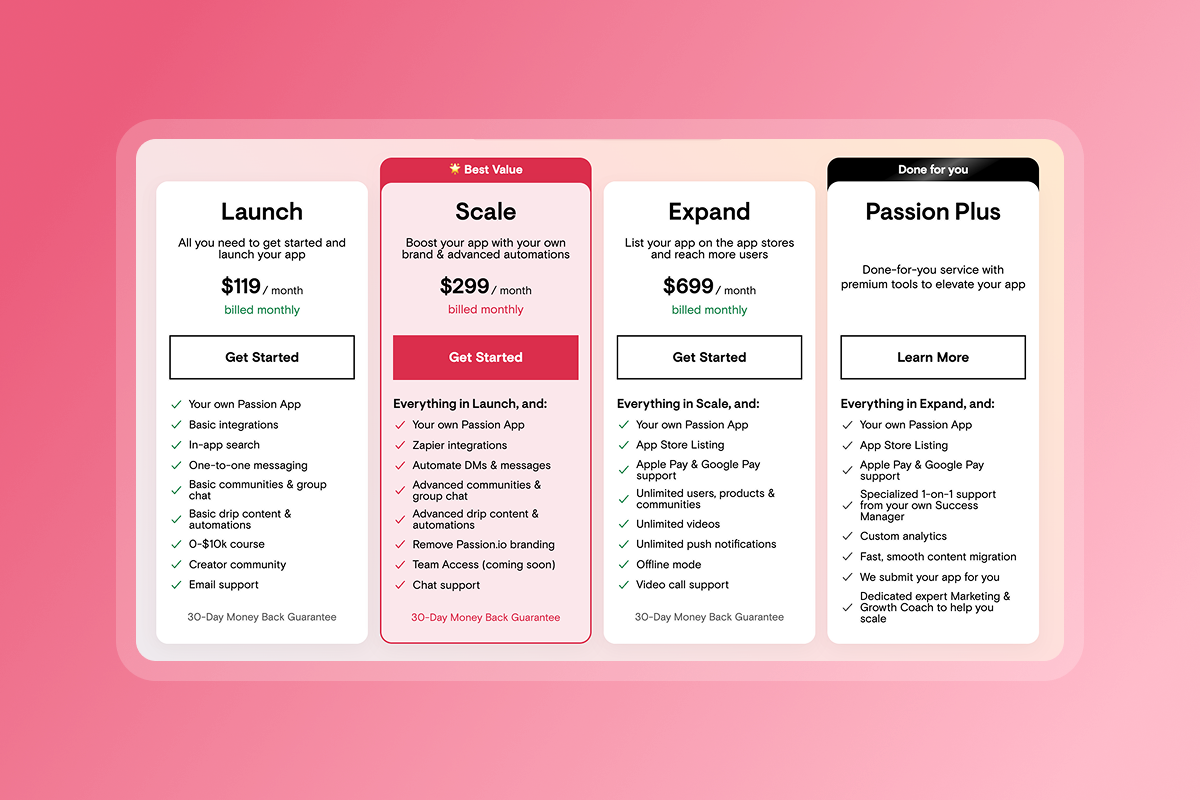
White-label platform costs. Passion.io's pricing ranges from $99/month (Launch plan, billed annually) to $599/month (Expand plan, billed annually). The PassionPlus done-for-you service runs $10,000-$20,000 for white-glove onboarding, content migration, and App Store submission. You avoid the months-long dev cycle and the ongoing retainer for a dev team.
The table below compares TCO over 24 months:
| Option | Total Cost (24 Months) | Time to Launch | Maintenance Included |
|---|---|---|---|
| Custom Agency Build | $180,000–$240,000 (build + 2-year maintenance) | 5–9 months | No (15–25% annually) |
| Passion.io PassionPlus + Expand | $24,000–$34,000 (onboarding + subscription) | Weeks | Yes (hosting, updates, support) |
For mid-level creators earning mid-five-figure MRR or more, PassionPlus eliminates the project management burden entirely. You hand over content and brand assets. Passion.io's white-glove team handles migration, design, and App Store submission while you focus on launches and growth. The investment compresses your timeline from months to weeks and preserves your most constrained resource: founder time.
"I knew for my type of work an app would be the best way to serve my people... Incredible support, constant innovation, a step by step guide so you can follow the process, and the best FB community I have ever belonged to." - Lori on Trustpilot
How to choose: Native apps vs PWAs vs Hybrid
Three platform models exist: native apps, progressive web apps (PWAs), and hybrid apps.
Native apps use platform-specific languages (Swift for iOS, Kotlin for Android) and distribute through app stores. Native apps deliver full device hardware access, reliable push notifications, and the highest performance.
PWAs are web experiences that mimic apps using HTML, CSS, and JavaScript. PWAs skip App Store approval but have limited push notification support on iOS and cannot access device features like cameras or biometric authentication.
Hybrid apps wrap web code in a native shell using frameworks like React Native. They offer moderate performance, but often feel less polished.
For coaching and education businesses, native apps win. Push notification reliability and professional polish drive retention and brand perception. Passion.io builds native iOS and Android apps while publishing a web app so users can access content on desktop when needed.
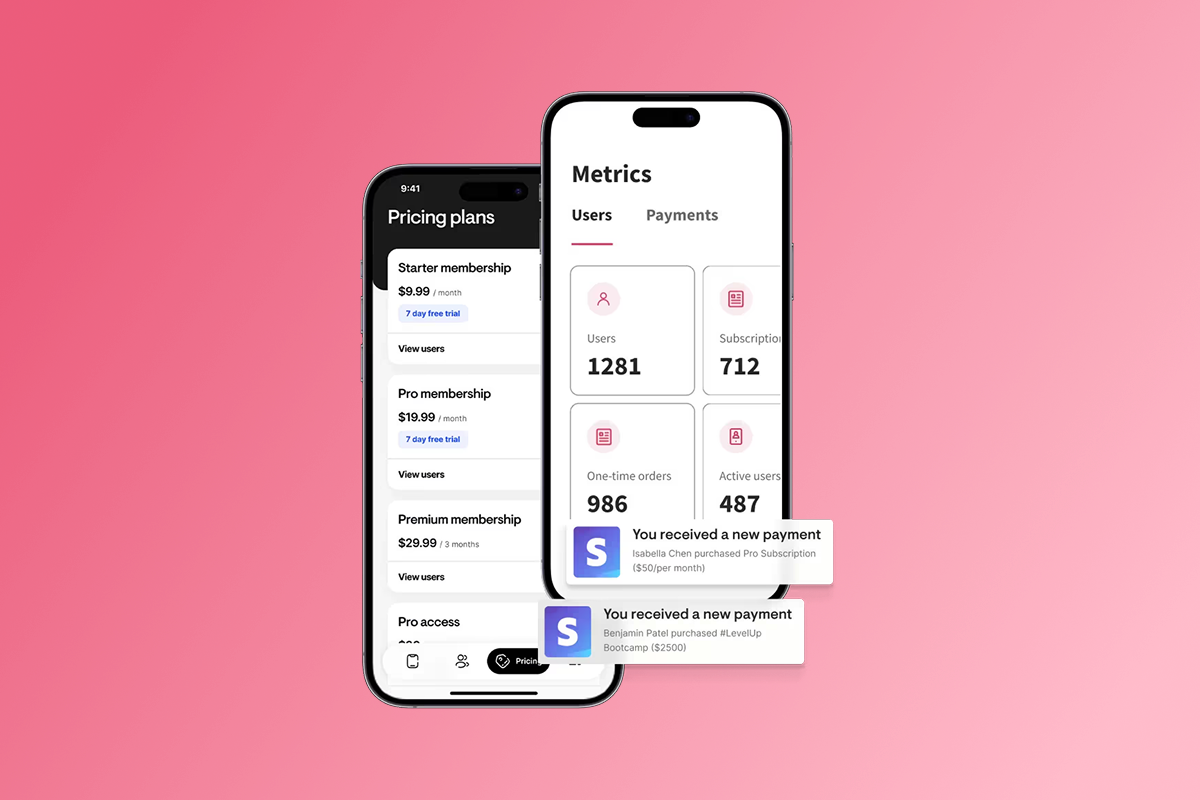
The white-glove approach: Launching without the technical headache
You have revenue, content, and an audience. You do not have time to become a project manager for app development. White-glove onboarding services eliminate the technical drag.
Passion.io's PassionPlus program includes done-for-you app build, content migration, branding setup, and App Store submission. Your dedicated success manager handles the technical workflow so you focus on curriculum and launches. The web app can go live within weeks, with App Store submissions typically processing in 4-8 weeks depending on review timelines.
The process follows a structured path. You provide your content library, brand assets (logo, colors, fonts), and pricing model. The Passion team migrates lessons, configures community channels, and sets up payment flows. You review mockups, request adjustments, and approve the final design.
"We chose the Passion Plus Lite package, and feel that every penny of it was well invested from creation to launch... Any and all app updates are handled by Connor's team, and everyone I have been in contact with has been extremely responsive and pleasant to work with." - Angie on Trustpilot
Handling app store submissions and maintenance
App Store approval trips up most creators. Apple and Google enforce strict content, metadata, and functionality guidelines. A single misstep triggers rejection and delays your launch by weeks.
Apple charges $99 per year for the Apple Developer Program. Google Play charges a one-time $25 registration fee. Both platforms take 15-30% commission on in-app purchases. You qualify for the reduced 15% rate if you earned less than $1 million in the previous calendar year.
Most creators hit at least one rejection during initial submission. Passion.io's submission blueprint and hands-on support on Expand and Plus plans reduce approval time and eliminate back-and-forth confusion. Your success manager handles the communication with Apple and Google. Help documentation walks you through compliance requirements for health, fitness, and content categories.
Maintenance is also covered. As iOS and Android release new versions, Passion.io updates the app infrastructure automatically. The SaaS model includes hosting, security patches, and compatibility updates.
"Passion does a great job with supporting their clients to succeed, even after purchasing their product... Everything else about Passion I've appreciated." - Jesse Wiens Chu on Trustpilot
Creators who made the switch
Passion.io has helped thousands of creators launch branded apps across fitness, wellness, education, and business coaching. The platform's track record includes creators achieving six-figure months and mid-five-figure MRR, often within 90-180 days of launch.
The migration pattern is consistent. Creators move from fragmented tool stacks into a unified app experience. Push notifications and in-app community features drive engagement. Completion rates improve because users access content on mobile and offline.
Fitness coaches report stronger accountability after shifting from PDF downloads and Zoom check-ins to branded apps with video lessons, progress tracking, and daily push reminders. Members show up more consistently, which reduces churn.
Business coaches and educators run challenges, cohorts, and tiered subscriptions inside one app, which consolidates the student experience. Push notifications remind users about live calls, new lessons, or community discussions, increasing participation and perceived value.
"A beautiful platform to scale real impact. Passion.io helped me turn my vision into a fully branded app that inspires equestrian women daily." - Jenna Knudsen on Trustpilot
The pattern is clear: moving from "rented land" to owned infrastructure changes retention dynamics. You control the engagement levers instead of depending on email open rates or social algorithms.
Diagnostic checklist: Is your business ready for an app?
Use this 60-second checklist to assess whether a white-label app makes sense for your current business stage. If you check yes to at least four criteria, you are ready to explore a white-label app.
Audience engagement. Do you have an engaged audience who would download and use an app? Established email lists, paid members, or active social followers indicate readiness.
Revenue scale. Are you generating consistent recurring revenue? The app investment should align with your business stage and growth goals.
Content model. Is your content recurring, habit-based, or subscription-worthy? Apps work best for ongoing programs, challenges, memberships, and communities rather than one-off courses.
Retention goals. Do you want to increase completion rates, reduce churn, and drive daily engagement? Apps deliver these outcomes through push notifications and offline access.
Operational pain. Are you managing 4+ separate tools for content, community, payments, and email? Consolidation saves admin hours and reduces support tickets.
Competitive positioning. Are leaders in your niche launching branded apps? If competitors offer app-based experiences, staying web-only risks looking outdated.
Time constraints. Do you have money but no time to manage a dev team? White-glove services like PassionPlus eliminate the project management burden.
Passion.io offers a 30-day money-back guarantee, which reduces risk during the evaluation phase.
You built a five- or six-figure coaching business. You proved your content sells. The Frankenstein stack that got you here is now the constraint preventing you from reaching seven figures. A white-label app is not a luxury upgrade. It is infrastructure that consolidates your tech stack, secures your audience data, and gives you the member retention levers that matter: push notifications, offline access, and in-app community.
Custom development costs six figures and takes months. White-label platforms like Passion.io launch your branded app in weeks for a fraction of the TCO. PassionPlus handles the build, migration, and App Store submission so you focus on content and launches.
If you are earning mid-five-figure MRR, experiencing tool sprawl, and watching completion rates stall, the diagnostic signals are clear. Own your distribution. Control your engagement. Build on infrastructure you own.
See how a branded app works for your business. Book a demo with Passion.io or watch the 5-minute platform walkthrough to see push notifications, community features, and checkout paths in action.
Frequently Asked Questions
How long does it take to launch a white-label app?
Your web app can go live within 2-3 weeks of starting. App Store submissions typically occur by week 3-4, with approvals processing in 1-3 weeks depending on review complexity and any required clarifications.
What are the platform fees for payments?
Passion.io's PassionPayments charges a 3.9% platform fee on web checkouts, plus standard Stripe processing fees. Apple and Google take 15-30% commission on in-app purchases, depending on your annual revenue.
Do I own my user data?
Yes. You own your user list, content, and subscriber data. The app runs on your branded domain and developer accounts.
Can I migrate from an existing course platform?
Yes. PassionPlus includes content migration services to move lessons, videos, PDFs, and user lists from other platforms.
What happens if Apple rejects my app?
Passion.io's submission support on Expand and Plus plans includes handling rejections. Your success manager communicates with Apple, makes required adjustments, and resubmits. Most rejections resolve within 1-2 weeks.
Can users access content without downloading the app?
Yes. Passion.io publishes both a native app and a web app. Users can access content on desktop browsers or mobile web if they prefer not to download the app.
Key Terms Glossary
White-label app: Software developed by one company that other companies rebrand and publish as their own. White-label app builders like Passion.io provide the infrastructure while you control the branding and content.
Push notifications: Clickable messages sent directly to a mobile device that appear on the lock screen. Well-implemented push campaigns achieve substantially higher engagement than email for habit-based content.
Native app: Software built using platform-specific programming languages and distributed through app stores. Native apps offer full access to device hardware and deliver the highest performance.
Progressive Web App (PWA): A web experience that mimics app-like behavior using service workers and web app manifests. PWAs do not require App Store approval but have limited device access.
In-App Purchase (IAP): Buying content or subscriptions directly through Apple or Google's billing system. IAP commissions range from 15-30% depending on your annual revenue.
Tool sprawl: Managing multiple disconnected platforms for courses, community, payments, and communication. Consolidation into a single app reduces admin overhead and improves user experience.