


7 Advanced Patreon Alternatives to Own Your Audience & Boost MRR
 By Julieta Gil
For creators seeking to move beyond Patreon's limitations, advanced alternatives like Passion.io offer a path to own your audience, diversify monetization, and build predictable recurring revenue through a branded mobile app experience. We built Passion to help you launch a real branded app (iOS, Android, web) in weeks with courses, community, push notifications, and flexible payments. Expect your web app live in 2-4 weeks and App Store submission by week 3-4. Plans start at $99/month (annual), with PassionPayments at 3.9% web fee plus Stripe, or Apple/Google IAP at 15-30%. This guide compares 7 platforms, highlighting their features, fees, and suitability for different creator needs.
Why creators seek advanced Patreon alternatives
You may have started on Patreon to receive recurring support from fans. Yet as your creator business grows, Patreon's limitations in audience ownership, mobile engagement, and diversified monetization can cap your potential.
The limitations of "rented land"
When you build on Patreon, you're building on someone else's platform. You don't own the customer relationship or the data. Algorithm changes and platform instability can threaten your income overnight.
Patreon's limited course structuring makes it harder to deliver comprehensive educational content. Creators also face restricted customization and branding options that limit your ability to establish a unique brand identity. When you rely on a single platform, you're exposed to risks you can't control.
The need for mobile-first engagement
Your audience checks apps dozens of times per day, but email open rates continue to decline. Patreon's web-first experience lacks native push notifications, offline content, and the in-app community features that drive daily engagement and course completion.
Without these mobile-first tools, your members forget to engage. Completion rates often drop below 20% and monthly churn exceeds 6%. A branded mobile app increases retention by putting your content directly in members' pockets, changing this dynamic entirely.
Understanding your needs when choosing the right alternative
Before comparing platforms, ask yourself three questions to clarify what success means for your creator business:
1. What are your monetization goals?
Do you want to sell online courses, digital downloads, coaching sessions, or tiered memberships? Some platforms excel at video courses, others at digital product sales, and a few at community-first memberships.
Building multiple income streams from courses, memberships, and products reduces platform risk and smooths revenue. If your goal is predictable recurring revenue rather than launch spikes, prioritize platforms that make subscriptions and memberships easy to set up and manage.
2. How important is audience ownership and engagement?
Audience ownership means you control the customer data, the communication channels, and the access. Look for platforms that provide your own branded app, not just a creator page on their marketplace.
Push notifications, in-app community, and offline content access are the levers that drive completion rates and community growth. Platforms that force you to rely on email or social for engagement leave you vulnerable to deliverability issues and algorithm changes.
3. What technical lift can you handle?
How much time and skill do you want to invest in setup and maintenance? No-code platforms with drag-and-drop builders, templates, and training reduce time to launch. Others require WordPress knowledge or custom dev work.
Check whether the platform handles App Store submission or whether you're on your own. Training and playbooks that teach you how to structure offers and launch can be as valuable as the software itself.
Top 7 advanced Patreon alternatives for creators
Each of these platforms offers you more control, better engagement tools, and diverse monetization options than basic Patreon subscriptions.
1. Passion: Your branded mobile app for courses, community, and payments
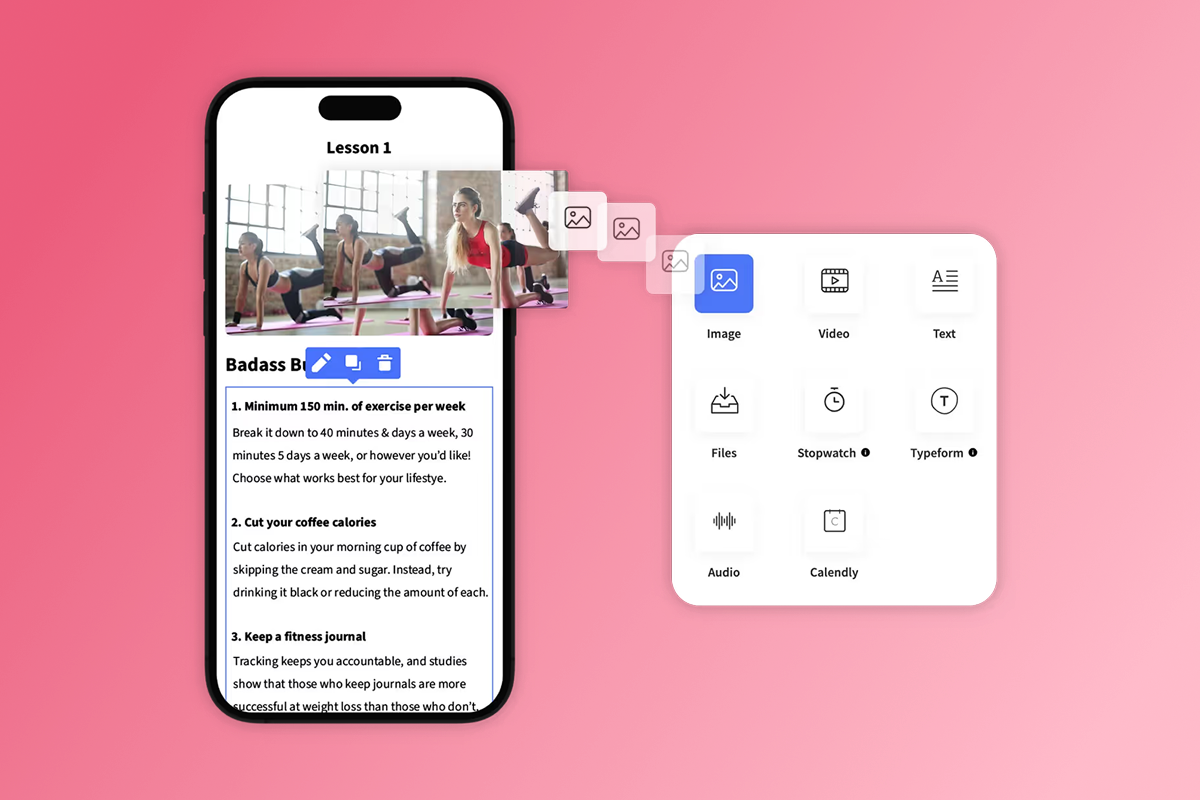
We built Passion as a no-code platform that lets you build, launch, and monetize your own branded mobile app (iOS, Android) plus web app for courses, coaching, and communities without hiring developers. You drag in videos, audios, PDFs, and text, set pricing, and publish. We handle app hosting, updates, and on certain tiers, App Store submission support.
Core features for advanced monetization:

We consolidate courses, community, and payments into one branded experience through our features platform. You create structured lessons with drip schedules, quizzes, goal tracking, and offline downloads. Our in-app community includes channels, polls, and private messaging. Push notifications let you nudge members at launch, mid-challenge, and renewal.
Choose subscriptions (weekly, monthly, annual), one-time purchases, freemium access, or bundles. PassionPayments (Stripe-powered) for web checkouts charges a 3.9% platform fee. Apple/Google in-app purchases incur 15-30% fees but offer mobile convenience. We charge 0% on external checkouts processed outside PassionPayments.
Transparent pricing and fees:

Our plans start at $99/month when billed annually for the Launch plan, $239/month for Scale, and $599/month for Expand. The Plus plan offers done-for-you build and launch at $10,000-$20,000 depending on scope.
Launch includes up to 100 videos, ~100 subscribers, and ~1,000 push notifications/month. Expand removes most quotas and includes App Store submission support. Our detailed pricing guide breaks down all plan tiers and features. PassionPayments adds 3.9% plus Stripe's standard processing on web checkouts. Apple/Google IAP fees are 15-30%. Apple Developer Program costs $99/year, Google Play $25 one-time.
Verify current trial offer at signup.
Launch timeline and support:

Expect your web app live in 2-4 weeks, with App Store submissions underway by week 3-4 depending on your plan. We provide templates, a drag-and-drop builder, and integrations with Calendly, Typeform, YouTube/Vimeo, and Zapier.
Training includes the Expert Unleashed Challenge and Passion Academy, which customers credit for helping them structure offers and sell. One creator shared in a TrustPilot review:
"Passion.io helped me turn my vision into a fully branded app that inspires equestrian women daily. It's easy to use, incredibly supportive, and built for creators who actually care about changing lives." - Jenna Knudsen
Why it wins for audience ownership:

We deliver a true branded mobile app, not a web page in someone's ecosystem. Your members install your app, not Patreon's. You control the push reach, the community, and the data. Creators using push notifications and challenges report measurable improvements in engagement and revenue.
One creator noted in a G2 review:
"What I love about Passion is that it's not just a platform to create your own app – it also provides invaluable training on how to build and sell your course. It's more than just the tech; it's the know-how." - Mathilde N.
The platform serves over 15,000 creators spanning fitness, wellness, mindset, arts, and business coaching.
2. Uscreen: Video-first monetization with branded apps
Uscreen is an all-in-one video monetization platform that helps creators launch their own branded OTT apps for iOS, Android, Roku, Apple TV, and web. Built for video-first businesses like fitness studios, entertainment channels, and educational series, Uscreen focuses on helping creators own their audience through direct distribution.
Strengths:
- Robust video hosting with unlimited bandwidth on higher tiers
- Live streaming and TV app distribution reach living room audiences
- Supports subscriptions, pay-per-view, and rental models for flexibility
- Built-in marketing tools include email campaigns, coupons, and abandoned cart recovery
- Plans start at $99/month with 0% transaction fees. Video hosting scales to 100GB+ on higher tiers.
Limitations:
- Higher starting price than course-only alternatives
- Best suited for video-heavy content rather than text-based courses or digital downloads
- Less flexible for non-video digital products
- Community features are more limited than community-first platforms
Best for: Creators who produce high-quality video content and want to reach audiences on TV platforms and mobile with a premium streaming experience.
3. Kajabi: All-in-one for courses and marketing
Kajabi is an established all-in-one platform for online courses, memberships, coaching, and digital products. It combines a website builder, course hosting, email marketing, funnels, and checkout in one ecosystem, making it popular among course creators who prioritize marketing automation.
Strengths:
- Comprehensive marketing automation with email sequences and funnel templates
- Strong website and landing page builder with professional themes
- Excellent for creators who want to consolidate marketing and sales tools
- Plans start at $149/month (Basic) up to $399/month (Pro) with no transaction fees
Limitations:
- No true native mobile app for your brand (web-responsive only)
- Web-first experience limits push notification capabilities and offline access
- Higher upfront software costs than course-only platforms
- Marketing complexity can overwhelm solo creators who just want to teach
Best for: Established creators and course sellers who prioritize marketing automation and funnel optimization over mobile-first engagement.
4. Thinkific: Course creation and community
Thinkific is a dedicated course platform that allows creators to build, market, and sell online courses from their own branded site. It also includes community and membership features, appealing to educators who want simplicity and affordability.
Strengths:
- User-friendly course builder with quizzes, assignments, and certificates
- Free plan available for beginners to test the platform
- Paid plans start at $49/month (Basic) with transaction fees, or $149/month (Pro) with 0% transaction fees
- Strong customer support praised across reviews
Limitations:
- No native mobile app (web-responsive only)
- Push notifications not available
- Limited marketing automation compared to all-in-one platforms like Kajabi
- Community features are less robust than community-first platforms
Best for: Course creators who want simplicity, a free starting tier, and don't need mobile app distribution or advanced engagement tools.
5. Ghost: Owned publishing and memberships
Ghost is an open-source publishing platform designed for newsletters, blogs, and membership sites. It emphasizes content ownership and clean, fast publishing, attracting writers who want to avoid platform lock-in.
Strengths:
- Full content ownership and portability with open-source code
- Built-in newsletter functionality for email subscribers
- Supports paid subscriptions with Stripe integration
- SEO-friendly and developer-extensible for custom features
- Managed hosting starts at $9/month for up to 500 members, or self-host for free. Stripe transaction fees apply (~2.9% + $0.30)
Limitations:
- Primarily text-focused with limited multimedia support
- No native course builder, video hosting, or mobile app
- Requires more technical setup than no-code platforms (especially for self-hosting)
- Limited community features beyond comments
Best for: Writers, bloggers, and newsletter creators who prioritize content ownership and don't need video courses or mobile apps.
6. Substack: Newsletter-first subscriptions
Substack is a newsletter platform that makes it easy for writers to publish and monetize email newsletters through paid subscriptions. Known for its simplicity and built-in discovery, Substack attracts journalists and writers who want to launch quickly.
Strengths:
- Extremely simple setup with minimal technical friction
- Built-in audience discovery through Substack's network and recommendations
- Free to start, with a 10% fee only on paid subscriptions
- Handles all payment processing automatically
Limitations:
- Limited customization and branding options
- No course creation tools or structured content delivery
- No mobile app for your brand
- 10% platform fee reduces margins at scale (higher than many alternatives)
Best for: Writers and journalists who want to quickly launch a paid newsletter without technical setup and can benefit from Substack's discovery network.
7. Ko-fi: Simple support and commissions
Ko-fi is a creator-friendly platform that allows fans to support creators through one-time "coffees" (tips), memberships, commissions, and shop purchases. Popular among artists and independent creators, Ko-fi offers a low-barrier entry to monetization.
Strengths:
- Free plan with 0% fees on tips and donations (5% on sales/memberships)
- Ko-fi Gold costs $6/month (annual) or $9/month (monthly) and removes all platform fees except payment processing
- Simple setup for digital product sales and memberships
- No payout thresholds for creator earnings
Limitations:
- Basic features compared to full course or community platforms
- No branded mobile app
- Limited course structuring and drip content capabilities
- Less suitable for complex subscription tiers or advanced monetization
Best for: Creators who want a low-cost, low-friction way to accept support and sell digital products without investing in a full platform.
Comparison tables: Patreon alternatives at a glance
Platform capabilities and monetization
| Platform | Branded App | Primary Monetization | Best For |
|---|---|---|---|
| Passion | iOS, Android, Web | Subscriptions, courses, digital products, one-time | Mobile-first engagement, audience ownership, diversified income |
| Uscreen | iOS, Android, TV, Web | Video subscriptions, rentals, PPV | Video content creators, OTT distribution |
| Kajabi | Web only | Courses, memberships, coaching, digital products | Marketing-focused course creators |
| Thinkific | Web only | Courses, memberships | Course creators wanting simplicity |
| Ghost | Web only | Newsletter subscriptions | Writers, bloggers, newsletter publishers |
| Substack | Web only | Newsletter subscriptions | Writers seeking quick newsletter launch |
| Ko-fi | Web only | Tips, memberships, shop | Low-cost support and digital sales |
Fees, features, and ease of use
| Platform | Transaction Fees | Community Features | Ease of Use |
|---|---|---|---|
| Passion | 3.9% web (PassionPayments) or 15-30% IAP | In-app community, push, challenges | No-code builder, templates, training |
| Uscreen | Varies by plan (typically low %) | Limited | Video-focused setup, moderate learning curve |
| Kajabi | Low % on payments | Basic | Comprehensive but complex for beginners |
| Thinkific | 0-10% depending on plan | Basic | Very user-friendly, quick start |
| Ghost | ~2.9% + $0.30 (Stripe) | Limited (comments) | Technical setup required |
| Substack | 10% platform fee | Comments only | Extremely simple |
| Ko-fi | 0-5% depending on plan | Limited | Very simple, minimal setup |
Your audience isn't waiting for you on Patreon. They're on their phones, checking apps, ready to engage if you give them a reason. The right Patreon alternative doesn't just collect payments, it helps you own the relationship, consolidate your tools, and build recurring revenue that doesn't depend on someone else's algorithm.
We built Passion.io to give you a real branded app with courses, community, push notifications, and payments in one place. Launch your web app in weeks, start your App Store submission, and use push notifications to drive the completion and retention that Patreon can't deliver.
Try Passion.io. Or download the 30-day app launch checklist and see the exact steps creators follow to go live.
Frequently asked questions
What are the best Patreon alternatives for artists and writers?
For artists, Ko-fi and Gumroad offer simple digital product sales with low fees and minimal setup friction. Writers benefit from Ghost or Substack for newsletter-based monetization with built-in subscriber management. For artists and writers who want to build deeper engagement through courses, community, and mobile push notifications, Passion provides a branded app experience that consolidates content, community, and sales in one place you control.
Is there a free Patreon alternative?
Ko-fi offers a free plan with 0% fees on tips and donations (5% on sales/memberships for free users, removed with Ko-fi Gold). Thinkific provides a free tier for basic course hosting with limited features. However, free plans restrict branding, advanced features, and monetization flexibility. Most advanced alternatives require paid plans to access branded apps, push notifications, robust community tools, and the training needed to launch successfully.
What is the Patreon controversy?
Patreon's 2019 fee structure change and subsequent creator frustration, plus platform policy shifts affecting adult content creators and political voices, drove many to seek alternatives. The core issue remains platform dependence and lack of audience ownership. When Patreon changes policies or fees, creators have limited recourse. Many now prioritize platforms that provide true audience ownership, direct data access, and control over communication channels that can't be restricted by a third party.
Key terms glossary
Patreon alternative: A platform that allows creators to monetize content and build community without relying on Patreon's infrastructure, offering greater control, diverse revenue streams, and audience ownership.
Membership platform: Software that enables creators to offer tiered access to content, community, and benefits in exchange for recurring subscription fees.
Creator economy: The economic ecosystem where individuals monetize their skills, knowledge, and content directly to audiences through digital platforms and tools.
Audience ownership: The ability to control customer data, communication channels, and access without intermediary platforms that can restrict reach or change terms.
Recurring revenue: Predictable income from subscriptions or memberships that renews automatically, providing stable monthly cash flow (MRR) rather than one-time launch spikes.
Branded app: A mobile or web application with your business name, logo, and design that members download and use, building brand equity and direct access.
No-code app builder: A platform that allows non-technical users to create and launch functional mobile and web applications using drag-and-drop tools and templates without writing code.
Transaction fees: Percentage-based charges on each payment processed through a platform, separate from subscription fees paid to use the software.
Community building: The process of creating engaged groups of members who interact with each other and your content, improving retention and outcomes through connection.
Monetization: The strategies and tools used to generate revenue from content, courses, coaching, digital products, subscriptions, and other creator offerings.

Build the business
behind what you know.
Turn your expertise into a branded app with courses, community, and the You AI Coach. Launch plan from $99/month.