

How Personal Trainers Can Create Their Own Fitness App (No Code Required)
Updated January 29th, 2026
Introduction
Your workout videos live on YouTube. Your clients ask questions in Instagram DMs. Your payment links scatter across Stripe and PayPal. Your community exists in a Facebook Group where the algorithm decides who sees your posts.
This is the rented land problem. You built your fitness business on platforms you don't control, and the instability shows up in low completion rates, unpredictable revenue spikes, and constant support requests. A branded mobile app consolidates content, community, and payments into one experience you own. Push notifications reach clients directly on their home screens. More than 345 million people used fitness apps in 2024, generating over 850 million downloads, because mobile-first training delivers results.
Why Fitness Creators Are Moving from Rented Land to Branded Apps
Instagram prioritizes engagement for advertisers, not completion for your clients. Facebook Groups bury your posts under algorithm changes. Mobile-responsive course sites fit phone screens but don't provide real App Store presence with native features like offline downloads and push notifications.
The Owned Audience Advantage
When you own the app, you own three critical assets:
- Direct communication: Push notifications appear on home screens, not buried in email. Push notifications average 20% open rates with 28% click-through rates, while email hovers around 20% opens.
- Customer data: You control the relationship without platform intermediaries filtering who sees your content.
- Business equity: Your app becomes a sellable asset with real value.
Gyms have weak Wi-Fi. Traveling clients need offline access. Passion.io's offline feature lets users download workout videos, PDFs, and audio files to their device, so dropped connections don't kill momentum mid-set.
Community Without the Chaos
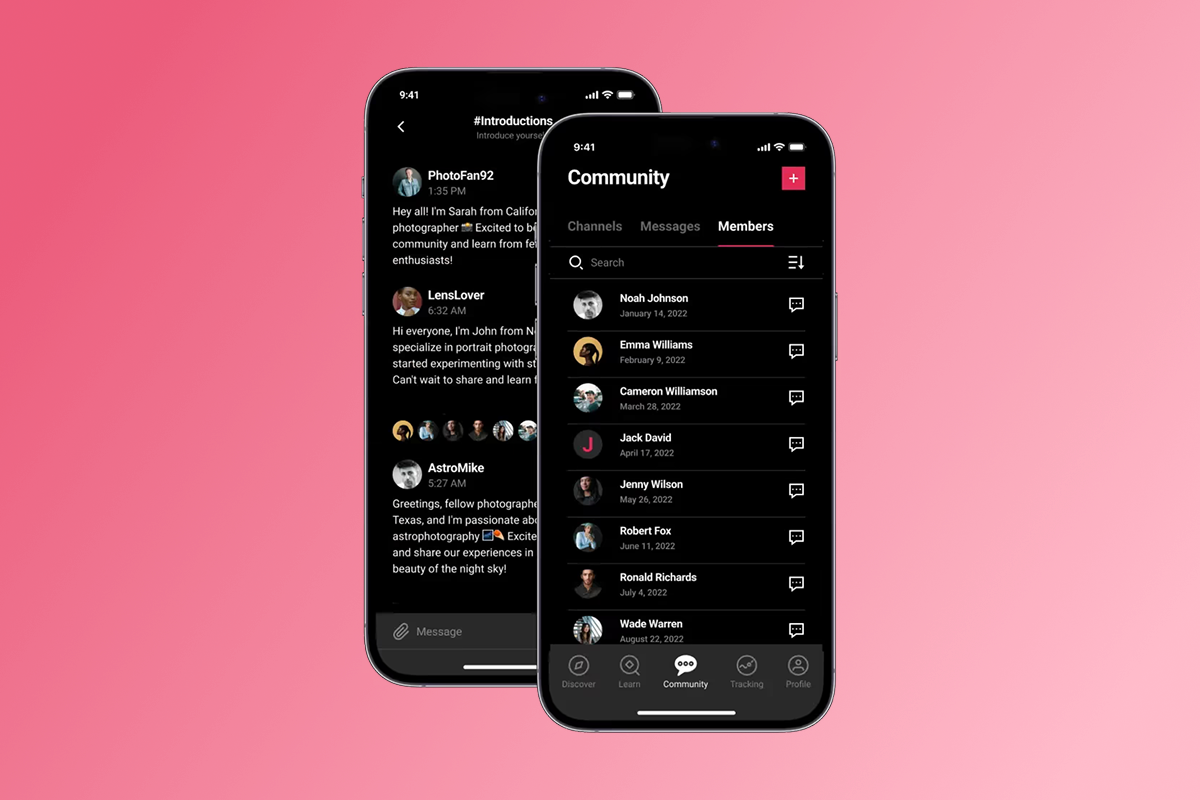
Facebook feeds mix your coaching with political posts, shopping ads, and unrelated content. Your app creates a dedicated training space. Passion.io's community features include discussion channels, direct messaging, and member profiles without social media noise.
"I have really enjoyed creating my passion app over the past year and half. I would not have been able to make my idea for an app come to life without the platform passion provides... I felt very supported." - Fit With Brit on Trustpilot
How to Build Your Fitness App in 5 Steps (No Code Required)
No-code means you build by clicking, dragging, and uploading rather than writing Swift or Kotlin. Passion.io's builder handles cloud hosting, mobile frameworks, and payment processing while you focus on content and branding. Most fitness creators publish their web app within two weeks, according to Passion.io's launch data.
Step 1: Choose Your Fitness Template
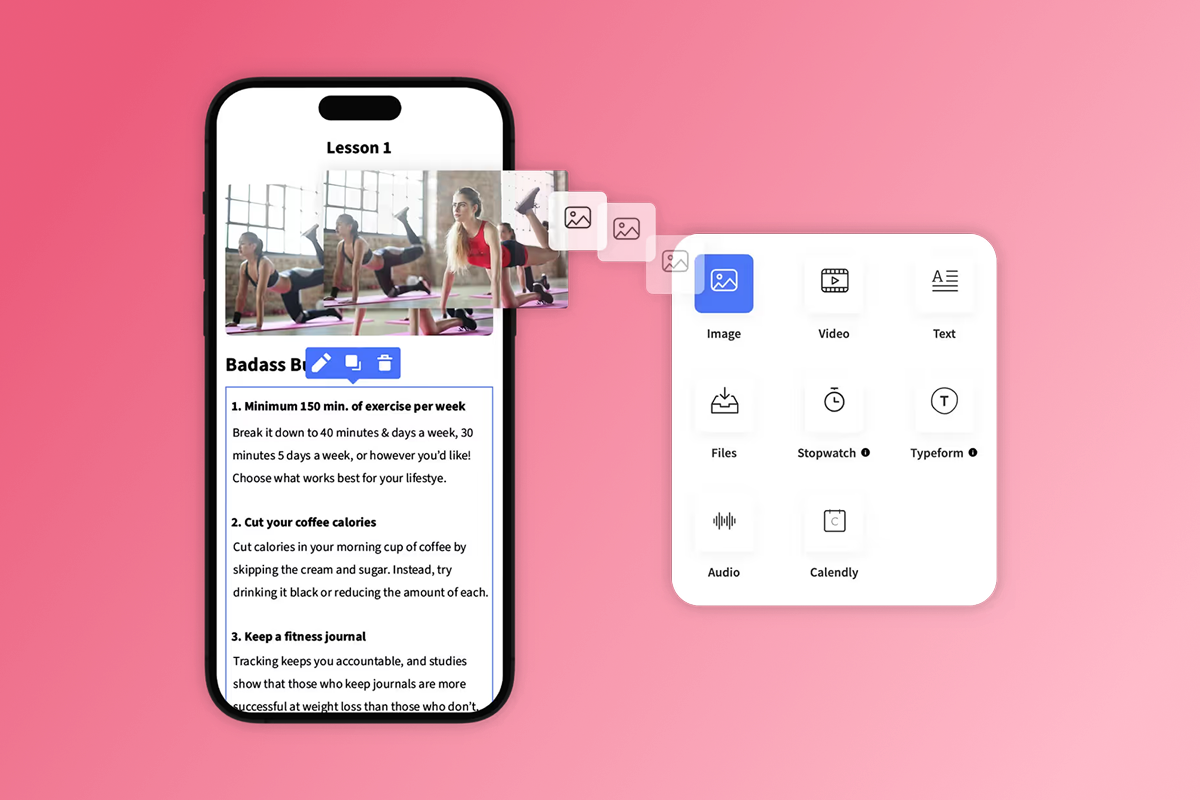
Passion.io offers templates designed for fitness training, yoga instruction, and wellness coaching. Templates come pre-configured with lesson structures, navigation menus, and community channels. You can start from scratch, but templates cut setup time by giving you a working app on day one. The health and fitness use case page shows workout tracking layouts, challenge frameworks, and progress dashboards.
Step 2: Upload Your Workout Content
Migrate videos, PDFs, audio files, and images into the platform. Passion.io's course builder accepts content from Vimeo, YouTube, or direct uploads. You organize material into lessons and modules, then add interactive elements:
- Quizzes to test form knowledge
- Timers for interval training
- Goal tracking features for reps, weights, or meditation minutes
- Drip scheduling to release content by week
Watch Passion.io's platform demo for a complete walkthrough of the drag-and-drop interface.
Step 3: Structure Your Fitness Offering
Choose your business model based on your content and audience:
- Course: One-time access to a complete library (example: $197 for "12-Week Strength Builder")
- Challenge: Time-bound cohort with start and end dates (example: $97 for "30-Day Core Challenge")
- Membership: Ongoing access with recurring billing (example: $29/month for "Daily Workout Library")
Passion.io's payment features support all three models plus hybrid pricing. Tiffany Wilkerson, a fitness creator on Passion.io, structured her app with monthly plans at $80/month and 6-week challenges priced between $400-$800, generating over $60,000 in revenue with more than 50 subscribers after moving from Trainerize.
Step 4: Brand Your Fitness Experience
Upload your logo, choose brand colors, and customize fonts to match your existing brand. Passion.io removes their branding from your app interface on paid plans. Add your app icon (the square image on phone home screens), write your app store description, and prepare screenshots showing workouts and community features. The App Store Optimization guide walks through keyword research, title optimization, and visual best practices.
Step 5: Follow the 30-Day Launch Timeline
Week 1:
- Open your Apple Developer account ($99/year) and Google Play Console($25 one-time)
- Upload branding assets and pick your template
- Create navigation structure and community channels
- Set up first course or challenge content
Week 2:
- Finish uploading lessons and configure pricing plans
- Launch your web app (live at yourappname.passion.io)
- Test purchase flow and member experience
- Configure payment settings for web checkout or in-app purchases
Week 3:
- Submit app metadata to Apple and Google
- Expand and Plus plans include submission support for technical requirements
- According to Apple's data, up to 90% of submissions receive review within 24 hours
Week 4:
- Plan marketing launch while apps are in review
- Create promotional content and schedule announcements
- Prepare email sequences for launch
"Passion.io have been so supportive in helping me develop my App, the training, customer support (especially Hope) have been second to none! I highly recommend them if you are thinking of developing an App. They guide you through the process every step of the way." - Karen on Trustpilot
Monetization Models: Choosing Between Web Checkout and In-App Purchases
Your payment pathway directly impacts profit margins. Web checkout (buying through your website) and in-app purchases (buying inside the iOS/Android app) charge different fees and offer different user experiences. Most fitness creators use both, routing annual plans through web checkout while offering monthly subscriptions via in-app purchases.
The Web Checkout Path (PassionPayments)
PassionPayments is Passion.io's Stripe-powered payment system for web purchases. The platform fee is 3.9% plus Stripe's standard processing (approximately 2.9% + $0.30 per transaction). On a $29 monthly subscription sold through your web app, you pay roughly $2.10 in fees and keep $26.90.
Advantages:
- Higher margins on every sale
- Full control over pricing changes and discount codes
- Trial periods without platform restrictions
- 0% Passion.io fee if you use external checkout outside PassionPayments
Tradeoffs:
- Users must create accounts and enter payment details
- Adds 30-60 seconds of friction compared to one-tap purchases
- Can reduce conversion rates by 10-15%
Best use cases: Annual plans ($249/year saves 30% vs monthly), high-ticket programs ($497 for 12-week transformation), bundles, maximum margin scenarios.
The In-App Purchase Path (IAP)
Apple and Google charge commissions on purchases made inside apps. Under the App Store Small Business Program, creators earning less than $1 million per year pay 15% instead of 30%. Google Play's reduced service fee charges 15% on the first $1 million annually, then 30% beyond that threshold.
On a $29 monthly subscription sold via in-app purchase, Apple or Google retains $4.35 (15%) or $8.70 (30%), leaving you with $24.65 or $20.30. Passion.io charges 0% additional platform fee on in-app purchases.
Advantages:
- One-tap purchase using stored credentials
- Users trust Apple/Google billing
- Converts 10-15% better for impulse purchases
Tradeoffs:
- Lower margins per sale
- Platform restrictions on discounts and trials
- Delayed payouts (30-60 days)
Best use cases: Monthly subscriptions under $50, workout packs ($9.99 for "30 Days of HIIT"), convenience-focused mobile users.
Hybrid Monetization in Action
Savannah Rae Bohlin built The Portal App using Passion.io with a hybrid strategy. She charges $22.22/month for access to holistic health content, personalized workouts, and meal plans. With over 250 subscribers, the app generates approximately $66,000 annually. By offering both web checkout and in-app purchases, she captures margin-conscious web signups alongside mobile-first users who prefer one-tap convenience.
Engagement Strategy: Using Push Notifications to Boost Completion
Low completion rates kill fitness businesses. When clients don't finish programs, they don't get results. That means no testimonials, no referrals, and high churn. Email reminders compete with 100+ other inbox messages. Push notifications appear on lock screens and home screens, creating direct client contact that doesn't depend on email management.
The Smart Nudge Framework
Build your notification calendar around four strategic types:
- Morning mindset (7:00 AM): "Your 5-minute breathwork starts now." Attach to a short lesson for low-friction entry.
- Workout reminder (5:00 PM): "Leg day waits for no one. Your 30-minute lower body blast is ready." Time for peak usage hours based on your analytics.
- Community wins (Friday 12:00 PM): "Sarah just crushed her 50th workout. Celebrate with her in the community." Social proof drives continued engagement.
- Weekly check-in (Sunday 6:00 PM): "You completed 4 workouts this week. That's 80% of your goal." Progress tracking creates accountability.
Research shows that 60% of app users say push notifications make them use apps more frequently, but timing and relevance determine whether users engage or disable notifications. Passion.io's course features include analytics showing which lessons have highest drop-off rates, when users log in, and how many days pass between sessions.
The 90-Day Completion Target
Fitness creators using push notifications with in-app community features and structured challenges report 15-30% higher completion rates within 90 days in Passion.io case studies. If your current program has a 40% completion rate (40 out of 100 clients finish), a 20% improvement brings you to 48 completions. Those eight additional success stories translate directly to testimonials, referrals, and higher renewal rates.
App Store Submission: A Realistic Timeline for iOS and Android
Apple and Google require separate developer accounts and follow different review processes. Plan for your web app to go live in two weeks, with app store submissions starting by week three. According to Apple, up to 90% of submissions receive their first review within 24 hours, though complex apps or those requiring clarification may take longer.
Developer Account Requirements
Apple Developer Program: You pay $99 per year and need a valid Apple ID, business information (or personal details for individual accounts), and a payment method. Create your account in Week 1 because Apple occasionally requires additional verification steps that add 2-3 days.
Google Play Console: You pay a $25 one-time registration fee with no recurring annual cost. Account approval typically completes within several hours to a few days. If you're building a fitness app, you must comply with Google's Health and Fitness Apps Declaration, which requires accurate descriptions of health-related features and data handling.
The Submission Process
Passion.io handles technical app building and submission. On the Expand and Plus plans, the platform includes hands-on submission support where the team walks you through metadata requirements, screenshots, and compliance questions. On the Launch and Scale plans, you follow step-by-step guides in the help center and submit independently using your own developer accounts.
You provide app metadata (title, description, keywords, category), screenshots (typically 3-5 images showing key features), app icon, and privacy policy. Passion.io's ASO guide recommends using 5 free ASO tools to identify high-traffic keywords like "home workout app," "yoga training," or "fitness challenge."
Common Rejection Risks and Fixes
Apple rejected approximately 1.93 million out of 7.77 million submissions in 2024, meaning roughly one in four apps faces initial rejection. The most common issues are fixable within 1-3 days:
- Incomplete metadata: Apps get rejected when descriptions don't match functionality, titles include promotional language like "Best Fitness App," or screenshots show placeholder content. Fix: Use real workout content in screenshots and write clear, factual descriptions.
- Missing privacy policy: Both Apple and Google require a working privacy policy link accessible within the app and in the app store listing. Fix: Use a standard privacy policy template customized for your app.
- Performance issues: Apps that crash during review or show broken features get rejected immediately. Fix: Test thoroughly on actual iOS and Android devices. Have three beta users try every core function.
If Apple or Google request changes, you receive specific feedback through the developer console. Make the requested edits, resubmit, and plan for a 1-2 day re-review.
Total Cost of Ownership: Budgeting for Your App Launch
Custom app development typically starts at $30,000 and requires 4-6 months. Passion.io's no-code approach costs a fraction while delivering native iOS, Android, and web apps in weeks.
Total first-year cost for Launch plan:
- Passion.io: $99/month × 12 = $1,188
- Apple Developer: $99
- Google Play: $25
- Total: $1,312 (before transaction fees)
Return on Investment Timeline
According to Passion.io's pricing analysis, at $5,000/month revenue with Launch plan (annual), the breakdown is $99 (subscription) + $195 (PassionPayments 3.9%) + $220 (Stripe) = $514/month in fees, leaving $4,486 net revenue.
The SmartWorkout Pro case study shows real-world results. The fitness eCommerce brand generated €163,000+ annually from a €5 app subscription, with 72% of new Shopify orders adding the app to their purchase. The mobile app became the primary retention and upsell vehicle.
Frequently Asked Questions About Fitness App Builders
Do I need to know how to code to build a fitness app on Passion.io?
No, the platform uses drag-and-drop tools designed for non-technical creators.
Can I migrate my existing clients from another platform?
Yes, Passion.io supports bulk user imports and email invitation systems.
What happens to my app if I cancel my Passion.io subscription?
You own your content files but the app goes offline when you cancel.
How long does Apple App Store approval typically take?
Most approvals complete within 24-48 hours, though review times vary.
Can I offer free trials with in-app purchases?
Yes, but Apple and Google have specific rules about trial periods and auto-renewal disclosures.
Key Terminology for Fitness App Creators
Native app: A mobile application built specifically for iOS or Android platforms, installed directly from the App Store or Google Play, with access to device hardware features like push notifications, offline storage, and camera integration.
Progressive web app (PWA): A web-based application that runs in a browser but can be installed on a device's home screen, offering some app-like features without full native device access or App Store distribution.
In-app purchase (IAP): A transaction processed through Apple's or Google's payment system within a mobile app, subject to platform commission fees ranging from 15-30%.
Churn rate: The percentage of subscribers who cancel their subscriptions within a given time period, typically calculated monthly or annually.
Push notification: A message sent from an app to a user's device that appears on the lock screen or notification center, even when the app is not actively open.
Your fitness content already exists. The workouts are filmed, the meal plans are written, and your clients trust your expertise. What you need is the container that turns content into completion and completion into recurring revenue.
Building a branded app used to require a development team and six months of technical debt. Now it takes weeks, $99/month, and the willingness to own your audience instead of renting space on someone else's platform. Passion.io's fitness and wellness page shows dozens of creators who made this move, consolidated their tools, and built sustainable coaching businesses on mobile-first experiences.
Start building your branded fitness app today with Passion.io. Your web app launches in two weeks. Your first 50 members can join by week four. You stop managing Instagram DMs starting today.

Build the business
behind what you know.
Turn your expertise into a branded app with courses, community, and the You AI Coach. Launch plan from $99/month.