

White Label App Case Studies: Creator Revenue Results
Updated February 12, 2026
TL;DR: Creators generating mid-five to six-figure MRR are moving from fragmented tool stacks to white-label mobile apps to own their audience and reduce churn. We've documented 15-30% completion rate improvements and churn drops from 12% to 5-7% across fitness, coaching, and education verticals. Our white-glove service launches branded iOS, Android, and web apps in 4-8 weeks for $10k-$20k setup plus ongoing SaaS fees, 80% less than custom development's average $171,450 cost. This article examines five creators who migrated to branded apps and grew recurring revenue by owning their distribution channel.
Why Established Creators Move From "Rented Land" to Branded Apps
If you're running a six-figure creator business, you already know the fragmentation problem. You're managing Instagram DMs for customer service, hosting your community in a Facebook Group you don't control, running Zoom calls for live sessions, using Kajabi or Teachable for course hosting, and stitching together Stripe links for payments. Each tool adds another login, another support ticket, and another point of failure.
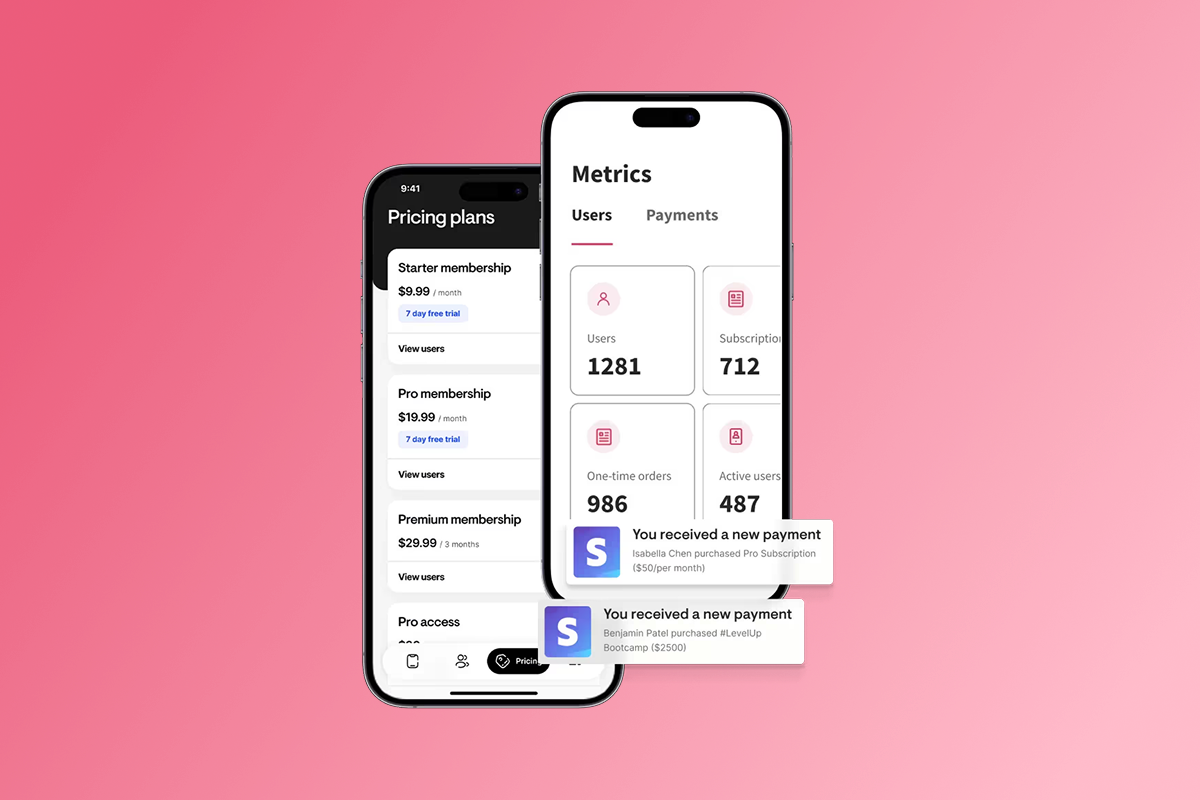
A white-label mobile app flips this model. You get iOS, Android, and web apps under your brand name, with our infrastructure handling hosting and maintenance while you own customer relationships and data. Your logo sits in the app store. Your brand colors fill the interface. Push notifications go out under your name, not a third-party platform's.
White-label means we provide the infrastructure and technology, but your end users see only your brand. No "Powered by" badges in critical touchpoints. No competing for attention in someone else's news feed. You control the message, the timing, and the data.
For creators at the Enterprise level, this shift solves three core problems. First, it consolidates your tech stack from 5-7 tools down to one hub. Second, it gives you push notification access, which mobile apps achieve significantly higher engagement rates than email. Third, it builds a tangible asset you own, complete with exportable user data and direct communication channels.
"Passion.io is legit. They are professional, helpful, and incredible. I could NOT have launched my app without their help. Even with their platform, and their incredible guides of step by step to do, I still needed hand-holding in the process." - Kirsten Larsen on Trustpilot
5 Creators Who Scaled Revenue and Retention With a White-Label App
Fitness: How Nicki Bianco Reduced Churn and Scaled to $300k Monthly With Push Notifications
The challenge: Nicki Bianco ran Slice Squad, a fitness program with strong content but weak re-engagement. Members would sign up during launches, complete a few workouts, then drift away. Her email reminders landed in spam or got ignored. Education and fitness subscriptions typically see monthly churn rates between 8-12%.
The solution: Bianco migrated to a branded mobile app with daily push notifications tied to workout schedules. She built in challenge structures, streak tracking, and community channels where members could post progress photos. The offline download feature meant users could work out without internet access, removing a common friction point.
The result: Slice Squad grew into a $300,000+ monthly business, with one single month generating $130,000 in revenue. The app's push notification system kept users engaged between live launch periods. By moving from email-only communication to in-app nudges, Bianco cut her churn rate and extended customer lifetime value. Members now open the app daily to check challenges and community updates, driving the completion rate improvements that push-enabled apps consistently achieve.
Arts/Skills: How Adam Frater Built a 7-Figure Calisthenics Business by Consolidating Tools
The challenge: Adam Frater had built a half-million-follower audience on Instagram teaching calisthenics. He was running a patchwork system: YouTube for free content, Gumroad for paid downloads, a private Facebook Group for community, and Google Sheets to track student progress. Every new student required manual onboarding across multiple platforms. Support requests came through DMs, emails, and Facebook messages. The operational overhead was choking growth.
The solution: Frater launched Calxthenics, a white-label app consolidating his entire business. Paid courses, community forums, progress tracking, and push-driven engagement all moved into one branded experience. He used drip content scheduling to release progressive training programs, and built in form-check features where students could upload videos for feedback.
The result: Frater's business crossed seven figures in digital product revenue. More important than the top-line number, his admin hours dropped dramatically. Student onboarding became a single step (download the app, log in, access your program). Support consolidated into in-app messaging. The community migrated from Facebook to his owned platform, eliminating algorithm dependency.
Frater's case demonstrates the value of consolidation at scale. When you're managing thousands of students, having one dashboard for users, content, payments, and analytics isn't a convenience factor, it's the difference between spending 20 hours per week on admin or spending 5.
Business Coaching: How Spartan RAM Transitioned From Facebook Groups to Owned Community Revenue
The challenge: Many high-ticket business coaches build community as a core value proposition. The default path is a private Facebook Group, which works until it doesn't. You can't control the feed algorithm. You can't send targeted messages to subgroups. Facebook owns the member data. If your group gets flagged or your account suspended, you lose access to your paying customers.
The solution: Spartan RAM, a fitness creator operating in the business coaching model, moved to a subscription-based app with tiered access. The app offered monthly subscriptions ranging from $97 to $297, each unlocking different levels of content and community access. Push notifications announced new training modules, weekly challenges, and exclusive Q&A sessions. The in-app community channels replaced the Facebook Group entirely.
The result: With 180 active subscribers, Spartan RAM generates over $200,000 annually. The per-user revenue is higher than typical course models because the app positions membership as a premium experience. The app's design, push cadence, and community moderation all reinforce that positioning.
The economics matter here. If you're running a Facebook Group as your community platform, you're paying $0 in platform fees but accepting 100% platform risk. If you move to a white-label app, you pay SaaS subscription fees plus payment processing. For Spartan RAM's $200k annual revenue, the tradeoff is clear: paying 5-7% in total platform and processing costs to own the channel beats paying 0% to rent someone else's algorithm.
Wellness: How Savannah Bohlin Increased Member LTV Through In-App Challenges and Streaks
The challenge: Wellness and mindfulness creators face a specific retention problem. Initial motivation is high, but daily habits are hard to build. Students sign up excited, meditate for three days, then fall off. Without built-in accountability mechanisms, completion rates tank and churn spikes.
The solution: Savannah Bohlin built her holistic health and fitness app around challenge structures and streak tracking. Each program includes a 30-day challenge with daily check-ins. Users earn badges for consecutive days, and the app sends push reminders each morning at their chosen time. Community channels let users share progress and encourage each other. Offline access means a missed internet connection doesn't break the streak.
The result: Bohlin's app serves hundreds of monthly active users generating tens of thousands of dollars. The key metric isn't the top-line revenue but the retention curve. Research shows that sending even a single onboarding push within the first week can boost retention by 71% over two months. Bohlin's daily push system keeps that retention engine running.
The LTV calculation matters. If a typical wellness subscriber stays for 3 months at $20 monthly, their lifetime value is $60. If push notifications and challenges extend that to 6 months, LTV doubles to $120. Multiply that across 250 users, and the retention improvement adds $15,000 in annual revenue from the same acquisition spend.
Education: How Fit In Twenty Scaled Course Sales Using Freemium App Funnels
The challenge: Paid course creators face high upfront friction. Cold audiences won't pay $297 for a course from someone they just discovered. The traditional funnel uses lead magnets and email sequences, but email engagement rates vary widely across industries, meaning a significant portion of your funnel never engages.
The solution: The creator behind Fit In Twenty built a freemium mobile app offering 7 free workouts with premium programs locked behind a subscription. New users download the app, try the free content, and receive push notifications highlighting premium features. The app showcases testimonials, before/after photos from the community, and previews of locked programs. Upgrading happens in-app via subscription tiers (weekly, monthly, annual).
The result: Fit In Twenty generates $37,500 monthly, combining one-time course sales with recurring subscriptions. The freemium model allows users to experience the full app interface before committing. Push notifications drive repeat engagement, keeping the app top-of-mind during the consideration period.
The Economics of Ownership: TCO and ROI Analysis
The objection I hear most often from established creators is cost anxiety. You're already paying for Kajabi, Zoom, ConvertKit, and a dozen other tools. Why add another platform fee?
The answer is that a white-label app isn't additive, it's consolidating. You're replacing 5-7 tools with one. Let me break down the numbers.
Custom development path: If you hire an agency to build a native iOS and Android app, mobile app development costs average $171,450. Medium-complexity apps with course hosting, community, and payments cost $50,000-$120,000, while complex applications with advanced features run $100,000-$300,000. Most funded teams building a production-ready app land in the $80,000-$250,000 range.
Then comes maintenance. App maintenance costs 15-20% of the original development cost annually. If you spent $100,000 building your app, budget $15,000-$20,000 per year for updates, bug fixes, security patches, and feature additions. That's $115,000-$120,000 total cost of ownership in year one.
White-label platform path: Our PassionPlus service offers white-glove setup for a custom scope fee (typically $10,000-$20,000 based on complexity) plus ongoing SaaS subscription. The standard Expand plan runs $599 monthly billed annually, totaling $7,188 per year. Add the Plus setup fee, and year-one TCO is roughly $17,000-$27,000.
That's an 80-85% cost reduction versus custom development. Year two and beyond, you're paying only the SaaS fee with no maintenance invoices from dev agencies. We handle hosting, updates, security, and infrastructure.
| Option | Upfront Cost | Annual Cost (Yr 2+) | Time to Launch | Maintenance Responsibility |
|---|---|---|---|---|
| Custom Development Agency | $80,000–$250,000 | $15,000–$20,000 | 6–12 months | You (hire devs or agency retainer) |
| White-Label Platform (PassionPlus) | $10,000–$20,000 | $7,188 (Expand annual) | 4–8 weeks | Platform provider |
Payment processing economics: You also need to factor transaction fees. Our PassionPayments system charges a 3.9% platform fee for web checkouts, plus Stripe's standard 2.9% + $0.30, totaling roughly 6.8% + $0.30 per sale. Apple and Google charge 15-30% for in-app purchases, depending on your revenue and program tier.
Choose web checkout via PassionPayments for high-value purchases where margin matters, such as annual subscriptions, course bundles. Reserve in-app purchases for mobile acquisition and convenience upsells where the user is already inside the app and the 15-30% fee is worth the conversion lift.
ROI calculation: If you're generating $50,000 monthly revenue, and a white-label app increases retention, that's additional monthly revenue or a significant increase annually.
Developer account fees add $99 annually for Apple and $25 one-time for Google Play, negligible in the TCO calculation.
How the "White-Glove" Launch Process Works
The operational question isn't whether a white-label app makes financial sense, but whether you have the time and expertise to build it. This is where PassionPlus differentiates from DIY platforms.
Here's the step-by-step process based on documented implementations:
1. Strategy and content audit (Week 1): You meet with a dedicated success manager who audits your existing content, pricing structure, and customer journey. They map out which courses, community forums, and features move into the app. You discuss monetization strategy (subscription tiers, freemium access, challenge structures).
2. Migration and setup (Weeks 2-3): We migrate your content from your current platforms. Videos, PDFs, lesson structures, and user lists move into the app builder. You provide branding assets (logo, colors, fonts), and our team builds the interface. Interactive lessons, drip schedules, and offline downloads are configured based on your content strategy.
3. Developer account setup (Week 2): While content migration happens, you register Apple and Google developer accounts. Apple charges $99 annually. Google Play is $25 one-time. We guide you through the registration process to avoid common mistakes that trigger rejections.
4. App store submission (Weeks 3-4): Once the app build is complete, we handle the submission process to Apple and Google. This includes preparing screenshots, writing store descriptions, selecting categories, and handling metadata requirements. Apple reviews typically take 24-48 hours for most apps in 2025-2026. Google can be faster but sometimes requires additional compliance documentation.
5. Launch strategy and onboarding (Week 4-5): Before the app goes live in stores, we help you build a launch campaign including audience migration via bulk user import tools and push notification schedules to drive early engagement.There's a 30-day money back guarantee, as well.
Post-launch: Your success manager remains available for ongoing optimization, feature requests, and troubleshooting. Platform updates, security patches, and infrastructure maintenance happen automatically without requiring your involvement. The Creator MBA training program offers additional resources on monetization strategy, and access to the PassionFighters community gives you a peer network of other creators solving similar problems.
"I knew for my type of work an app would be the best way to serve my people. I was researching a little and kept coming back to Passion.io. I decided to take the leap and give it a try. I am thrilled with everything so far." - Lori on Trustpilot
Security, Data Ownership, and Platform Reliability
For enterprise creators managing six-figure revenue, security and data ownership aren't optional concerns. Three questions matter most.
Who owns the customer data? You own it. We let you export your subscriber list at any time through the Users section. The export includes names, emails, join dates, and subscription plans in CSV format. You can download this data daily if you want. There's no lock-in period or export fee.
What security measures are in place? We employ technical and organizational measures including two-step verification, password security, and physical security controls. Our servers run on major cloud providers (AWS, Google Cloud, or Azure) to guarantee infrastructure-level security. All URLs and APIs use SSL encryption. Payments happen through app store infrastructure (Apple/Google) or Stripe, not on our servers, reducing PCI compliance burden.
What happens if the platform shuts down? You retain your exported customer data and can migrate to another platform. Your content (videos, PDFs, course materials) should always exist in backup storage outside the platform. The app is white-labeled to your brand, so your customers see your business name, not ours. If you need to migrate, you have your customer list, your content, and your brand equity intact.
Platform reliability matters. We ranked No. 1,563 on the 2022 Inc. 5000 with 409% three-year revenue growth. Our CEO confirmed in September 2025 that we're a profitable eight-figure business, indicating financial stability.
Ready to move from platform risk to audience ownership? Book a demo to see how our white-glove team can build your branded app in 4-8 weeks, or explore the Creator MBA training to learn monetization strategies before you launch. Or, if you didn't find what you're looking for, there's a 30-day money-back guarantee.
Frequently Asked Questions About White-Label Apps
How long does it take to launch a white-label app? Most creators using PassionPlus have fully published iOS, Android, and web apps within weeks of signup. DIY builders on Launch or Scale plans can publish web apps in 2-3 weeks and submit to app stores on their own timeline. The variable is app store review, which Apple and Google control.
Can I migrate my existing students and content? Yes. We provide bulk user import tools via CSV upload. Export your user list from your current platform (Kajabi, Teachable, etc.) and import it into your app. Content migration works by uploading videos, PDFs, and lesson structures through our course builder interface.
What happens if I want to leave the platform? You own your customer data and can export it at any time. Your content remains yours. You would need to find a new hosting solution for your app or migrate users back to a web-based platform. There's no contractual lock-in beyond your subscription term.
Do I need technical skills to manage the app? You don't need technical skills. Our builder interface uses drag-and-drop functionality. Adding lessons, setting pricing, scheduling push notifications, and managing users happen through a dashboard. PassionPlus includes a success manager who handles technical setup, but ongoing management requires no coding knowledge.
What support is available after launch? All plans include access to the Passion.io Help Center. Scale and Expand plans offer priority support. PassionPlus includes a dedicated success manager and coaching depending on scope. The PassionFighters community provides peer support from other creators.
Key Terminology for App Builders
Native app: A mobile application built specifically for iOS or Android using platform-specific code, offering the best performance, offline functionality, and push notification access. White-label platforms generate native apps without requiring you to write code.
Progressive Web App (PWA): A website that behaves like an app when accessed on mobile browsers. PWAs are cheaper to build but have limited native features and can't be listed in the Apple App Store as standalone apps.
Push notifications: Messages sent directly to a user's device home screen, even when the app isn't open. Push notifications drive significantly higher engagement than email for mobile-first audiences.
In-App Purchase (IAP): A transaction completed inside a mobile app using Apple or Google's payment systems. IAP transactions incur 15-30% platform fees (15% if you qualify for Apple's Small Business Program) but offer convenience for users already inside the app.
Developer account: The registration required to publish apps in the Apple App Store or Google Play Store. Apple charges $99 annually. Google Play charges $25 one-time. Both require business documentation and review.
White-label: A product built by one company but branded and sold by another. In the app context, we provide the technology infrastructure, but your end users see your brand, logo, and company name throughout the experience.