

Should Creators Build Their Own App or Stay on Social Media?
Updated January 29th, 2026
Social algorithms now restrict organic reach to single-digit percentages of followers, making revenue unpredictable. The solution is a branded mobile app where you own the audience, the data, and the monetization. Using no-code platforms like Passion.io, you can launch on web and mobile in 4–8 weeks. Creators who add push notifications and in-app communities report 15–30% higher completion rates and more stable monthly recurring revenue.
If you have 50,000 Instagram followers but your posts reach only a fraction of them, you don't have a business. You have a gamble. Every algorithm tweak, policy shift, or platform mood swing can cut your income in half overnight.
I've watched creators with six-figure followings lose their primary revenue stream because they built everything on rented land. The most successful creators are moving their audiences off social media and into branded apps they control. This guide explains how to build an influencer monetization app without writing code so you can turn followers into predictable recurring revenue.
Why relying on social algorithms kills creator revenue
According to Social Insider's 2025 Instagram benchmarks, engagement fell 28% year-over-year, with the average engagement rate now sitting at just 0.45%. Swydo's analysis of Instagram organic metrics shows that even healthy accounts struggle with reach in the low single digits of total follower count.
The "link in bio" strategy compounds this problem. Even when followers see your post, asking them to tap your profile, find the link, and leave Instagram creates massive drop-off. Research from Campaign US highlights that the "link in bio" creates significant friction in the conversion funnel.
This is the rented land trap. Social platforms own the distribution channel. They decide who sees your content, when they see it, and whether your call-to-action reaches anyone at all. You can spend years building an audience only to wake up one day with half your reach gone.
Meanwhile, you're stitching together Zoom for live sessions, Stripe links for payments, Facebook Groups for community, and email for follow-up. Tool sprawl creates disjointed experiences that hurt completion rates and renewals. Members forget where to log in, miss notifications, and churn faster than you can replace them.
The alternative is owning the customer relationship directly through a branded mobile app on their home screen, where you control the reach, the data, and the monetization without platform fees or algorithm risk.
What is an influencer monetization app?
An influencer monetization app is a native mobile application for iOS and Android (plus web) that consolidates your content delivery, community engagement, and payments into one branded platform you own. Unlike a responsive website or a Patreon page, a native app provides push notifications, offline content access, and a home screen presence that keeps you top-of-mind.
The key differences from alternatives:
Native apps vs. websites: Apps deliver push notifications with roughly 20% average open rates, significantly outperforming many traditional channels. Apps also work offline and live on the home screen where users see your icon daily.
Your own app vs. Patreon or Instagram Subscriptions: Those platforms control your audience data and take a cut of every transaction. With your own app, you own the customer relationship, the email list, and the ability to switch payment processors if you want. On web checkouts, you can avoid app store commissions entirely.
Native apps vs. web course platforms: Traditional learning management systems deliver courses through a browser. While some offer web-based push notifications, native mobile apps provide deeper integration with device features, including offline downloads and persistent home screen presence that creates daily habit formation.
One creator recently shared on Trustpilot:
"I have played around with several app building platforms and Passion is the best to me... I finally have an app that allows me to share my hypnosis audios in a way that's easy for my students to use." - Quiana LaChe Ross on Trustpilot
The branded app becomes the hub where your audience consumes lessons, engages with community, and subscribes to premium tiers without ever leaving your ecosystem.
3 ways a branded app stabilizes your income
Push notifications beat the algorithm
Push notifications deliver click rates around 28% CTR compared to traditional email marketing's much lower engagement. When you send a push notification, it appears on the user's lock screen immediately. There's no spam folder, no subject line test, and no competition with dozens of other unread messages.
This direct access drives habit formation. If you're running a 30-day fitness challenge, you can send a push reminder at 6 AM every morning. Members open the app, complete the session, and mark progress without opening email or checking Instagram. This consistent nudge cadence helps increase completion rates by 15-30% within 90 days according to Passion.io's health and fitness use case data.
In-app communities replace chaotic Facebook groups
Facebook Groups are noisy, ad-cluttered, and algorithm-dependent. Members get distracted by unrelated content, notifications from other groups, and the constant pull of the News Feed.
An in-app community is distraction-free. When users open your app, they see only your content, your channels, and your members. You can organize discussions by topic, run challenges with dedicated threads, and offer direct messaging for premium tiers using Passion.io's community features.
"Passion.io helped me turn my vision into a fully branded app that inspires equestrian women daily. It's easy to use, incredibly supportive, and built for creators who actually care about changing lives." - Jenna Knudsen on Trustpilot
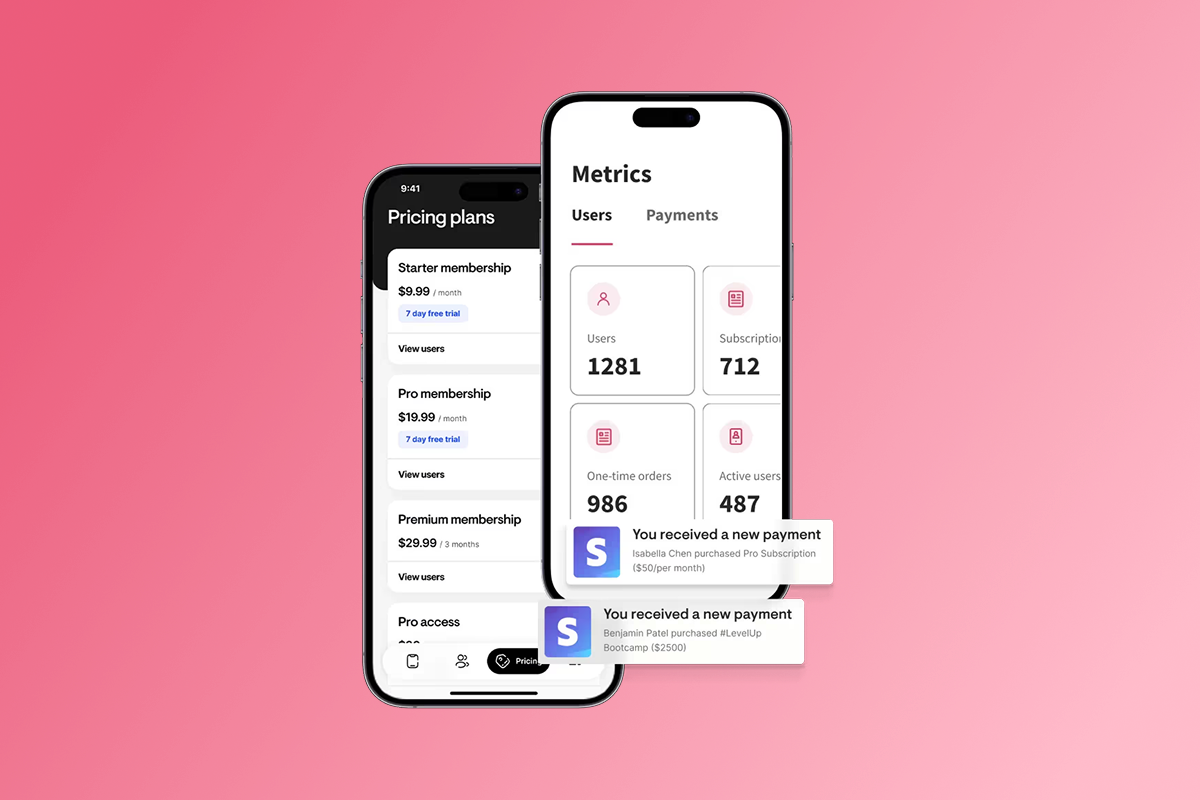
Subscriptions create predictable MRR
One-off product sales are exhausting. You launch, make $10,000, then spend the next month re-launching to hit the same number. Monthly recurring revenue flattens that cycle. Instead of chasing individual transactions, you build a base of subscribers paying $29, $49, or $99 per month for ongoing access to courses, community, and live events.
Passion.io's app monetization features support monthly and annual billing, freemium tiers, one-time purchases, and bundles all within the same app. You can offer a free trial to lower the barrier, then convert users to paid memberships after they experience value.
The shift from launch spikes to stable subscriptions happens when you consolidate content, community, and checkout into one experience that users access daily via push and app icon, not sporadically via Instagram when the algorithm allows it.
How to choose the right app builder for your business
Custom development vs. no-code platforms
AdDevice reports that custom mobile app development costs range from $30,000 to $250,000, with the average project running around $171,450. According to MLSDev, timelines stretch from 9+ months for complex apps to 4-6 months for simpler builds. Then you face ongoing maintenance with iOS updates, Android compatibility patches, and bug fixes.
No-code platforms like Passion.io reduce the investment to $99-$599 per month depending on your plan, and compress the timeline to 4-8 weeks for a fully live app on iOS, Android, and web. You don't need to hire developers, manage a technical team, or troubleshoot code. You drag in videos, PDFs, and text, set up pricing, and publish.
One creator who switched from custom development shared this on Passion.io's case studies:
"In no time at all, the Calxthenics app was live on iOS, Android, and the web as Adam had intended for the original custom app." - Adam Frater Review on Passion.io
The trade-off with no-code is customization depth. You won't get fully bespoke UI flows or proprietary features. But for most creators, the pre-built templates, drag-and-drop builder, and native integrations cover everything you need.
Web platforms vs. native mobile apps
| Feature | Native App (Passion.io) | Web LMS | Custom Dev |
|---|---|---|---|
| Speed to Launch | 4–8 weeks | 4–12 weeks | 9+ months |
| Cost | $99–$599 / month | $49–$399 / month | $30k–$250k |
| Push Notifications | Native integration | Web-based available | Native integration |
| Home Screen Presence | Yes | No | Yes |
| Tech Skills Needed | None | Minimal | Expert team |
If your audience lives on mobile and you want daily habit formation, native apps provide advantages. The home screen icon, native push integration, and mobile-first design create stickiness that helps build recurring revenue.
Your 90-day launch plan
Days 1-30: Content migration and setup
Upload 8-10 core lessons into the Passion.io course builder. Keep lessons short (5-15 minutes each) for mobile consumption. Add PDFs, worksheets, or integrated quizzes as supplemental materials.
Set up your branding with logo, color scheme, app name, and tagline. Submit your Apple Developer Program account ($99 per year) and Google Play Developer account ($25 one-time). Both require several days for approval, so start early.
Configure your pricing for monthly subscriptions ($29-$99/mo is common), annual plans, or freemium tiers. Use web checkout via PassionPayments for better margins (3.9% platform fee plus Stripe's processing) or enable in-app purchases for mobile convenience (Apple and Google take 15-30%).
By day 30, your web app should be live. App store submissions will be in progress, with iOS and Android listings typically going live within 1-2 weeks depending on review times.
Days 31-60: The soft launch and feedback loop
Invite 15-25 superfans from your social following to beta test. Give them free or discounted access in exchange for feedback. Run a small challenge during this period. If you're a fitness coach, launch a 7-day challenge with daily lessons and community threads for progress updates. Push a notification each morning to drive logins.
Test your monetization flows with a handful of beta users subscribing via both web checkout and in-app purchase so you can compare conversion rates and margin impact.
Fix onboarding friction based on feedback. If users struggle to find features, add onboarding tooltips. If push timing feels off, adjust the schedule.
Days 61-90: Full public launch and push cadence
Announce the official launch across Instagram, email, YouTube, and any other channels where your audience lives. Create a launch offer with time-bound urgency to drive action.
Schedule push notifications twice per week to start. Don't over-push. More than 3-4 notifications per week risks opt-outs. Use Passion.io's help documentation on building community to optimize engagement timing.
Run a 30-day challenge starting on day 61. Challenges create urgency, drive daily logins, and give new members a structured reason to engage.
By day 90, measure your success metrics: completion rate improvements, monthly recurring revenue growth, daily active users, and organic community engagement.
Understanding the costs: Fees, margins, and ROI
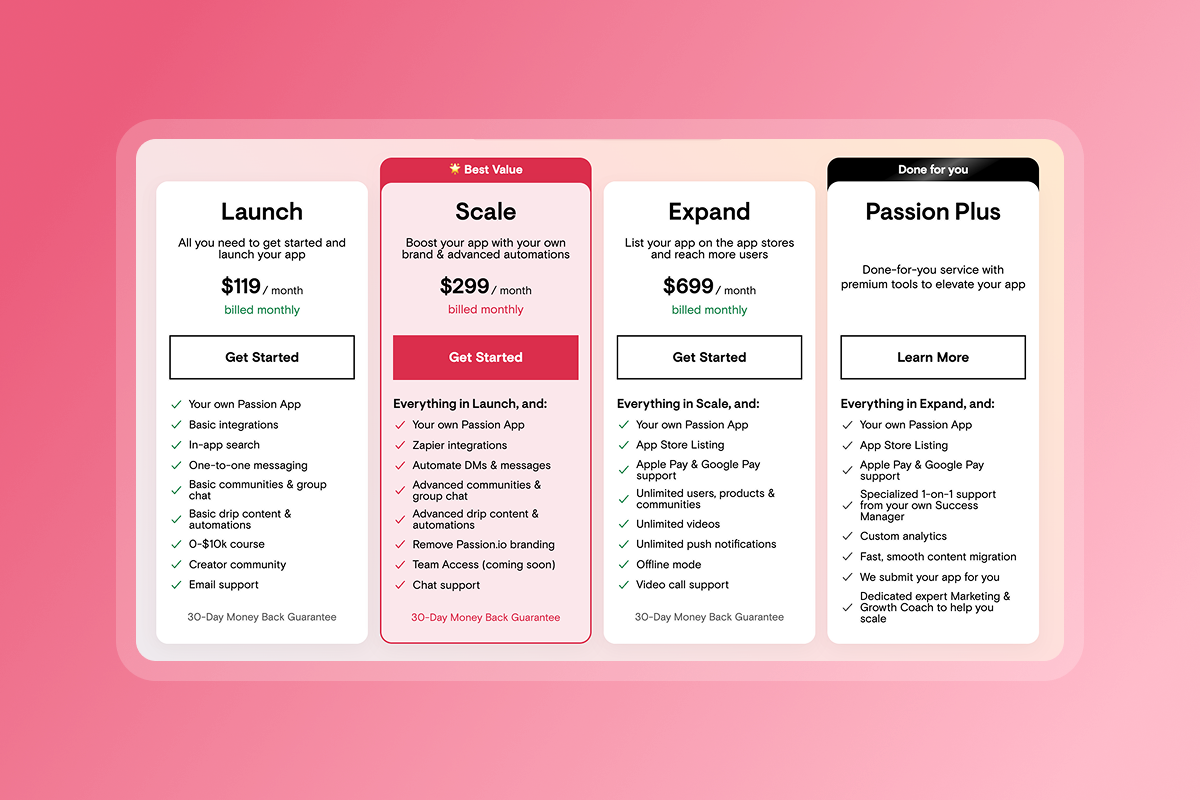
According to Passion.io's pricing page, plans start at $99/month on the Launch plan (annual billing) or $119/month paid monthly, scaling to $239/month (Scale) and $599/month (Expand) depending on features.
For payments, you choose between two paths:
Web Checkout via PassionPayments: The 3.9% platform fee plus Stripe's standard processing totals approximately 6.8% + $0.30 per transaction. This path offers the best margins but requires users to complete checkout in a browser.
In-App Purchases (IAP): Apple and Google charge 15-30% commission depending on your annual revenue. If you earn under $1 million per year, both platforms offer 15% rates through their small business programs. IAP provides seamless one-tap checkout inside the app.
Use web checkout for high-ticket bundles and annual subscriptions where margin matters. Use IAP for low-friction monthly subscriptions where conversion rate matters more than margin.
Developer account fees total $99 per year for Apple and $25 one-time for Google.
ROI Calculation Example: If you charge $49/month and acquire 100 subscribers via IAP at 15% commission, you net $4,165/month. Subtract $239/month for the Scale plan, leaving $3,926/month or $47,112/year. Compare that to custom app development at $50,000+ upfront with zero revenue until launch.
Real-world examples: Creators who made the switch
Nicki Bianco built Slice Squad, a hair and beauty education app. According to Passion.io's resource library, she generates over $290,000 per month by consolidating courses, community, and coaching into one branded platform.
Adam Frater's Calxthenics app serves his Instagram followers with bodyweight training programs. After challenges with a previous development approach, he rebuilt on Passion.io and relaunched quickly. The case study notes his app went live on iOS, Android, and web as intended.
Creators consistently highlight the training and support as differentiators. One Trustpilot review noted:
"I can't think of a better company that will deliver on the tech side of things but also really care about the impact you're going to make as a creator or coach." - Andrew Truong on Trustpilot
Another reviewer building a meditation app shared:
"Passion helped bring my courses to life through my app. Monitaiz is a transformative platform combining spiritual and practical strategies for success in money, passion, and personal growth." - Gail De Souza on Trustpilot
Frequently asked questions
Do I need developer accounts to publish my app? Yes. Apple requires a $99/year membership, and Google charges a $25 one-time fee. Both take several days to approve.
Can I keep my existing website and tools? Yes. Your app can run alongside your website, email list, and social channels. You can integrate with Zapier, Calendly, and Typeform.
How long does app store approval take? According to Median, Apple reviews most apps within 24-48 hours, though complex apps may take longer. Google Play typically reviews within 3 days based on recent review time data.
What happens if I want to switch platforms later? You own your content and customer data. You can export member lists, lesson files, and community data if you decide to migrate.
Key terms glossary
MRR (Monthly Recurring Revenue): Predictable monthly income from subscription-based memberships, calculated by multiplying active subscribers by average subscription price.
Churn: The rate at which customers cancel their subscriptions, expressed as a percentage of total subscribers lost over a given period. Target churn rates under 5% monthly for healthy subscription businesses.
IAP (In-App Purchase): Digital purchases made directly within a native mobile app, subject to Apple (15-30%) or Google (15-30%) commissions and processed through app store payment systems.
Push Notification: A clickable message sent directly from an app to a user's mobile device that appears on the lock screen, used to drive engagement without relying on social media algorithms.
Native App: An application built specifically for a mobile operating system (iOS or Android), providing access to device features like push notifications, offline mode, and home screen presence.
Stop building your business on rented land. Social algorithms will continue to throttle reach, platforms will keep changing policies, and your revenue will stay unpredictable as long as someone else controls the distribution channel.
The creators building sustainable, scalable income are moving their audiences into branded apps they own. Ready to see how your app could look? Book a demo with Passion.io or explore the Creator MBA program to learn the full launch framework. Your followers are waiting for a better way to access your content. Give them an app they can open every day.