.png)

Updated 23rd December, 2025
Your content is gold, but is it truly yours? Every post, every member, every revenue dollar sits on Patreon's infrastructure. One policy change, one algorithm shift, and your income can evaporate. A branded app with powerful push notifications transforms your creator business from "rented land" to an "owned home" with predictable recurring revenue—and you can launch it in weeks, not months.
This guide shows you how to choose the right Patreon alternative and why push notifications inside your own app can move you from fragmented and stressed to owned and scalable.
Why creators seek Patreon alternatives
Patreon helped thousands of creators monetize their work, but its limitations become clear as your business grows. Creators increasingly look for platforms that offer greater control, lower fees, and mobile-first engagement tools.
The limitations of "rented land"
Operating on Patreon means building on someone else's infrastructure. When you rely on a third-party platform, you face Patreon's inherent risks and fees that can change without warning, including algorithm risk, audience dependency, and 8-12% platform fees. Patreon retains control over how your content appears, when members see updates, and which features you can access.
The fee structure adds up quickly. For a creator earning $5,000 monthly, that's $400-$600 going to Patreon before payment processor costs.
Community features remain basic. While the platform serves millions of monthly active patrons, it offers limited native tools for member-to-member interaction. Many creators must integrate external tools like Discord to build true community spaces, adding another layer of tool sprawl.
"Poor Organization, But Still Great for Hosting." - Patreon review on G2
Revenue unpredictability compounds these challenges. Membership income fluctuates with churn, creating a treadmill where you must constantly promote to maintain revenue rather than building systems that retain and engage members automatically.
What a true alternative must offer
A genuine Patreon alternative must deliver direct audience connection through mobile-first channels. Push notifications offer this direct line, reaching members instantly on their devices without depending on email open rates or social media algorithms.
Research shows that push notifications can increase app engagement by up to 88%, and users who receive push notifications demonstrate 92% higher long-term retention rates compared to those who opt out.
You need flexible monetization with transparent fees. Clear cost structures help you model margin and scale. Custom app development typically requires $30,000+ and months of work. No-code platforms enable creators to build and launch branded apps in weeks using drag-and-drop interfaces that require zero technical experience.
Top Patreon alternatives compared
Multiple platforms compete in the creator monetization space, each with distinct strengths and trade-offs.
Overview of leading platforms
- Ko-fi offers a free tier with minimal fees (0-5% depending on plan). Best for artists and writers wanting lightweight, low-cost donations, but it lacks native mobile apps and push notifications.
- Substack dominates newsletter and written content with 10% of subscription revenue as its fee. Writers appreciate the clean reading experience and discovery features. However, it remains web and email-first with no native mobile app builder or push capabilities.
- Ghost provides open-source publishing with built-in memberships. Self-hosted installations charge 0% platform fees, while managed hosting starts at $9/month with fees up to 9%, but it requires technical setup and lacks native push notifications.
- Uscreen specializes in video-on-demand with branded apps for iOS, Android, and TV. Pricing starts higher than many alternatives, and its video focus means course features and community tools are less developed.
- GroupApp and Easy.tools focus on community building with mobile apps, enabling group communication and event scheduling. They work well for community-first needs but offer limited course hosting and monetization compared to platforms designed for online education.
Comparison table: Features and use cases
App & Engagement Features
Fees, Ownership & Best Use
This comparison shows that few platforms combine true branded mobile apps, native push notifications, integrated community features, and flexible monetization in one no-code platform.
Passion: Your branded app with powerful push notifications
We address the core limitations of Patreon and other alternatives by providing you a complete mobile-first ecosystem. You get a true branded app, powerful engagement tools, and flexible monetization without writing code or hiring developers.
Launch your branded app in weeks, not months
Our no-code drag-and-drop builder lets you migrate existing content quickly. Upload videos, audio files, PDFs, and text lessons into structured modules. Add quizzes, timers, goal tracking, and drip schedules to create interactive learning experiences. Customize your app's look with your logo, brand colors, and fonts.
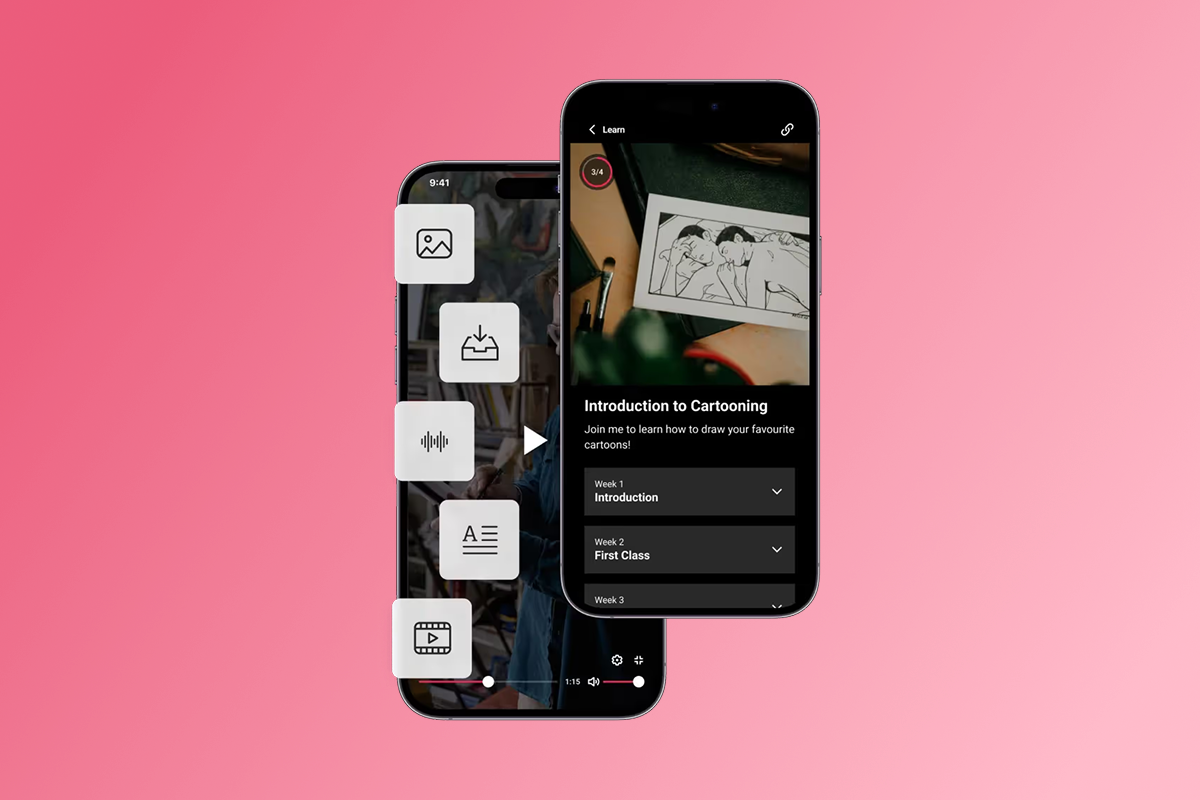
Our template libraries accelerate setup. Rather than starting from scratch, choose from pre-built course structures for common niches like fitness challenges, meditation series, or business frameworks.
"Passion.io helped me turn my vision into a fully branded app that inspires equestrian women daily. It's easy to use, incredibly supportive, and built for creators who actually care about changing lives." - Jenna Knudsen on Trustpilot
App store submission support varies by plan. Our Expand and Plus tiers include hands-on assistance with App Store and Google Play submissions. Launch and Scale users can self-submit using detailed checklists and support documentation. Budget for Apple's $99/year Developer Program fee and Google's $25 one-time fee.
Web apps typically go live in 2-3 weeks with focused effort. iOS and Android submissions begin by Week 4-6, with review processes adding 1-2 weeks for approvals.
"With their no-code, drag-and-drop platform, I was able to design, build, and launch a fully functional app in just a few hours—no tech experience required." - Rob M. on G2
Drive engagement with push notifications
We provide the direct communication channel through push notifications that Patreon lacks. Unlike email, which averages 15-25% open rates, or social media posts that reach only a fraction of followers, push notifications deliver messages instantly to users' lock screens.
We've studied the research: personalized push notifications drive higher engagement than generic broadcasts, and users who receive push notifications in their first 90 days demonstrate significantly improved retention compared to those who opt out.
Strategic implementation requires three key tactics:
- Segment your audience: Group users by behavior (completed Module 1 but not Module 2), demographics, subscription tier, or custom attributes. Send notifications about advanced content only to users who've finished foundational lessons. A fitness app case study showed that personalized reminders and challenge notifications led to a 30% increase in 30-day retention.
- Optimize timing: Analyze when your users are most active through app analytics and schedule notifications during those windows. Event-triggered notifications (sent after specific user actions) often perform best. Research on push notification timing indicates that poorly timed messages significantly increase opt-out rates.
- Personalize content: Reference specific progress ("Great work completing Week 2, Sarah. Week 3 unlocks tomorrow"), recommend content based on consumption patterns, and celebrate milestones. Personalized, value-driven messages increase loyalty and reduce churn through the psychological principle of reciprocity.
Build a thriving in-app community
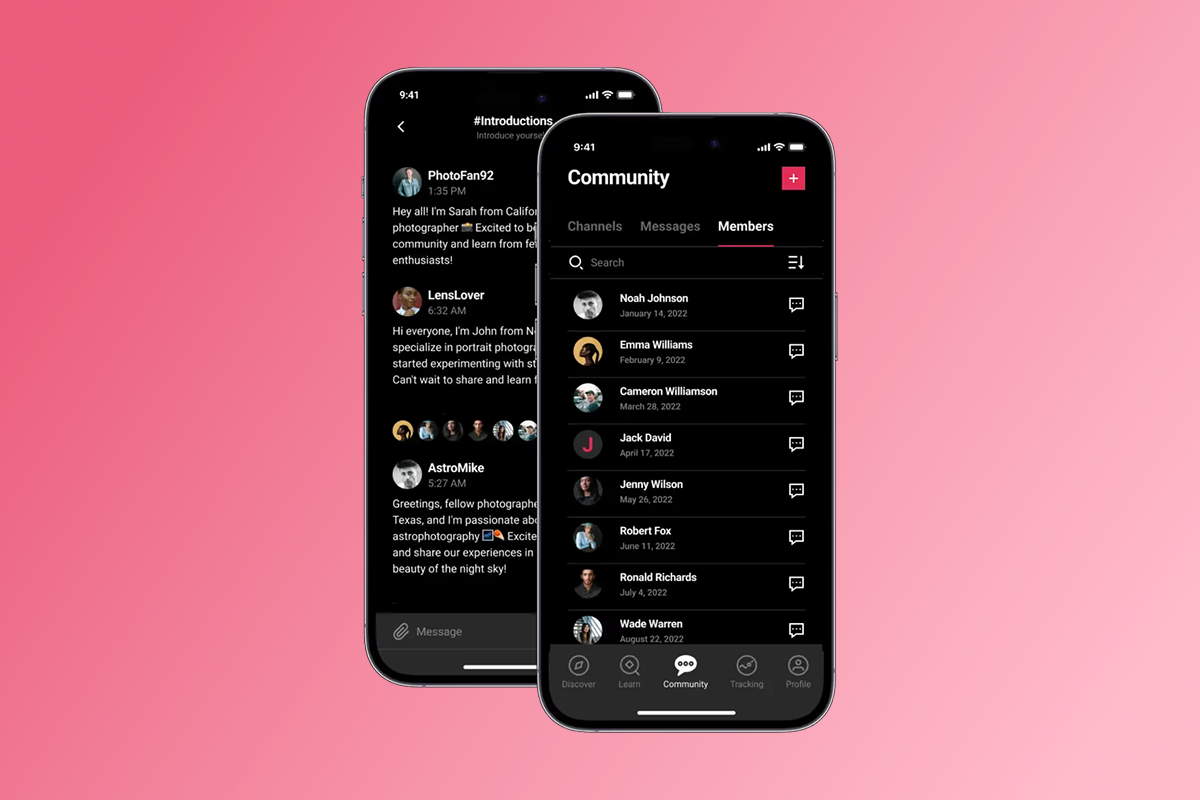
Our community features transform your passive content consumers into active participants who support each other. Research shows that in-app communities can boost retention by 40%, increase engagement by 35%, and accelerate growth by 30%.
We provide dedicated community channels organized by topic, making it easy for members to find relevant discussions. Create separate channels for different subscription tiers, course cohorts, or interest areas.
Interactive challenges drive consistent engagement. Launch 30-day challenges where members post daily progress, encouraging accountability and peer support. Push notifications announcing challenges and reminding participants about daily activities keep momentum high.
Polls, surveys, and private messaging round out the community toolkit. Ask questions about future content topics while increasing interaction. Enable one-on-one support and member-to-member connections. Social proof and FOMO principles work powerfully when members see that "15 people just posted their Day 7 progress."
Monetize with flexible subscriptions and transparent fees
Our monetization options let you structure offers strategically. Offer weekly, monthly, or annual subscriptions to capture different commitment levels. Add one-time purchases for workshops or masterclasses. Create a freemium tier with limited content. Bundle multiple offers at discounted rates to increase average transaction value.
We provide transparent fee structures to help you model margin accurately:
- PassionPayments web checkout: 3.9% platform fee plus standard Stripe processing fees (typically 2.9% + $0.30 per U.S. transaction). Total effective rate is approximately 6.8% + $0.30 per web transaction.
- In-app purchases (IAP): Apple and Google retain 15-30% on IAP depending on transaction volume and programs. We add no additional platform fee on top of these commissions.
- External checkouts: 0% Passion platform fees when you process payments outside PassionPayments through processors like Gumroad or ThriveCart.

This flexibility lets you route transactions strategically. For low-margin products or high-ticket offers, direct members to web checkout or external processors to minimize fees. For mobile convenience and impulse purchases, enable IAP despite higher fees.
Compare this to Patreon's flat 8-12% of all earnings. A creator earning $10,000 monthly pays $800-$1,200 to Patreon. With our Scale plan ($239/month) and blended transaction fees, that same creator might pay ~$439/month total, representing 50-75% fee savings as revenue scales.
How to choose the best Patreon alternative for your business
Selecting the right platform requires honest assessment of your current situation, future goals, and what you're willing to invest in building owned infrastructure.
Assess your audience and content
Start with your existing audience size and where they engage most. If your members primarily consume content on mobile devices, a branded mobile app makes sense. If your audience consists mainly of desktop readers who prefer email, a newsletter-first platform might suffice.
Content format matters significantly. Video-heavy creators might prioritize Uscreen's streaming capabilities. Course creators teaching multi-module programs need robust lesson sequencing, quizzes, and progress tracking. Community-focused creators need strong discussion and messaging features.
Ask whether your content benefits from offline access. We enable offline content downloads, letting members access lessons during flights, commutes, or areas with poor connectivity. This feature drives completion rates by removing access barriers.
Evaluate engagement and monetization needs
Calculate your current completion and retention rates. If members subscribe but don't finish courses, you need engagement tools like push notifications and challenges. Target +15-30% completion improvement in your first 90 days by implementing a weekly push cadence and at least one in-app challenge.
Revenue predictability shapes your platform choice. If you're tired of launch-dependent income spikes followed by churn, prioritize platforms that support recurring subscriptions, retention features, and clear analytics. Our dashboard tracks member activity, course progress, and revenue by tier, giving you visibility into what's working.
Consider Total Cost of Ownership
Add up all costs, not just platform subscription fees. For our platform, TCO includes:
- Platform subscription: $99-$599/month depending on plan (annual billing for best rates)
- Developer program fees: $99/year Apple, $25 one-time Google
- Transaction fees: 3.9% + Stripe for web, 15-30% for IAP, 0% for external
- Optional services: Plus tier at custom pricing for done-for-you launch

Compare this to Patreon's 8-12% of all revenue plus processing fees. Model both scenarios at your target monthly revenue to see where the breakeven point occurs for your business.
Prioritize ownership and control
Weigh how much platform risk you're willing to accept. If Patreon changed its fee structure tomorrow, raised rates, or modified its content policies, could you move your members elsewhere quickly? Platform controversies around fee changes and policy updates have burned creators before.
Owning your app, member data, and direct communication channels insulates you from platform dependency. You control the user experience, data access, feature prioritization, and long-term roadmap. This ownership becomes more valuable as your business grows and your member base deepens.
Own your audience, drive your revenue
You've built valuable content and a loyal audience. Now build the infrastructure to own both. Moving from Patreon's rented platform to your own branded mobile app gives you direct audience ownership, higher retention rates through push notifications, and transparent monetization that scales without eating more of your revenue.
For most coaches, course creators, and community builders, we offer the complete package: no-code app builder, native push notifications, in-app community, flexible subscriptions, and the training to make it all work.
Ready to build your mobile-first empire? Try Passion with a 30-day money-back guarantee and start owning your audience today. Verify current trial terms and plan features at signup.
Prefer to see it in action first? Book a demo to watch how creators launch apps in 4-8 weeks, or explore success stories from creators in your niche who've made the transition from fragmented tools to unified, branded app experiences.
Frequently asked questions
What are the best Patreon alternatives for artists and writers?
Ko-fi works well for artists needing simple donations, while Ghost suits tech-savvy writers. For multimedia creators wanting mobile-first engagement with push and community, we provide a complete branded app.
Is there a free Patreon alternative?
Ko-fi offers a genuinely free tier for donations and tips, though advanced features require paid plans. We don't offer a permanent free plan, but provide a 30-day money-back guarantee to try the platform risk-free with our Launch plan starting at $99/month when billed annually.
What is the Patreon controversy?
Patreon has faced controversies over fee structure changes that shifted costs to patrons and content moderation policies that led to feelings of censorship. These controversies highlight the core risk of building your business on rented land where platform policy changes happen without your input.
Key terms glossary
Branded app: A mobile application (iOS/Android) and web app customized with your logo, colors, and brand identity that members download directly. This creates a premium owned channel free from platform algorithms and policy changes.
Push notifications: Direct messages sent to a user's mobile device lock screen or notification center. These enable instant communication without relying on email open rates or social media algorithms.
In-app purchases (IAP): Transactions processed through Apple's App Store or Google Play Store within a mobile app. These are subject to 15-30% platform fees retained by Apple/Google but offer seamless mobile purchasing convenience.
PassionPayments: Our Stripe-powered web checkout system charging a 3.9% platform fee plus standard Stripe processing fees. This applies to transactions completed outside of Apple/Google's in-app purchase systems.
Tool sprawl: The operational burden and inefficiency created by managing multiple disconnected platforms (Instagram, Facebook Groups, Zoom, Stripe, email tools). This leads to support chaos and member confusion.
Recurring revenue: Predictable monthly or annual subscription income that renews automatically. This provides business stability compared to launch-dependent one-time sales that create feast-or-famine cash flow cycles.