.png)

Updated February 5, 2026
The monthly subscription fee is just the tip of the iceberg. When you evaluate a white-label app builder, the real cost lives below the waterline: transaction fees that can eat 30% of your revenue, mandatory developer accounts, and the hidden time cost of app store submissions. I'm breaking down every dollar you'll spend to launch and run a branded mobile app, because for established creators earning mid-five to six figures monthly, getting the fee structure wrong can cost you tens of thousands annually.
Beyond the subscription: The four layers of app pricing
Every white-label app platform operates on four distinct cost layers, and most creators only look at the first one. Layer 1 is your platform subscription. This represents the monthly or annual SaaS fee. Layer 2 covers mandatory app store developer accounts. Layer 3 is where margins live or die: transaction and payment processing fees. Layer 4 encompasses maintenance, updates, and technical support.
The platforms advertising "low monthly fees" often extract their real revenue from Layer 3. When you process a $100 purchase through Apple's In-App Purchase system, you might keep only $70 after Apple's commission. Understanding how to route transactions strategically between web checkout and in-app purchases is worth more than negotiating your monthly platform fee.
Custom development appears to avoid Layers 1 and 3, but Layer 4 becomes a recurring expense that compounds yearly. The typical custom mobile app costs $30,000-$250,000 to build, with 15-20% of that initial cost required annually just to maintain compatibility with new iOS and Android versions.
White-label platforms consolidate most of Layer 4 into your subscription. Passion.io handles hosting, OS compatibility updates, and core app stability as part of the platform service, eliminating the need to retain developers on retainer or scramble when Apple releases iOS 20.
Layer 1: Monthly platform fees vs. custom development costs
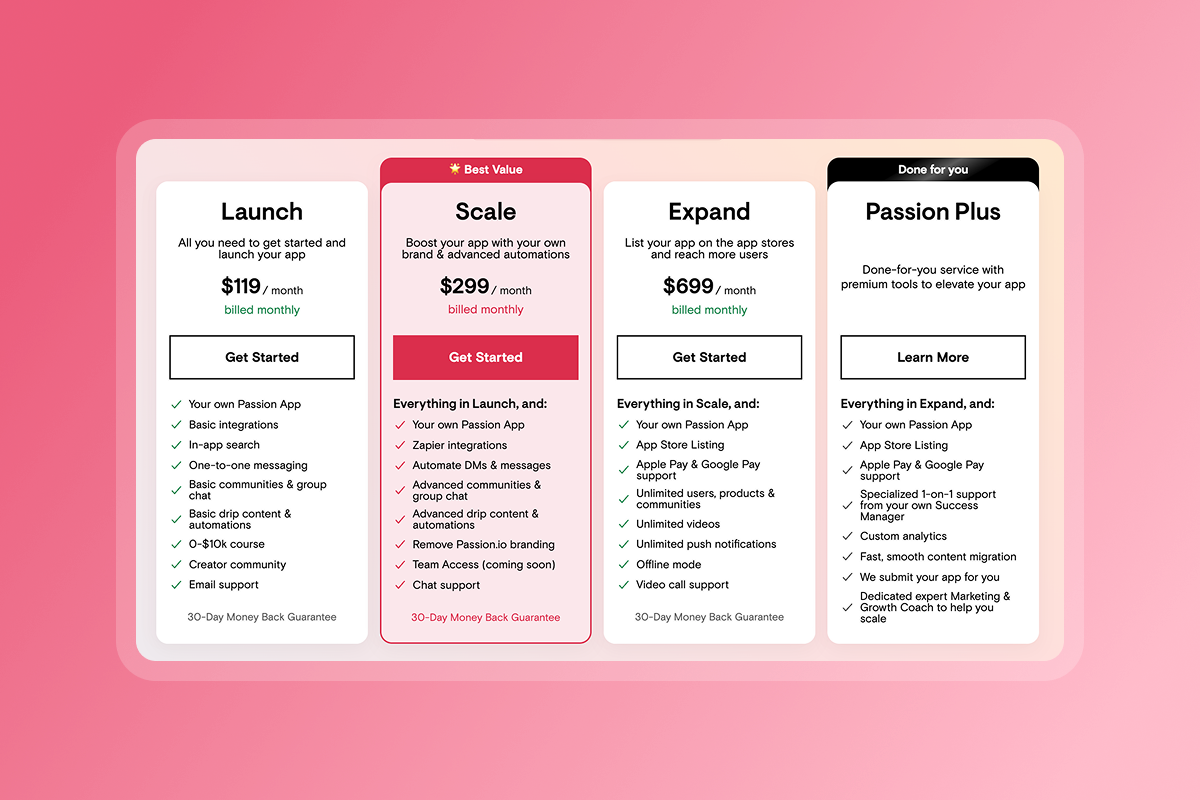
Passion.io's pricing structure starts at $119/month for the Launch plan ($99/month billed annually), scales to $299/month for Scale, and reaches $699/month for Expand ($599/month annually). The PassionPlus tier offers done-for-you service starting at $10,000-$20,000 for white-glove app building, content migration, and app store submission.
Compare that to custom development with simple apps starting at $20,000-$50,000 and complex apps reaching $250,000. Development timelines stretch from 3-9 months before you see a working product.
The math gets clearer over time. By year three, even Passion.io's highest self-serve tier costs less than a single custom build, and you've gained two additional years of feature updates, OS compatibility, and infrastructure improvements. PassionPlus clients launching in 30 days or less avoid the 3-9 month development wait entirely, which matters when you're trying to capture market timing or competitive advantage.
North American mobile development teams charge $70-$180+ per hour, and a medium-complexity app requires hundreds of development hours. One client review emphasized the value of the all-in approach:
"I stepped into Passion.io because I chose a platform that creates structure around my content and supports the way my services evolve... the layout gives me the sense that I can create something meaningful with steady ease." - Thea White on Trustpilot
Layer 2: Transaction fees and the "Apple Tax" reality
This is where creators either preserve their margins or watch 30% of revenue disappear. The fundamental choice is between web checkout via PassionPayments and in-app purchases (IAP) through Apple and Google.
Web Checkout (PassionPayments): When customers purchase through your website or web app, PassionPayments charges a 3.9% platform fee plus Stripe's standard processing fees of 2.9% + $0.30 per transaction. Total cost: approximately 6.8% + $0.30 per transaction. For a $100 sale, you keep roughly $93.
In-App Purchases (IAP): When customers purchase inside your iOS or Android app, Apple and Google collect 15-30% commission. The good news is that creators earning under $1 million annually can qualify for Apple's Small Business Program at 15% and Google's 15% Service Fee Tier. For a $100 sale through IAP, you keep $85 (at 15%) or $70 (at 30%).
The strategic implication is clear: route high-ticket coaching packages, annual memberships, and bundles through web checkout. Use IAP for low-friction, impulse purchases where the convenience of one-tap buying outweighs the higher commission.
For a creator generating $20,000 monthly revenue, choosing 30% IAP fees over 6.8% web checkout costs approximately $4,640 per month ($55,680 annually) in unnecessary platform commissions. That's the price of a full-time team member.
Recent court rulings in the U.S. now allow apps to include buttons and external links directing users to web checkout without Apple collecting commission, though you must still offer IAP as an option within the app. This creates a hybrid strategy: promote your best deals and annual plans via web links, while maintaining IAP for users who prefer native app convenience.
One creator highlighted the importance of the payment flexibility:
"Setting up my coaching app on Passion.io has been one of the easiest and most intuitive processes I've experienced... Everything is housed in one place, content, communication, client access, design, and it's all optimized to save time while delivering a high-quality user experience." - Everchanging Butterfly on Trustpilot
Layer 3: Mandatory app store developer accounts
Before your app can appear in the Apple App Store or Google Play Store, you need developer accounts. These are non-negotiable costs that apply whether you build custom or use a white-label platform.
Apple's Developer Program costs $99 per year (individual or organization membership), while Google Play Console charges a one-time $25 registration fee. Total first-year cost: $124. Subsequent years: $99 for Apple renewal.
You pay these fees because you are the publisher. Your brand name appears in the app stores, you control the listing, and you own the direct relationship with users who download your app. This is the fundamental difference between a white-label solution like Passion.io's branded apps and simply hosting content on someone else's platform.
The developer accounts also give you access to Apple's Small Business Program (15% commission instead of 30% for developers earning under $1M annually) and critical infrastructure like push notification certificates, analytics, and TestFlight for beta testing.
Layer 4: Hidden costs of maintenance and submission support
Custom app development carries a hidden tax that most creators discover only after launch. When Apple releases a new iOS version or Google updates Android, your app must adapt or risk breaking. Industry benchmarks show maintenance costs run 15-20% of the initial development cost annually, which translates to $5,000-$50,000+ per year for apps that cost $30,000-$250,000 to build.
On a white-label platform, OS compatibility updates roll out automatically as part of your subscription. Passion.io handles hosting and core app stability within the SaaS model, with no separate maintenance invoices.
The second hidden cost is app store submission expertise. Getting an app approved by Apple requires navigating detailed requirements around metadata, screenshots, privacy policies, and guideline compliance. Rejections are common and each revision can add 3-7 days to your timeline.
PassionPlus's done-for-you service handles submission from end to end: building your app, migrating content, preparing store assets, and managing the back-and-forth with Apple and Google review teams. For established creators, this eliminates weeks of technical friction and accelerates time to market. The service includes a dedicated success manager and typically launches apps within 30 days.
For creators on self-serve plans, Passion.io provides detailed submission guides covering Apple preparation, accepting terms and agreements, and managing in-app purchases. The learning curve exists, but the platform walks you through each step.
A creator who worked with support on technical setup shared:
"The passion platform and people has been so supportive already. I feel like they are on my side to get this done and genuinely want me to succeed." - Kate Parsons on Trustpilot
Total Cost of Ownership (TCO) models: Launch vs. Scale vs. Custom
Let's model three realistic scenarios for a creator, running established programs with steady recurring revenue.
Scenario A: Self-Serve Launch (Starter Creator)
- Monthly Revenue: $5,000
- Platform: Passion.io Launch Plan ($99/mo annual billing)
- Developer Accounts: $124 Year 1, $99/year after
- Primary Sales Channel: Web checkout (6.8% fees)
- Transaction Fees: $5,000 x 6.8% = $340/month
- Total Monthly Cost: $99 + $340 = $439
- Annual Cost Year 1: $5,392
Scenario B: White-Glove Premium (Pro Creator)
- Monthly Revenue: $20,000
- Platform: Passion.io Expand Plan ($599/mo annual) + PassionPlus setup ($15,000 one-time)
- Developer Accounts: $124 Year 1, $99/year after
- Primary Sales Channel: 60% web checkout, 40% IAP (15% tier)
- Transaction Fees: ($12,000 x 6.8%) + ($8,000 x 15%) = $816 + $1,200 = $2,016/month
- Total Monthly Cost (Year 1): $599 + $2,016 = $2,615 + $15,124 setup/accounts (amortized: $1,260/mo)
- Annual Cost Year 1: $46,404 (includes $15,124 one-time)
- Annual Cost Year 2+: $31,291
Scenario C: Custom Development (Pro Creator)
- Monthly Revenue: $20,000
- Initial Build: $75,000 (medium complexity)
- Developer Accounts: $124 Year 1, $99/year after
- Annual Maintenance: $11,250 (15% of build cost)
- Primary Sales Channel: 60% web, 40% IAP via Stripe/custom integration
- Transaction Fees: Similar to Scenario B (~$2,016/month)
- Total Year 1 Cost: $75,124 + $11,250 + $24,192 = $110,566
- Annual Cost Year 2+: $35,442 (maintenance + transaction fees + accounts)
Metric
Scenario B delivers the highest ROI for established creators. Yes, the year-one investment is higher than a basic Launch plan, but you gain mobile-first engagement features that drive retention, and in-app community features that reduce churn. The white-glove service means you launch in weeks, not months, capturing revenue faster.
Scenario C appears cost-competitive in years 2-3, but that assumes no major feature additions, no designer hours for UI updates, and no developer time for bug fixes beyond the 15% maintenance budget. In practice, custom apps require ongoing development attention that compounds costs.
The retention multiplier makes the business case stronger. Mobile apps retain nearly 3 times as many users at the 30-day mark compared to mobile web, and app sessions run 2-2.4x longer. A 20% lift in customer lifetime value (LTV) from better retention pays for the entire platform fee within months.
How to calculate your break-even and ROI
Use this framework to model your specific situation:
Step 1: Calculate your current tool sprawl cost
Add up monthly subscriptions for your course platform, community software, email service, video hosting, scheduling tool, and payment processor. Many established creators pay $500-$1,200/month across 5-8 tools.
Step 2: Estimate transaction fee savings
Current state: If you're using a course platform charging 5-10% transaction fees, calculate monthly fees paid.
Future state: Model a split between web checkout (6.8%) and IAP (15%) based on your offer structure.
Step 3: Factor in retention gains
If your current completion rate is 40% and you lift it to 52% (30% relative increase), more students finish, refer others, and renew. Model the LTV impact of a 10-20% retention improvement.
Step 4: Calculate the platform cost
Passion.io pricing plus $124/year in developer accounts.
Step 5: Add your time value
If launching a custom app would consume 60+ hours of your time at $200/hour (opportunity cost), that's $12,000 in founder time. PassionPlus eliminates most of that drag.
The retention multiplier compounds this. For a business with 500 active subscribers at $40/month average, a 10% retention lift protects $24,000 in annual recurring revenue.
Book a demo to model your specific TCO with a Passion.io specialist who can map your current state costs to platform options, with a 30-day money-back guarantee.
Comparing white-label to legacy course platforms
Most established creators currently stitch together web-based course platforms with separate community tools. The pricing can appear attractive, but they lack true native mobile app infrastructure.
Web platforms don't offer real push notifications. They can't provide offline content access. They don't create home screen icons that users see daily. The "mobile responsive" experience is fundamentally different from a native app that drives 2-2.4x longer sessions.
If you want brand equity and audience ownership, your app needs to exist in the iOS and Android app stores under your company name. Web platforms can't give you that without custom development on top of their service, which brings you right back to the $30,000+ custom build scenario.
Passion.io's approach is to provide both: a fully functional web app for desktop and browser access, plus native iOS and Android apps with push notifications, community features, and interactive course content that work offline. You get the reach of web with the engagement of mobile.
"Our support team has been so helpful and personable from day one... We chose the Passion Plus Lite package, and feel that every penny of it was well invested from creation to launch... Any and all app updates are handled by Connor's team." - Angie on Trustpilot
For use-case examples, health and fitness professionals demonstrate the platform's strength in high-touch coaching, while platforms like CirquePlus show specialized skills training in action.
The decision between white-label platforms and custom development comes down to speed, control, and total cost of ownership. For established creators generating meaningful monthly revenue, Passion.io's transparent pricing structure combined with strategic fee routing can deliver lower TCO than custom builds while launching 6+ months faster. The key is modeling your specific transaction volume, revenue mix, and retention goals to identify your break-even point.
If you're currently scattered across multiple tools and watching 25-30% of your mobile revenue disappear to platform commissions, the numbers justify consolidation. Start with a platform demo to map your current state costs and see the specific ROI calculation for your business model.
Frequently asked questions about app builder costs
Do I pay Passion.io a percentage of all my sales?
Only on web transactions processed through PassionPayments (3.9% platform fee). Passion.io adds 0% commission to Apple/Google in-app purchases. If you use external checkout methods outside PassionPayments, you pay 0% to Passion.io (only your payment processor's fees apply).
Can I avoid Apple's 15-30% commission entirely?
For purchases made inside the iOS app for digital goods, you must offer IAP. However, recent court rulings allow U.S. apps to include external payment links directing users to web checkout without Apple collecting commission. Physical goods, services consumed outside the app (like Zoom coaching calls), and reader apps have more flexibility to use external payments.
What's included in PassionPlus's done-for-you service?
PassionPlus typically costs $10,000-$20,000 and includes app building/compilation, content migration from your current platform, app store submission handling, dedicated success manager, and coaching. Timeline is usually 30 days or less from kickoff to live apps.
When do I need to resubmit my app to Apple or Google?
Major changes require resubmission: adding new in-app purchases, changing your app name or icon, or modifying core functionality. Content updates, pricing changes on existing products, and design tweaks within your app usually don't require store review.
How do I qualify for the 15% commission rate instead of 30%?
Apply to Apple's Small Business Program if you earned less than $1 million in proceeds during the previous calendar year. Auto-renewing subscriptions on both platforms start at 15% from day one.
What happens if my app gets rejected by Apple?
Apple commonly requests clarifications on metadata, screenshots, or guideline compliance. You fix the issues they flag and resubmit, typically adding 3-7 days to your timeline. PassionPlus clients have dedicated support managing this process, while self-serve plans have detailed help documentation guiding you through common scenarios.
Key terms glossary
In-App Purchase (IAP): Transactions processed through Apple's or Google's native payment system within a mobile app, subject to 15-30% platform commission depending on developer revenue tier.
Merchant of Record: The legal entity responsible for processing payments and handling tax collection. In web checkout, you (or your payment processor) are typically the merchant of record. In IAP, Apple or Google serves as merchant of record.
Total Cost of Ownership (TCO): The comprehensive cost of acquiring and operating technology over its useful life, including initial purchase price, transaction fees, maintenance, training, and opportunity costs.
White-Label Platform: Software infrastructure that allows you to rebrand and deploy a product as your own, appearing under your company name in app stores and to end users.
PassionPayments: Passion.io's Stripe-powered web checkout system charging a 3.9% platform fee (plus standard Stripe processing fees) on transactions processed through the web app.